

Are you the author? Sign in to claim
The OKF-go provides a high-performance suite of utilities to validate bundles, harvest metadata from databases and APIs,
The Open Knowledge Format (OKF) is a vendor-neutral, lightweight specification for structuring organizational knowledge (documentation, runbooks, metrics, database schemas, and API definitions) into machine-readable, human-friendly Markdown files.
By representing knowledge as a directory of Markdown files with structured YAML frontmatter, OKF bridges the gap between structured metadata repositories and unstructured text documentation, serving as an ideal substrate for AI agents, Retrieval-Augmented Generation (RAG) pipelines, and the Model Context Protocol (MCP).
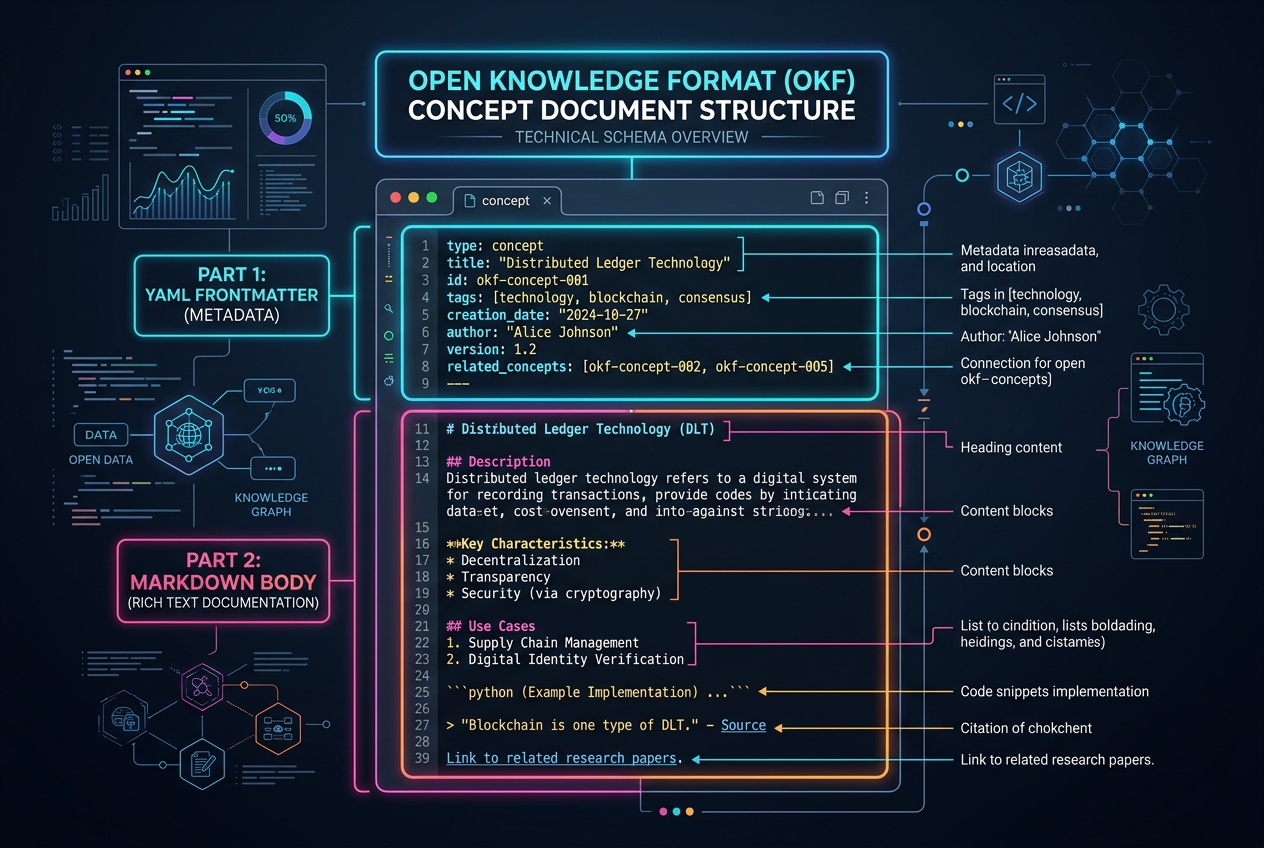
The Open Knowledge Format (OKF) is an open, vendor-neutral specification developed by Google Cloud for representing structured metadata as plain Markdown files with YAML frontmatter. For the full format specification, conventions, schema details, and reference examples, see the official Google Cloud OKF Specification.
The OKF-go provides a high-performance suite of utilities to validate bundles, harvest metadata from databases and APIs, assemble context for Large Language Models (LLMs), and run an MCP Server.
okf lint): Validates knowledge bundles for YAML frontmatter correctness, required attributes, and broken internal/external markdown links.okf harvest): Automatically extracts and converts schemas from databases (PostgreSQL, MySQL, Cloud Spanner, BigQuery), OpenAPI specs, Protobuf files, Git repositories, and web pages into OKF concept documents.okf assemble): Performs graph-based Breadth-First Search (BFS) starting from a core concept, resolving related concepts within a specified character/token budget to build pruned, high-quality prompt context.okf mcp): Exposes your knowledge base directly to MCP-compatible AI clients (e.g. Claude Desktop, Cursor, Antigravity) via Stdio or SSE transport.okf diff / okf merge): Compare two OKF bundles for structural and content differences, or merge them to unify distributed knowledge bases.--ai-enrich flag): AI-powered concept curation during metadata harvesting to automatically generate business descriptions and categorize concepts using Gemini models.okf export): Export your OKF graph into JSON-LD format for the semantic web.okf doc): Compiles an OKF bundle into an interactive static web application with search, tagging, and link relationship graphs.okf lsp) & VS Code Extension: Runs an LSP server over Standard I/O to publish diagnostic errors/warnings in real-time inside IDEs. A dedicated VS Code Extension is also available.okf sync): Automatically synchronizes local concepts with remote document nodes in Notion, Confluence, Jira, and Google Drive.This section details how to install and run the pre-built okf CLI binaries, how developers can automate releases, and how to structure and bundle OKF repositories.
You can install the okf CLI without building it from source using the options below:
Run the automated installer script to download, verify, and install the correct binary for your OS and CPU architecture:
curl -sSfL https://okfgo.dev/install.sh | sh
By default, this installs to /usr/local/bin (if writeable), ~/.local/bin, or ./bin (fallback).
Go to the Releases page on GitHub and download the appropriate archive for your operating system:
okf_<version>_darwin_arm64.tar.gzokf_<version>_darwin_amd64.tar.gzokf_<version>_linux_amd64.tar.gzokf_<version>_linux_arm64.tar.gzokf_<version>_windows_amd64.zipExtract the binary and add it to your system's PATH.
If you have Go installed, you can compile and install the CLI directly from the GitHub repository:
go install github.com/abcubed3/okf@latest
Ensure your GOBIN directory (typically $HOME/go/bin or $GOPATH/bin) is in your system's PATH.
An OKF Knowledge Bundle is a structured directory of Markdown files. Bundles can be versioned, archived, and distributed easily.
A typical bundle layout looks like this:
my-knowledge-bundle/
├── index.md                  # Optional directory index for progressive disclosure
├── log.md                    # Optional change history log
├── tables/                   # Conceptual namespace for DB tables
│   ├── users.md
│   └── orders.md
├── apis/                     # Conceptual namespace for API routes
│   └── create_user.md
└── playbooks/                # Runbooks and guides
    └── database_cleanup.md
To distribute a bundle (e.g., to upload to an ingestion pipeline, send to an agent, or attach to a deployment artifact), you can compress the bundle folder:
Using tar (Gzipped Tarball):
# Compress the bundle
tar -czvf my-bundle-v1.0.tar.gz -C my-knowledge-bundle/ .

# Extract the bundle
tar -xzvf my-bundle-v1.0.tar.gz -C /path/to/destination/
Using zip:
# Compress the bundle
zip -r my-bundle-v1.0.zip my-knowledge-bundle/

# Extract the bundle
unzip my-bundle-v1.0.zip -d /path/to/destination/
[!TIP] GitOps Distribution: Because OKF bundles are plain-text Markdown files, the recommended way to distribute, track changes, and review updates to your knowledge graph is via Git. You can run
okf lintas a pre-commit hook or CI/CD workflow step.
lint)Ensures that the knowledge bundle conforms to the specification. It verifies YAML syntax, ensures required fields are set, and checks that internal Markdown links are not broken.
# Lint the bundle in the current directory
./okf lint

# Lint a bundle at a specific directory
./okf lint /path/to/my-bundle
type field in frontmatter.title, description).[Users](users.md)) to guarantee the graph is fully connected and lacks orphaned links.harvest)Extracts metadata from databases, API specs, protobuf files, git repositories, and web pages, generating structured OKF concepts automatically.
harvest db)Supports PostgreSQL, MySQL, Cloud Spanner, and BigQuery. Connects to the database, queries the information schema, and generates tables, columns, constraints, and relationships as OKF concepts.
# PostgreSQL Example
./okf harvest db \
  --driver postgres \
  --conn "postgresql://postgres:password@localhost:5432/my_db?sslmode=disable" \
  --schema public \
  --output ./my-bundle/tables

# MySQL Example
./okf harvest db \
  --driver mysql \
  --conn "user:password@tcp(localhost:3306)/my_db" \
  --output ./my-bundle/tables

# Cloud Spanner Example
./okf harvest db \
  --driver spanner \
  --conn "projects/my-project/instances/my-instance/databases/my-db" \
  --output ./my-bundle/tables

# BigQuery Example
./okf harvest db \
  --driver bigquery \
  --conn "projects/my-project" \
  --dataset "my_dataset" \
  --output ./my-bundle/tables
harvest openapi)Parses OpenAPI spec documents (JSON/YAML) and generates OKF concepts representing API endpoints.
# Harvest an OpenAPI spec and output to a bundle
okf harvest openapi
  --spec ../openapi-sample.yaml
  --output harvested-endpoints
harvest proto)Extracts messages, RPC services, and field definitions from .proto schemas.
okf harvest proto \
  --path ./protos/user_service.proto \
  --output ./my-bundle/protobufs
harvest git)Extracts metadata from a Git repository, turning commits, file structures, and architecture documents into OKF concepts.
./okf harvest git \
  --repo https://github.com/abcubed3/okf.git \
  --output ./my-bundle/git
harvest web)Crawls target URLs to scrape documentation and structure it as OKF concepts. Optionally powered by the AI Curator (--ai-enrich flag) to automatically generate business descriptions and enrich concepts using Gemini models.
./okf harvest web \
  --url https://example.com/docs \
  --output ./my-bundle/web \
  --ai-enrich
assemble)Traverses the concept relationship graph starting from a target concept ID. Follows relative markdown links up to a configured traversal depth to compile a unified context document for LLMs.
./okf assemble tables/orders \
  --bundle ./testdata/sample \
  --depth 2 \
  --direction bidirectional \
  --format xml \
  --max-chars 16000
--bundle: Path to the OKF bundle (default: . or current directory).--depth: Maximum depth of link traversal (default: 2).--direction: Traverse outbound, inbound, or bidirectional links (default: bidirectional).--format: Output format, either xml or markdown (default: xml).--max-chars: Maximum character budget for the output. If exceeded, traversal stops to prevent context overflow (default: 16000).mcp)Exposes the OKF graph as an MCP Server. This allows LLM clients (like Antigravity, Claude Desktop or Cursor) to dynamically discover, search, retrieve, and assemble context from the bundle.
Ideal for local IDE and Desktop applications:
./okf mcp --bundle ./testdata/sample --transport stdio
Ideal for remote integrations or network-based MCP clients:
./okf mcp --bundle ./testdata/sample --transport sse --port 8080
To register the OKF-go MCP server with Claude Desktop, add the server to your claude_desktop_config.json (typically located at ~/Library/Application Support/Claude/claude_desktop_config.json on macOS or %APPDATA%\Claude\claude_desktop_config.json on Windows):
{
  "mcpServers": {
    "okf-knowledge": {
      "command": "/Users/abcubed3/okf-go/okf",
      "args": [
        "mcp",
        "--bundle",
        "/Users/abcubed3/okf-go/testdata/sample"
      ]
    }
  }
}
okf://index: A text/markdown list of all concepts in the bundle.okf://concept/{id}: Resolves the complete document for a concept by its ID.okf_concept_context: Automatically generates an analysis prompt for a concept along with its assembled subgraph.list_concepts: Returns summaries of all concepts.search_concepts: Search matching terms in concept IDs, titles, descriptions, and tags.get_concept: Fetch raw contents of a concept.assemble_context: Run depth-traversal context assembly dynamically from the LLM.doc)Compiles an OKF knowledge bundle into a fully self-contained static HTML documentation portal featuring search, tagging, and link graphs.
# Compile bundle in current directory to docs/ folder
./okf doc

# Compile specific bundle to custom directory
./okf doc --bundle /path/to/my-bundle --output /var/www/okf-portal
--bundle: Path to the OKF bundle (default: .).--output: Output path for the static website files (default: docs).lsp)Integrates OKF validation directly into your IDE. The LSP daemon runs over standard input/output to report conformance linter diagnostics (missing types, broken relative links) as you type.
# Start Language Server over Stdio
./okf lsp
To use with Cursor or VS Code, configure your LSP client to invoke ./okf lsp for markdown files.
sync)Keeps your OKF knowledge bundle in sync with remote document nodes. The sync daemon queries local changes and pushes them, while pulling remote updates from your workspace.
# Perform a single sync cycle
./okf sync --config okf.yaml

# Run continuously as a daemon
./okf sync --config okf.yaml --daemon --interval 300
okf.yaml)Create an okf.yaml file in the bundle directory to define connector credentials:
connectors:
  google_drive:
    folder_id: "1234567890abcdef"
    service_account: "sa-test@project.iam.gserviceaccount.com"
  notion:
    token: "secret_notion_api_token"
    parent_id: "notion_page_parent_uuid"
  confluence:
    domain: "your-company.atlassian.net"
    email: "user@company.com"
    token: "jira_api_token_here"
    space_key: "SPACEKEY"
  jira:
    domain: "your-company.atlassian.net"
    email: "user@company.com"
    token: "jira_api_token_here"
Contributions are welcome! Please read our Contributing Guide to learn how to set up your development environment, run linters, execute unit tests, and submit pull requests.
This project is licensed under the Apache License 2.0. See the LICENSE file for the full text.
Run Claude Code as an MCP server so any agent can delegate coding tasks to it
 @microsoft✓ Official
Browser automation using accessibility snapshots instead of screenshots
 @googleapis✓ Official
Google's universal MCP server supporting PostgreSQL, MySQL, MongoDB, Redis, and 10+ databases
 @github✓ Official
Official GitHub integration for repos, issues, PRs, and CI/CD workflows