

Are you the author? Sign in to claim
Source-driven knowledge dossiers for Claude: ingest documents into a compounding wiki with traceable analyses, plans, ac
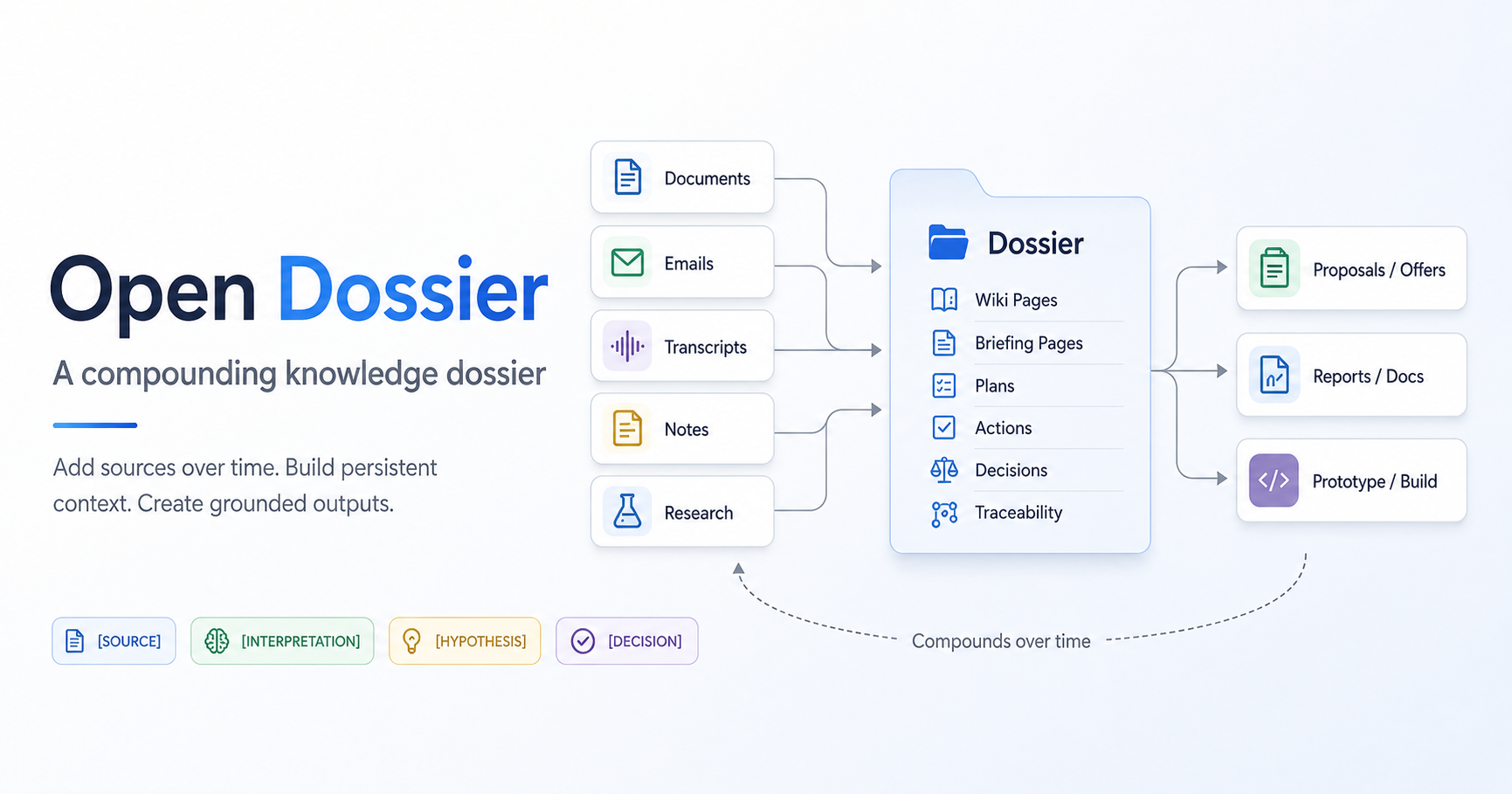
A compounding knowledge dossier for work that starts with sources and ends in outcomes.
Open Dossier is an open-source Claude skill for building a persistent body of knowledge from documents, emails, transcripts, notes, presentations and research.
Start with an empty dossier. Add sources as your work progresses. Open Dossier preserves them, analyzes what matters, connects new information to what is already known and keeps the whole dossier coherent over time.
The result is more than a searchable archive or a collection of summaries. It becomes working context Claude can use to:
Most AI workflows are temporary. You provide some documents, generate an answer and lose most of the accumulated understanding when the session ends.
Open Dossier is designed around the opposite model. Every source adds to a persistent knowledge structure:
Each substantive claim is labelled as one of [SOURCE] · [INTERPRETATION] · [HYPOTHESIS] · [DECISION]. That makes the dossier useful not only for retrieving information, but also for producing trustworthy work: you can see what came directly from a source, what was inferred, what still needs confirmation and what has actually been decided.
Add sources. Compound knowledge. Use it to make things.
Open Dossier combines two ideas:
my-project/
├── DOSSIER.md          # schema: scope, conventions, actors
├── briefing.md         # living synthesis: current state in one page
├── index.md            # catalog: every page, one line each
├── log.md              # append-only journal
├── sources/
│   ├── originals/      # immutable input documents
│   ├── converted/      # markdown conversions
│   └── analyses/       # compact analysis per source
├── wiki/               # entity and topic pages
├── plans/              # numbered living plans
├── actions.md          # central action register
├── decisions.md        # decision log
└── backlog.md          # open questions, sources to process
| Operation | What it does |
|---|---|
init | Scaffold a new dossier and write its schema |
ingest <doc> | Full pipeline: preserve → convert → register → analyze → compound the wiki → update plans/actions/decisions → update briefing/index/log |
query <question> | Answer from the dossier with citations; file valuable syntheses back in |
lint | Health check: contradictions, stale claims, orphans, traceability gaps, index drift |
brief | Refresh the one-page living synthesis |
/plugin marketplace add jpaarhuis/open-dossier
/plugin install open-dossier@open-dossier
The /plugin slash commands are not available in the desktop app; add the marketplace through the UI instead:
jpaarhuis/open-dossierCopy the skill folder into your skills directory:
# personal (all projects)
git clone https://github.com/jpaarhuis/open-dossier
cp -r open-dossier/skills/open-dossier ~/.claude/skills/

# or project-only
cp -r open-dossier/skills/open-dossier your-project/.claude/skills/
Upload the skill via Settings → Capabilities → Skills: zip the skills/open-dossier/ folder (the zip must contain SKILL.md at its root) and upload it. This also works in the desktop app if you prefer a skill-only install over the plugin.
/open-dossier init                       # set up a dossier in the current folder
/open-dossier ingest meeting-notes.docx  # process a document end-to-end
/open-dossier query what did we decide about the migration?
/open-dossier lint                       # health check
/open-dossier brief                      # refresh briefing.md
Or just talk: "ingest this transcript into the dossier", "what do we know about vendor X?" — the skill triggers on intent, not only on slash commands.
The four labels are the epistemic backbone:
[SOURCE] — stated literally in a source (always cites a source ID)[INTERPRETATION] — analysis or inference[HYPOTHESIS] — assumption awaiting confirmation[DECISION] — a settled choice, logged in decisions.mdA reader — human or a future Claude session — can instantly see what is fact, what is inference and what still needs confirmation. Hypotheses get promoted to decisions or killed, never silently forgotten. Contradictions between sources are recorded with both source IDs and flagged, not papered over.
DOSSIER.md plus the existing files teach the workflow, so even a Claude session that doesn't have the skill installed can read and extend the dossier correctly.Design enforcement with memory — keeps your UI consistent across a project
Create animation-rich HTML presentations using a coding agent's frontend skills
1000+ skills curated from Anthropic, Vercel, Stripe, and other engineering teams
Detects 37 AI writing patterns and rewrites text with human rhythm across 5 voice profiles