

Are you the author? Sign in to claim
A custom Agent OS built to be hackable, heavily inspired by OpenClaw.

Built for the hackers. A custom Agent OS heavily inspired by OpenClaw. Honestly, there's no grand vision here—I just wanted to build a hackable Agent OS from scratch to truly figure out how this stuff works under the hood.
A personal AI agent that lives on your machine.
It uses your tools, works in your projects, and delivers real files — not just chat.



MOZI is a desktop AI agent (think of a personal, self-hosted Codex) that runs entirely on your machine. You point it at a project folder, give it a task, and it executes: shell commands, file edits, web research, document generation. Every deliverable it claims is verified against the filesystem before it reports done — no fake success.
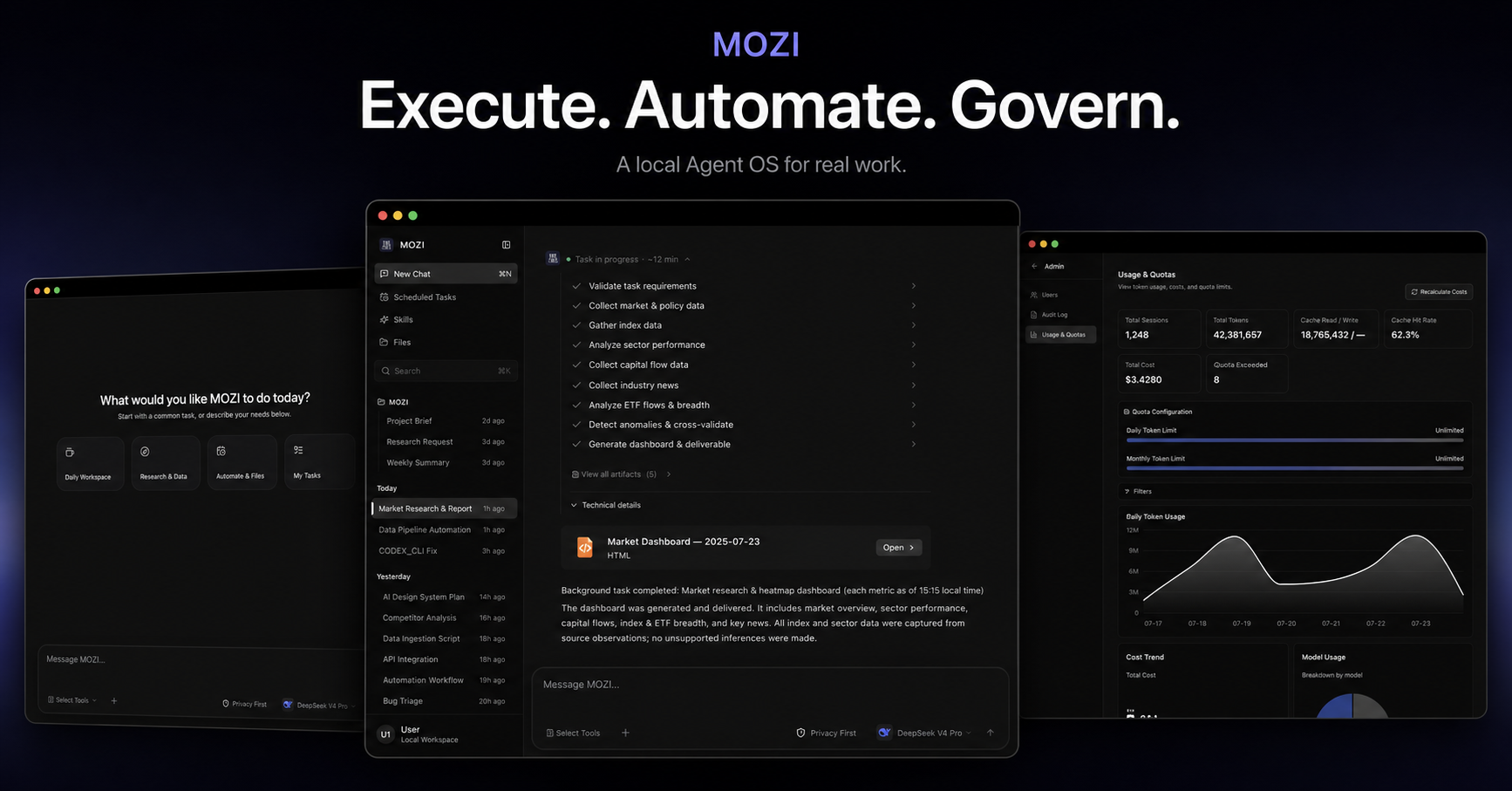
The composer is the cockpit: pick a project (any folder or git repo), the git branch to work on, the permission level (read-only → full access), and the model — then describe what you want.
git switch (never auto-stash, never force; conflicts abort with git's own message).SKILL.md into your workspace to add your own.The desktop app is the primary way to use MOZI. Build it from source (macOS, Apple Silicon):
git clone https://github.com/spytensor/openmozi.git
cd openmozi
corepack enable
pnpm install
pnpm desktop:pack:mac
# → desktop/dist/mac-arm64/MOZI.app  (drag into /Applications)
On first launch, create your local account and add an LLM API key. The app manages its own backend and data — no separate server to run. See docs/DESKTOP-APP.md for details.
Requirements: Node.js >= 22.12 and < 26. Native dependencies cap support below Node.js 26, and the build toolchain needs 22.12 or newer. Run corepack enable to use the repository-pinned pnpm version (or install that exact pnpm version another way). Optional extras: LibreOffice (slide/PDF conversion for previews), Docker (ONLYOFFICE editor-grade office viewing).
MOZI also runs headless with a Web UI — same runtime, same features:
Supported server architectures are Linux x64/arm64 and macOS Apple Silicon. Intel Macs are not supported because the vector database dependency does not publish a macOS x64 binary.
pnpm mozi onboard   # interactive setup: provider, API key
pnpm start          # Web UI at http://localhost:9210
Server-mode configuration lives in ~/.mozi/mozi.json (JSON, not YAML). Inspect or change it with pnpm mozi config get brain / pnpm mozi config set brain.model <model>, or re-run pnpm mozi onboard --update.
MOZI works with any OpenAI-compatible API — 26 providers are in the catalog. Switch anytime without losing data or history.
| Provider | Setup | Notes |
|---|---|---|
| MiniMax | MINIMAX_API_KEY | Default provider (MiniMax-M3) |
| OpenAI | OPENAI_API_KEY | GPT series |
| Anthropic | ANTHROPIC_API_KEY | Claude series |
| Google Gemini | GEMINI_API_KEY | Gemini Pro/Flash |
| DeepSeek | DEEPSEEK_API_KEY | DeepSeek V-series, R-series |
| Moonshot | MOONSHOT_API_KEY | Kimi models, long context |
| Groq | GROQ_API_KEY | Ultra-fast inference |
| Ollama | Local install | Fully local and private |
| …and 18 more (xAI, Mistral, Together, OpenRouter, NVIDIA, Bedrock, …) |
Regional endpoints are supported via <PROVIDER>_BASE_URL overrides.
You (Desktop app / Web UI)
  --> Gateway (sessions, auth, permission levels)
    --> Brain (LLM reasoning, planning, tool calls)
      --> Capabilities (shell, files, search, skills, sub-agents)
The LLM is the decision-maker; everything else is infrastructure that executes its decisions and reports the truth back. Deep dives:
pnpm dev          # backend watch mode
pnpm ui:dev       # Web UI dev server (hot reload)
pnpm test         # full test suite (vitest, real API calls)
pnpm desktop:dev  # desktop app in dev mode
src/
  core/          # Brain: LLM loop, model routing, provider failover
  gateway/       # sessions, auth, permission levels
  capabilities/  # shell, filesystem, search, vision
  skills/        # skill registry + 25 bundled SKILL.md assets
  memory/        # long-term memory, vector store
  store/         # SQLite (better-sqlite3)
ui/              # React + Vite desktop/web UI
desktop/         # Electron shell + packaging
Tech stack: TypeScript, Node.js 22, Fastify, better-sqlite3, Vercel AI SDK, React + Vite, Electron, Vitest.
Read CONTRIBUTING.md before opening an issue or pull request. Use the structured GitHub forms, report vulnerabilities privately, and never attach credentials or private data.
AGENTS.md, CLAUDE.md, and docs/CONSTITUTION.md for repository rules.pnpm verify:public-export before submitting changes.feat: / fix: / refactor: / docs: / test: / chore:.GitHub Actions are intentionally disabled. Releases are built and verified locally, then uploaded to GitHub Releases with DMG, ZIP, SHA-256 checksums, and a release manifest. See docs/RELEASE.md.
Deepest respect to the OpenClaw project, which served as the primary architectural inspiration for OpenMozi.
OpenMozi's own source code is licensed under the MIT License.
OpenMozi also depends on third-party software under its own terms. In particular, the optional interactive React preview includes CodeSandbox Nodebox, which uses the Sustainable Use License and restricts commercial use and distribution. See THIRD_PARTY_NOTICES.md and the bundled license texts before redistributing OpenMozi or using that preview commercially.
MOZI — an AI that works for you, not the other way around.
⚠️ Experimentelle Skill-Sammlung für deutsches Recht (Arbeits-, Gesellschafts-, Insolvenz-, Datenschutz-, Prozessrecht u
Manage multiple Claude Code agents from TUI or Web with tmux and git worktrees
Project management using GitHub Issues + Git worktrees for parallel agent execution
Core skills library for Claude Code with 20+ battle-tested skills including TDD, debugging, and brainstorming