

Are you the author? Sign in to claim
OpenSwarm — Autonomous AI dev team orchestrator powered by Claude Code CLI. Discord control, Linear integration, cogniti





Autonomous AI agent orchestrator — Codex, GPT, OpenRouter (any model), local models (Ollama/LM Studio), and Claude Code (
claude -p)
💬 Help shape OpenSwarm. Share feature ideas, vote on the roadmap, and ask questions in GitHub Discussions. The roadmap is built in the open — your feedback decides what ships next.
OpenSwarm orchestrates multiple AI agents as autonomous code workers. It picks up issues from Linear or a built-in local tracker, runs Worker/Reviewer pair pipelines, reports through a pluggable notifier (Discord, Slack, Telegram, webhook), and retains long-term memory via LanceDB. Workers run on OpenAI Codex/GPT, any OpenRouter model, local open-source models (Ollama, LM Studio), or Claude Code (claude -p, opt-in) — with cost-aware routing measured on an L0–L6 benchmark ladder.
Verified on real GitHub issues: the agentic harness solves SWE-bench Lite instances graded by the official harness. Hybrid mode — a frontier model diagnoses read-only, a lightweight model implements with a verification loop — resolved 3/3 attempted instances that every single lightweight model had failed, at a fraction of frontier-only cost. Workers also learn each repository over time: task outcomes are stored as per-repo knowledge and recalled into future prompts. (benchmark rubric & results)
OpenSwarm is proudly supported by Atlas Cloud — an enterprise AI infrastructure platform serving fast, stable LLM, image, and video APIs (partnered with OpenRouter and SGLang).
As an official provider sponsor, Atlas Cloud ships as the built-in atlascloud adapter (OpenAI-compatible Chat Completions, ATLASCLOUD_API_KEY) and provides ongoing monthly API credits that keep the project's autonomous runs going. To run OpenSwarm on Atlas Cloud, grab a key at atlascloud.ai, set ATLASCLOUD_API_KEY, and select adapter: atlascloud.
npm install -g @intrect/openswarm
openswarm init         # interactive setup wizard — provider auth + Linear OAuth + config
openswarm doctor       # verify your environment (runtime, native deps, providers, ports)
openswarm              # launches the TUI chat
openswarm init walks you through provider authentication, optional Linear OAuth (team/project picker), and writes a validated config.yaml. Prefer wiring a provider by hand? You need one first: openswarm auth login (ChatGPT OAuth, used by codex/gpt), openswarm auth login --provider openrouter (or export OPENROUTER_API_KEY=…), or just have an authenticated claude on PATH. Check what's wired with openswarm auth status, and diagnose any gaps with openswarm doctor.
openswarm init sets upThe wizard asks three questions, detects what you already have, and writes the config for you:
codex-responses — ChatGPT subscription via OAuth (Codex models, native loop) — easiest startcodex — external codex CLI · openrouter — any model (API key/OAuth) · gpt — OpenAI OAuthlmstudio / local — local servers, no account · claude — claude -p CLI (opt-in fallback)local SQLite issue store (no account) or linear (OAuth browser login or API key, then an arrow-key team → project picker for this repo)none / discord / slack / telegram / webhookIt then writes .env (secrets, chmod 600), config.yaml (validated), and — if you mapped a Linear project — openswarm.json (this repo → Linear team/project). Finally it prints next steps and can launch browser OAuth.
Re-running in a repo that already has
config.yamlis refused unless you pass--force, andinitrefuses to overwrite aconfig.yamlthat symlinks into the daemon's global config. For CI / non-interactive use,openswarm init --yeswrites a sample config only.
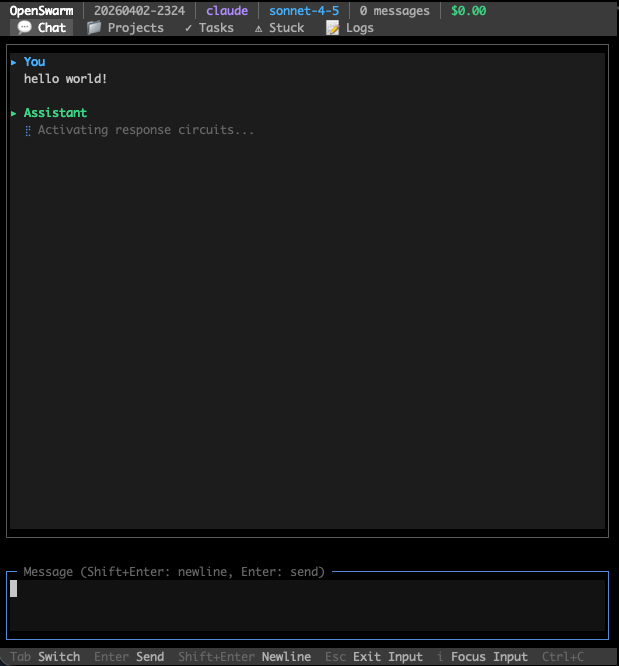
| Key | Action |
|---|---|
Tab | Switch tabs (Chat / Projects / Tasks / Stuck / Issues / Logs) |
Enter | Send message |
Shift+Enter | Newline |
i | Focus input |
Esc | Exit input focus |
Ctrl+C | Quit |
Status bar shows: provider · model · message count · cumulative cost
openswarm                        # TUI chat (default)
openswarm chat [session]         # Simple readline chat
openswarm resume                 # Reopen the most recent chat session (conversation + goal)
openswarm start                  # Start full daemon (requires config.yaml)
openswarm run "Fix the bug" -p ~/my-project   # Run a single task
openswarm exec "Run tests" --local --pipeline # Execute via daemon
openswarm init                   # Interactive setup wizard (provider auth, Linear OAuth, config)
openswarm provider               # Show/switch the active provider (interactive picker)
openswarm provider claude        # Switch straight to a provider — a running daemon switches in place
openswarm doctor                 # Diagnose environment (runtime, native deps, providers, ports)
openswarm validate               # Validate config.yaml

# Code review
openswarm review                 # Review the working-tree changes
openswarm review --max           # Full-codebase audit: fan reviewer subagents over areas
                                 #   → report at .openswarm/audit/ + PM-synthesized Linear
                                 #   issues by default (≤10 cohesive, master + sub-issues)
openswarm review --max --fix     # after the audit, dependency-related findings are grouped;
                                 #   independent fix units run in isolated sandboxes, then
                                 #   a PR is published only after every re-review and trusted
                                 #   deterministic repository check passes
                                 #   add --in-place to edit the current working tree instead
openswarm review --max --concurrency 8   # widen the fan-out — areas auto-split to fill the pool
                                 # more --max flags: --no-linear (report only) · --issues-per-area
                                 #   (legacy spray) · --issues <id> (set parent) · --fallback
                                 #   <adapter> · --out <file> · --dry-run (print the plan)

# CI / test gate auto-fix (npm / Cargo / Python auto-detected)
openswarm fix                    # Run the checks (package.json scripts, or cargo check+test,
                                 #   or ruff/mypy/pytest), fan a fix-worker out over the
                                 #   failures, re-run until green
openswarm fix --checks lint,test # only these checks · --concurrency <n> · --rounds <n> (default 3)
                                 # any language: put {"checks": {"test": "pytest -x"}} in openswarm.json

# PR autopilot (on-demand — conflict → comments → CI; does not merge)
openswarm pr status              # Snapshot: conflicts, CI, CHANGES_REQUESTED / critical comments
openswarm pr status --json       # Machine-readable; exit 0 only when merge-ready
openswarm pr fix                 # One-shot fix for the current branch's open PR (or --number N)
openswarm pr review              # Re-apply reviewer feedback only (Claude, Codex, or CHANGES_REQUESTED) — no conflict/CI work
openswarm pr review --fresh      # Run a brand-new code review of the PR diff and post it as a comment
openswarm pr review --all        # Review every open PR in the repo instead of just one (combine with --fresh)
openswarm pr watch               # Loop fix until merge-ready or --rounds exhausted (default 5)
openswarm pr create              # Local fix → commit → push → gh pr create (from feature branch)
openswarm pr create --no-fix --issue INT-123 --title "feat: …"  # skip local fix; set issue id

# Code Registry & BS Detector
openswarm check --scan           # Scan repo → register all entities
openswarm check src/foo.ts       # File brief (entities, tests, risk)
openswarm check --bs             # BS pattern scan (bad code smells)
openswarm check --stats          # Registry statistics
openswarm check --high-risk      # High-risk entities
openswarm check --search "name"  # Full-text search
openswarm annotate "funcName" --deprecate "reason"
openswarm annotate "funcName" --tag "needs-refactor"
openswarm annotate "funcName" --warn "error/security: SQL injection"
openswarm review exit codesreview is designed to work as a CI merge gate, and CI reads nothing but the
exit code:
| Exit | Meaning |
|---|---|
0 | The gate ran and did not reject (approve/revise), or there was nothing to review |
1 | The gate ran and the verdict is reject — with --fix, also when any area is left unresolved or deterministic verification did not pass |
2 | The gate did not run — no verdict was produced (provider usage limit, adapter failure, unparseable reviewer output). Never treat this as a pass |
Treat any non-zero exit as a failed check. The 1/2 split lets a workflow
retry or alert differently when the gate could not run at all (e.g. a quota
window exhausted — stderr names the cause and, when known, the reset time).
A composite action wraps the whole flow — install, diff against the PR base, review, and map the exit code onto the job result:
permissions:
  contents: read
  security-events: write   # only needed for the SARIF upload

steps:
  - uses: actions/checkout@v4
    with: { fetch-depth: 0 }   # the merge base has to be present to diff against
  - uses: actions/setup-node@v4
    with: { node-version: '22' }
  - id: review
    uses: unohee/OpenSwarm@main
    with:
      adapter: openrouter   # a hosted runner has no config; without this the CLI
                            # falls back to its `codex` default
    env:
      OPENROUTER_API_KEY: ${{ secrets.OPENROUTER_API_KEY }}
  - if: always() && steps.review.outputs.sarif-file != ''
    uses: github/codeql-action/upload-sarif@v3
    with: { sarif_file: ${{ steps.review.outputs.sarif-file }} }
Inputs: path (which checkout to review), base (defaults to the merge base of
the PR head and its base branch), adapter, read-only, version,
sarif-file, and fail-on-gate-not-run — the last defaults to true because a
review that did not happen must not read as a pass.
Outputs: decision, gate-ran, sarif-file.
The reviewer reads attacker-authored files with your provider credential in the environment. Two properties keep that from becoming code execution:
read-only defaults to true, which denies the reviewer every mutating tool
including bash. It is enforced per adapter, and an adapter that cannot enforce
it refuses to run rather than quietly ignoring the flag:
| Adapter | How read-only is enforced |
|---|---|
openrouter, atlascloud, gpt, codex-responses, local/lmstudio | The agentic loop withholds the mutating, web, and MCP tools, and the executor refuses them if called anyway |
claude | --permission-mode default with an allowlist of Read/Grep/Glob, instead of bypassPermissions |
codex | --sandbox read-only instead of workspace-write |
| anything else | Refused — spawnCli will not start a read-only run on an adapter that has not declared enforcement |
The reviewed checkout never becomes the working directory. OpenSwarm looks
for its own config.yaml in the current directory first, so a config committed
to the pull request would otherwise choose the run's adapter, model, and MCP
servers. The action runs from the runner temp and points --path at the
checkout instead.
Run the action's code from a trusted ref. uses: unohee/OpenSwarm@main
already does this — the action code comes from this repository, not from the
pull request. It is only uses: ./ that is unsafe, because after checking out a
pull request that path holds action.yml as the contributor wrote it, with your
secrets in scope. If you self-host the action, check it out from your default
branch into its own path and the pull request into another, then point path at
the latter — see
.github/workflows/review-gate.yml, which
does exactly that to dogfood this repository.
To run it automatically, the trigger is pull_request_target. A
pull_request run from a fork gets no secrets, so the provider key would be
empty and every fork PR would fail as gate-not-run.
For scripting without the action, --json prints the verdict on stdout under a
versioned schema (the human report is suppressed so openswarm review --json | jq works), and --sarif <file> writes SARIF 2.1.0 for code scanning. Findings
are reported at warning: the verdict is what blocks, while individual
follow-ups are advisory and some accompany an approve.
.github/workflows/review-gate.yml in this repository dogfoods the action. It is
workflow_dispatch only — the gate calls a paid model on every run, so enabling
it for every pull request is left as an explicit choice.
Autonomous pipelines enable baseline-diff verification by default: OpenSwarm runs repository test/typecheck commands once, compares a failing head against the merge base, and gives the reviewer structured evidence so pre-existing failures do not block unrelated work. Add .openswarm/verify.yaml for repository-specific commands (see templates/verify.example.yaml), or let OpenSwarm discover standard Node, Python, Rust, and Go checks. Configure the behavior under autonomous.verify; the legacy guards.qualityGate whole-tree check is deprecated.
On Linux, verification runs each command inside bubblewrap and fails closed when it cannot — running a worker's code unsandboxed to decide whether to trust it defeats the point. On macOS it uses the platform sandbox and needs no setup.
Installing the package is not always enough, and CI is where that bites:
| Environment | What it takes |
|---|---|
GitHub Actions ubuntu-latest | sudo apt-get install -y bubblewrap and sudo sysctl -w kernel.apparmor_restrict_unprivileged_userns=0. Measured 2026-08-01: the image sets that restriction to 1, and with it set even bwrap --unshare-user fails at setting up uid map: Permission denied. This repository's own CI asserts the recipe so it cannot go stale. |
| Docker, default seccomp | --security-opt seccomp=unconfined; add --cap-add SYS_ADMIN if the runtime also drops the capability |
| Debian/Ubuntu host | apt-get install -y bubblewrap, usually nothing else |
| Alpine | apk add bubblewrap |
When the sandbox is unavailable, OpenSwarm says which of these applies rather than reporting a bare failure: it runs bwrap to find out instead of guessing from sysctls, quotes bwrap's own error, and prints the matching fix.
For crash recovery, fenced execution leases, outbox semantics, rollout modes, and repository admission policy, see Durable autonomous loop.
openswarm exec options| Option | Description |
|---|---|
--path <path> | Project path (default: cwd) |
--timeout <seconds> | Timeout in seconds (default: 600) |
--local | Execute locally without daemon |
--pipeline | Full pipeline: worker + reviewer + tester + documenter |
--worker-only | Worker only, no review |
-m, --model <model> | Model override for worker |
Exit codes: 0 success · 1 failure · 2 timeout
For autonomous operation (Linear issue processing, Discord control, PR auto-improvement), you need a full config:
codex-responses (ChatGPT OAuth, native loop, no extra binary) is the smoothest start; codex delegates to the external Codex CLI. openswarm auth login handles the ChatGPT OAuthOPENROUTER_API_KEY or openswarm auth login --provider openrouteropenswarm auth login --provider gptlmstudio, :1234) or Ollama (local, :11434), auto-detected, no authclaude -p) — opt-in fallback; an authenticated claude on PATHbetter-sqlite3 and @lancedb/lancedb are native modules. Prebuilt binaries cover common platforms; if yours lacks one, npm install builds from source and needs python3 + a C/C++ toolchain (build-essential on Linux, Xcode Command Line Tools on macOS)openswarm auth login --provider linear (OAuth PKCE) or use an API key + team ID; Discord bot token (message content intent); GitHub CLI (gh) for CI monitoringAfter the global install, run the wizard in the directory you want the daemon to manage — it writes everything for you:
openswarm init      # writes config.yaml + .env (provider, task backend, notifications)
openswarm doctor    # verify providers, native deps, ports
See What openswarm init sets up for the prompts. Prefer to edit by hand? config.yaml supports ${VAR} / ${VAR:-default} substitution (resolved from .env) and is validated with Zod. A minimal .env (the wizard writes only what your choices need):
LINEAR_API_KEY=your-linear-api-key      # or: openswarm auth login --provider linear
LINEAR_TEAM_ID=your-linear-team-id
DISCORD_TOKEN=your-discord-bot-token    # only if you chose the discord notifier
DISCORD_CHANNEL_ID=your-channel-id
| Section | Description |
|---|---|
discord | Bot token, channel ID, webhook URL |
linear | API key, team ID |
github | Repos list for CI monitoring |
agents | Agent definitions (name, projectPath, heartbeat interval) |
autonomous | Schedule, pair mode, role models, decomposition settings |
prProcessor | PR auto-improvement schedule, retry limits, conflict resolver config |
adapter: codex # codex · codex-responses · cc-router · cursor · gpt · openrouter · atlascloud · lmstudio · local · claude
adapter accepts one of the registered values below (validated by Zod). For a ChatGPT subscription, codex-responses is the smoothest first-run choice — it runs OpenSwarm's native loop over the Responses API with no extra binary. Switch at runtime via Discord, e.g. !provider codex-responses / !provider openrouter.
| Adapter | Backend | Models | Auth |
|---|---|---|---|
codex-responses | OpenAI Responses API (native loop, no CLI binary) | gpt-5.6-terra (default), gpt-5.6-sol, gpt-5.6-luna | ChatGPT OAuth |
codex | OpenAI Codex CLI (delegated) | gpt-5-codex (default), o3, o4-mini | ChatGPT OAuth / codex CLI auth |
cc-router | Local CC-Router Responses endpoint (native loop) | Router's live model catalog | Existing CC-Router account pool |
cursor | Cursor Agent CLI (delegated, sandbox enabled) | Cursor account model catalog | Existing cursor-agent login session |
gpt | OpenAI Chat API | gpt-4o (default), o3, … | OAuth PKCE |
openrouter | OpenRouter API (native agentic loop) | any OpenRouter model — gpt-5, gemini-2.5, deepseek, glm, qwen, … | OPENROUTER_API_KEY or OAuth PKCE |
atlascloud | Atlas Cloud API (native agentic loop) · sponsor | Atlas models — deepseek-v4-pro (default), qwen3.5-flash, … | ATLASCLOUD_API_KEY |
lmstudio | LM Studio (OpenAI-compatible, local) | loaded LM Studio model (LMSTUDIO_MODEL) | None |
local | Ollama (local, auto-detected) | gemma, llama, qwen, mistral, … | None |
Claude Code (
claude -p) is supported as an opt-in fallback (and powers theclaude -pchat path) — install theclaudeCLI and authenticate it;openswarm initandopenswarm doctordetect it. It is a validadapter:value, but opt-in: nothing falls back to it automatically. Switch to it when another provider runs out of quota withopenswarm provider claude.
The openrouter adapter runs OpenSwarm's own agentic tool loop (read/search/edit/bash with verification guards), enables ZDR (data_collection: deny) for non-OpenAI models, and applies Anthropic prompt caching automatically. Local backends are auto-detected on standard ports (Ollama :11434, LM Studio :1234); use lmstudio for a dedicated LM Studio endpoint (LMSTUDIO_BASE_URL, default http://localhost:1234).
Each autonomous run snapshots the current Claude Code instruction hierarchy (~/.claude/CLAUDE.md, user rules, repository CLAUDE.md/AGENTS.md, and matching .claude/rules) once and applies the same capsule to orchestrator, worker, reviewer, Codex, CC-Router, and Cursor. The dashboard shows the capsule digest and source/error counts, not the rule bodies.
adapterRouting.primary must name the adapter the worker actually runs (adapter: at the top of the config, or roles.worker.adapter); a policy whose primary is some other adapter is ignored, and the fallbacks never engage. Role MCP grants and the coordination tools (coordination_read, coordination_peers, coordination_publish, coordination_thread_*, ask_human) additionally require an adapter that runs OpenSwarm's own tool loop — codex-responses, cc-router, gpt, openrouter, atlascloud, lmstudio, local. The delegated CLIs (codex, claude, cursor) bring their own tool loop, so those grants do not reach them; OpenSwarm logs a warning rather than pretending they applied.
A configured coordinationBoardIssueId turns one project-scoped tracker issue into the durable agent board. Worker advice/delegation, Discord questions, adapter routes, periodic reviews, and MCP denials are visible through GET /api/coordination, SSE, and the AGENT COORDINATION dashboard panel. Tool arguments, prompts, credentials, and rule bodies are redacted or omitted.
The transient inbox and the repository discussion board have separate jobs.
/threads stores topics, messages, subscriptions, unread cursors, and CAS
resolution in the automation SQLite database under the canonical Git repository
cell, so sibling worktrees and daemon restarts share one history. Replies wake
subscribed agents on their task-scoped inbox; /orchestration remains the live
event/agent graph.
autonomous:
  coordinationBoardIssueId: AGT-3993
  adapterRouting:
    primary: codex-responses
    fallbacks: [cc-router, cursor]
    allowReasons: [quota, infra, capability]
  mcpPolicies:
    orchestrator:
      servers: [github, linear, cloudflare]
      writeTools: [linear__save_comment]
  periodicReviews:
    - { profile: hygiene, schedule: "43 */6 * * *" }
  # Frontier project supervisor. Events provide the fast path; cron reconciles
  # anything missed while the daemon was down.
  orchestrator:
    enabled: true
    schedule: "17 */2 * * *"
    eventDriven: true
    eventDebounceMs: 1000
    adapter: codex-responses
    model: gpt-5.6-sol
    reasoningEffort: high
    timeoutMs: 600000
    maxTurns: 12
Every agent has a call sign — Magos Corvax-Vigilis, Adept Ferrus-Umbra — and messages are addressed to it. The name is derived from the repository, task, and role rather than randomly assigned, so it is stable across a restart or a retry and doubles as the agent's mailbox address; the worker and the reviewer on one task never share one. Call signs appear in the dashboard, in board comments, and in each agent's own prompt.
The project supervisor is separate from worker provider switching: pin its
adapter and model explicitly when it must remain on the frontier tier. Only
native-loop adapters can receive the role-scoped MCP tools while also enforcing
shellTools: false; delegated codex, claude, and cursor CLIs fail closed.
External MCP servers are optional: with no mcpPolicies.orchestrator entry, or
when discovery is temporarily unavailable, the supervisor still runs with only
the repository-scoped coordination inbox, thread tools, and a native cache-first
tracker bridge. The bridge reads the daemon heartbeat cache before any single-
issue lookup, can save only an idempotent comment to an issue already linked on
that repository's coordination board, and is available only to the orchestrator
role. This lets the supervisor settle evidence-backed worker questions without
copying OAuth state or granting every worker broad Linear access. No external
tool is granted implicitly, and decisions requiring new business authority stay
with the operator.
One sweep runs at a time per daemon and repository, concurrent daemons contend
on a file lock, and shutdown aborts then drains an active supervisor call. An
unchanged set of open board items is not sent to the model again. The deprecated
orchestratorSchedule key is still accepted as a cron-only, daemon-provider
compatible configuration, but new deployments should use orchestrator.
The native-loop supervisor also receives its repository-cell coordination
identity, so it can discover peers and create, join, or reply to durable threads
without gaining shell access to a worktree.
When cached tracker/dependency facts still leave a real tie, conflict cohort,
or high-impact ordering question, orchestrators can open a durable priority
council on an existing cross-task coordination thread. A proposal contains 2–8
options and the versioned cached evidence behind them; opening it never queries
Linear.
Eligibility is frozen from recently active independent peers, candidate-task
participants may submit evidence but cannot vote, and each actor+task pair gets
one equal-weight ranked ballot. Finalization is version-CAS guarded and records
quorum, cross-task/cross-role participation, tally, cited evidence, expiry, and
the deterministic taskId then optionId tie-break, independent of proposal
array order. Only an orchestrator may open a council through agent tools; the
authenticated operator HTTP route remains available for explicit intervention.
The resulting signal is deliberately advisory. coordination_council_consume
is orchestrator-only and can reorder only the existing option cohort's slots
when the council and cached snapshot versions still match. Its authority
contract explicitly forbids starting tasks, bypassing dependencies or file
leases, merging, destructive tools, and tracker mutation. The HTTP API exposes
list/read, operator proposal/evidence, and CAS finalization under
/api/coordination/councils; it intentionally has no vote endpoint because a
request body cannot establish an agent's actor/task identity. Ballots use the
trusted agent-tool context instead.
For automatic Decision Engine consumption, include scheduling_facts for every
option (priority, topology/due fields, downstream count, blockers, and tracker
state) and open with snapshot_version: auto. OpenSwarm stores a canonical
sched-v1 digest, recomputes it from the already-fetched task cache on each
heartbeat, CAS-consumes at most the newest matching finalized council, and then
changes only those tasks' existing slots. Repository scope comes only from a
task's explicit project path or the linear.projectId in that repository's
openswarm.json; an absent or ambiguous mapping fails closed. A missing
database, manual-only or no-quorum decision, stale facts, CAS race, partial
cohort, cross-repository match, or invalid authority is a no-op that preserves
deterministic ordering; none of these paths triggers another Linear request.
Blocking questions are sent to the configured Discord channel as !answer <correlation-id> <answer>. Only users in DISCORD_ALLOWED_USERS can settle them. The asking run stops and reports rather than guessing a default, and the question stays open on the board until someone answers — the answer is addressed back to the call sign that raised it, so the next run of that agent reads it from its inbox. When Discord is not configured the tool says so instead of claiming the operator was paged.
Per-role adapter overrides (each role may pick its own valid adapter + model):
autonomous:
  defaultRoles:
    worker:
      adapter: codex-responses
      model: gpt-5.6-terra
    reviewer:
      adapter: openrouter
      model: anthropic/claude-sonnet-4
Optional backlog grooming runs a read-only Planner over the fetched open queue
states for a mapped project (Todo, In Progress, In Review, and Backlog)
and compares them with the current repo. Keep mode: comment while validating
recommendations; mode: apply can update drifted descriptions and move strongly
stale issues to Done.
autonomous:
  backlogGrooming:
    enabled: false
    cadenceHours: 24
    mode: comment
    plannerModel: gpt-5.6-terra
    maxIssues: 80
autonomous:
  defaultRoles:
    worker:
      model: gpt-5.6-terra            # balanced default implementation
      escalateModel: gpt-5.6-sol      # frontier retry after a failed attempt
      escalateAfterIteration: 2
      timeoutMs: 1800000
    reviewer:
      model: gpt-5.6-sol              # correctness gate
      timeoutMs: 600000
    tester:
      enabled: false
      model: gpt-5.6-terra            # LLM fallback after deterministic verify
    documenter:
      enabled: false
      model: gpt-5.6-luna
    auditor:
      enabled: false
      model: gpt-5.6-sol
    skill-documenter:
      enabled: false
      model: gpt-5.6-luna
  jobProfiles:
    - name: light
      minMinutes: 1
      maxMinutes: 29
      effort: low
      roles:
        worker: gpt-5.6-luna
        reviewer: gpt-5.6-terra
    - name: heavy
      minMinutes: 30
      effort: high
      roles:
        worker: gpt-5.6-terra
        reviewer: gpt-5.6-sol
The native Codex adapter uses Terra when no model is pinned. Draft analysis uses Luna because it runs for every task; decomposition and hard review stay on Sol.
With the global install, the openswarm CLI manages the daemon directly — no repo or npm run scripts needed:
openswarm start               # start the daemon in the background
openswarm start --foreground  # run attached (logs stream to the terminal)
openswarm status              # pid, uptime, log path
openswarm stop                # stop the daemon
openswarm dash                # open the web dashboard (:3847)
From source / development (contributors): clone the repo and use the
npm run …scripts (npm run dev,npm start,npm run service:installfor a macOS launchd service,docker compose up -d). See CONTRIBUTING.md.
The repository ships a production image for the headless daemon (web dashboard on :3847, openswarm CLI on PATH). Published images live at ghcr.io/unohee/openswarm (tagged per release); building locally works the same way:
# Pull a release, or build from the repo
docker pull ghcr.io/unohee/openswarm:latest   # or: docker compose build

cp config.example.yaml config.yaml            # edit adapter/projects/keys
export OPENSWARM_WEB_TOKEN=$(openssl rand -hex 24)  # required to expose the dashboard
docker compose up -d
curl http://localhost:3847/api/health         # daemon health (token-less)
Without OPENSWARM_WEB_TOKEN the dashboard binds only inside the container — an unauthenticated 0.0.0.0 bind is refused by design — so the published port answers nothing while the daemon itself keeps running. With the token set, browser/API access from the host sends it as the X-OpenSwarm-Token header (/api/health stays token-less).
The compose file wires the persistent and local-data mounts that matter:
| Mount | Purpose |
|---|---|
./config.yaml → /app/config.yaml | daemon configuration (read-only) |
openswarm-state → /home/openswarm/.openswarm | task state, auth profiles, coordination board — must persist, and one container per state volume (two daemons sharing it would fight over locks and double-process issues) |
./workspace → /work | the repositories the daemon works on; point autonomous.allowedProjects at /work/<repo> |
../openswarm-warehouse → /warehouse | agent-readable, Git-external local assets (read-only) |
../openswarm-warehouse → /warehouse-rw | operator upload path used only by the authenticated /warehouse web UI |
Notes:
codex-responses adapter runs OpenSwarm's own tool loop against OAuth state — log in on the host (openswarm auth login) and mount ~/.codex / reuse the state volume. For the delegated CLI adapters (claude, codex, cursor), derive your own image: FROM ghcr.io/unohee/openswarm + npm install -g <cli>.~/.gitconfig or set GIT_AUTHOR_NAME/GIT_AUTHOR_EMAIL (and GH_TOKEN for gh) so worker commits and PRs attribute correctly.bubblewrap is installed but fail-closed under Docker's default seccomp profile. Enabling it requires security_opt: [seccomp=unconfined] + cap_add: [SYS_ADMIN] (commented in docker-compose.yml) — weigh that against your threat model.../openswarm-warehouse/INDEX.md, then open /warehouse in the dashboard to browse, download, or upload. Agents are prompted to inspect /warehouse/INDEX.md before asking for gitignored data. See docs/WAREHOUSE.md. ┌──────────────────────────┐
│ Linear API │
│ (issues, state, memory) │
└─────────────┬────────────┘
│
┌─────────────────────┼─────────────────────┐
│ │ │
v v v
┌──────────────────┐ ┌──────────────────┐ ┌──────────────────┐
│ AutonomousRunner │ │ DecisionEngine │ │ TaskScheduler │
│ (heartbeat loop) │─>│ (scope guard) │─>│ (queue + slots) │
└────────┬─────────┘ └──────────────────┘ └────────┬─────────┘
│ │
v v
┌──────────────────────────────────────────────────────────────┐
│ PairPipeline │
│ ┌────────┐ ┌──────────┐ ┌────────┐ ┌─────────────┐ │
│ │ Worker │──>│ Reviewer │──>│ Tester │──>│ Documenter │ │
│ │(Adapter│<──│(Adapter) │ │(Adapter│ │ (Adapter) │ │
│ └───┬────┘ └──────────┘ └────────┘ └─────────────┘ │
│ │ ↕ StuckDetector │
│ ┌───┴────────────────────────────────────────────────────┐ │
│ │ Adapters: Codex | GPT | OpenRouter | Local (Ollama) │ │
│ └────────────────────────────────────────────────────────┘ │
└──────────────────────────────────────────────────────────────┘
│ │ │
v v v
┌──────────────┐ ┌──────────────────┐ ┌──────────────────┐
│ Discord Bot │ │ Memory (LanceDB │ │ Knowledge Graph │
│ (commands) │ │ + Xenova E5) │ │ (code analysis) │
└──────────────┘ └──────────────────┘ └────────┬─────────┘
│
┌────────┴─────────┐
│ Code Registry │
│ (SQLite + FTS5) │
│ + BS Detector │
└──────────────────┘
claude -p, opt-in) with runtime provider switchingas any, etc.) with pipeline guard integrationreview --max) — fans reviewer subagents out over directory-shaped areas (auto-split to fill --concurrency), aggregates a deduped verdict into a markdown report, and synthesizes ≤10 cohesive Linear issues via a PM agent. Both review modes consult repository-local prior review logs; resolved/stale findings are not repeated, and byte-identical duplicate follow-ups are suppressed while unresolved issues remain visible. --fix groups findings by repository dependency closure, injects the package manager/manifests/verification contract and repo knowledge, runs only independent fix units concurrently in isolated sandboxes, and promotes disjoint in-scope diffs into an audit worktree. It publishes the PR only when every area re-approves and trusted deterministic verification passes; unavailable dependencies/checks fail closed. --in-place keeps edits in the current working tree but uses the same gates. Language-agnostic; codex usage-limit aware with automatic claude fallbackopenswarm fix) — runs the project's objective checks (lint / typecheck / build / test), groups the failures by file into areas, fans a fix-worker out over each, then re-runs the checks and repeats until green (or the round budget). Deterministic convergence — unlike the review fix pass, it verifies its own work. Multi-language: auto-detects npm scripts, Cargo.toml (cargo check/test, clippy on request), and Python tooling (ruff/mypy/pytest, gated on the repo's config); any other toolchain via a "checks" map in openswarm.jsonopenswarm pr) — on-demand surface over the daemon's PRProcessor + commitAndCreatePR. status reports conflicts / review feedback / CI; fix runs one autopilot pass (conflict → comments → CI); review re-applies reviewer feedback only, skipping conflict/CI work — recognizes Claude, Codex, and any formal CHANGES_REQUESTED review; review --fresh instead runs a brand-new code review of the PR's current diff (the same reviewer openswarm review uses) and posts the verdict as a PR comment, independent of any existing feedback; review --all reviews every open PR in the repo sequentially (combine with --fresh) instead of just the current branch's PR or --number; watch loops until merge-ready; create publishes the current feature branch (local fix → commit → push → gh pr create). Never merges or enables auto-merge.Linear (Todo/In Progress)
→ Fetch assigned issues
→ DecisionEngine filters & prioritizes
→ Resolve project path via projectMapper
→ PairPipeline.run()
→ Worker generates code (via the configured adapter)
→ Reviewer evaluates (APPROVE/REVISE/REJECT)
→ Loop up to N iterations
→ Optional: Tester → Documenter stages
→ Update Linear issue state (Done/Blocked)
→ Report to Discord
→ Save to cognitive memory
Hybrid retrieval: 0.60 × similarity + 0.25 × importance + 0.15 × recency
Memory types: belief · strategy · user_model · system_pattern · constraint
Background: decay, consolidation, contradiction detection, distillation.
Embeddings run locally via @huggingface/transformers (ONNX, no external
service). The default is Xenova/multilingual-e5-base (768d, int8), stored text is
embedded as a passage: and searches as a query: per the E5 asymmetric
convention. Weights are cached in ~/.openswarm/models so reinstalling OpenSwarm
does not discard them.
| Variable | Purpose |
|---|---|
OPENSWARM_EMBEDDING_MODEL | Hugging Face repo id. Models outside the known table must also set OPENSWARM_EMBEDDING_DIM. |
OPENSWARM_EMBEDDING_DIM | Vector dimension. Required for unknown models — a wrong value silently produces an unsearchable table. |
OPENSWARM_EMBEDDING_DTYPE | ONNX weight variant: q8 (default), q4, q4f16, fp16, fp32. |
OPENSWARM_MODEL_CACHE_DIR | Override the weight cache location. |
Changing any of these invalidates every stored vector: the store records an
embedding signature and warns when it no longer matches the active encoder.
Rebuild with openswarm memory reembed (stop the daemon first, or pass --force).
Repo knowledge loop — every completed task writes repo-scoped knowledge
(success → system_pattern with files changed + approach, review rejection →
constraint pitfall), and the next task on the same repo recalls the most
relevant entries into the worker prompt as a "Repository Knowledge" section.
Workers get better at a codebase the more they work on it. Workers can also actively query accumulated repo knowledge mid-task via the search_memory tool.
benchmarks/ contains a difficulty ladder for routing models by measured
capability — synthetic L0–L5 tasks with deterministic grading, and L6 = real
GitHub issues (SWE-bench Lite) solved by the OpenSwarm harness and graded by
the official swebench harness. Headline: hybrid mode (frontier read-only
diagnosis + lightweight implementer with a verification loop) resolved 3/3
attempted instances that every single lightweight model had failed. See
benchmarks/RUBRIC.md for the rubric, measured results,
and the harness defects the benchmark uncovered.
| Command | Description |
|---|---|
!dev <repo> "<task>" | Run a dev task on a repository |
!dev list | List known repositories |
!tasks | List running tasks |
!cancel <taskId> | Cancel a running task |
| Command | Description |
|---|---|
!status | Agent and system status |
!pause <session> | Pause autonomous work |
!resume <session> | Resume autonomous work |
!log <session> [lines] | View recent output |
| Command | Description |
|---|---|
!issues | List Linear issues |
!issue <id> | View issue details |
!limits | Agent daily execution limits |
| Command | Description |
|---|---|
!auto | Execution status |
!auto start [cron] [--pair] | Start autonomous mode |
!auto stop | Stop autonomous mode |
!auto run | Trigger immediate heartbeat |
!approve / !reject | Approve or reject pending task |
| Command | Description |
|---|---|
!pair | Pair session status |
!pair start [taskId] | Start a pair session |
!pair run <taskId> [project] | Direct pair run |
!pair stop [sessionId] | Stop a pair session |
!pair history [n] | View session history |
!pair stats | View pair statistics |
| Command | Description |
|---|---|
!schedule | List all schedules |
!schedule run <name> | Run a schedule immediately |
!schedule toggle <name> | Enable/disable a schedule |
!schedule add <name> <path> <interval> "<prompt>" | Add a schedule |
!schedule remove <name> | Remove a schedule |
| Command | Description |
|---|---|
!ci | GitHub CI failure status |
!provider <codex|codex-responses|openrouter|gpt|atlascloud|lmstudio|local> | Switch CLI provider at runtime |
!codex | Recent session records |
!memory search "<query>" | Search cognitive memory |
!help | Full command reference |
src/
├── index.ts                 # Entry point
├── cli.ts                   # CLI entry point (run, exec, chat, init, validate, start)
├── cli/                     # CLI subcommand handlers
│   └── promptHandler.ts     # exec command: daemon submit, auto-start, polling
├── core/                    # Config, service lifecycle, types, event hub
├── adapters/                # Provider adapters (codex, codex-responses, gpt, openrouter, local, lmstudio), agentic loop
├── agents/                  # Worker, reviewer, tester, documenter, auditor
│   ├── pairPipeline.ts      # Worker → Reviewer → Tester → Documenter pipeline
│   ├── agentBus.ts          # Inter-agent message bus
│   └── cliStreamParser.ts   # Claude CLI output parser
├── orchestration/           # Decision engine, task parser, scheduler, workflow
├── automation/              # Autonomous runner, cron scheduler, PR processor
├── memory/                  # LanceDB + Xenova embeddings cognitive memory
├── knowledge/               # Code knowledge graph (scanner, analyzer, graph)
├── registry/                # Code entity registry, BS detector, entity scanner
├── issues/                  # Local issue tracker (SQLite + GraphQL + Kanban UI)
├── discord/                 # Bot core, command handlers, pair session UI
├── linear/                  # Linear SDK wrapper, project updater
├── github/                  # GitHub CLI wrapper for CI monitoring
├── support/                 # Web dashboard, planner, rollback, git tools
├── locale/                  # i18n (en/ko) with prompt templates
└── __tests__/               # Vitest test suite
| Path | Description |
|---|---|
~/.openswarm/ | State directory (memory, codex, metrics, workflows) |
~/.openswarm/registry.db | Code entity registry (SQLite) |
~/.openswarm/issues.db | Local issue tracker (SQLite) |
~/.claude/openswarm-*.json | Pipeline history and task state |
~/.config/openswarm/telemetry.json | Anonymous install id + opt-out notice flag |
config.yaml | Main configuration |
dist/ | Compiled output |
OpenSwarm collects anonymous, opt-out usage telemetry to understand how it's actually used (npm downloads and GitHub stars don't tell us). A single event is sent per command invocation.
What is sent (and nothing else):
| Field | Example | Why |
|---|---|---|
| Random install id | V1StGXR8_Z5j... (nanoid) | De-duplicate installs — anonymous, local-only |
| Command | start, run, chat | Which features are used |
| Version | 0.9.3 | Version adoption |
| OS / arch | darwin / arm64 | Platform support priorities |
| Node version | 22.3.0 | Runtime support |
| Adapter family | codex | Which providers are popular |
| Error flag | 0 / 1 | Failure rate (boolean only) |
Never sent: source code, prompts, file paths, repo or issue names, Linear/Discord content, environment variables, API keys, or any personal data.
How to opt out (any one):
export OPENSWARM_TELEMETRY=0 # or DO_NOT_TRACK=1
# config.yaml
telemetry:
  enabled: false
CI environments (CI / GITHUB_ACTIONS) are excluded automatically. The collector
is a Cloudflare Worker writing to a private D1 table; telemetry never blocks or slows
the CLI (fire-and-forget with a short timeout, and failures are silently ignored).
| Category | Technology |
|---|---|
| Runtime | Node.js 22+ (ESM) |
| Language | TypeScript (strict mode) |
| Build | tsc |
| Agent Execution | Claude Code, OpenAI GPT/Codex, Ollama/LMStudio/llama.cpp |
| Local DB | better-sqlite3 (WAL mode, FTS5) |
| Task Management | Linear SDK (@linear/sdk) |
| Communication | Discord.js 14 |
| Vector DB | LanceDB + Apache Arrow |
| Embeddings | Xenova/transformers (multilingual-e5-base, 768D) |
| Scheduling | Croner |
| Config | YAML + Zod validation |
| Linting | oxlint |
| Testing | Vitest |
Full version history lives in CHANGELOG.md and the GitHub Releases page.
Latest — v0.17.7: openswarm stop now actually stops a launchd-managed
daemon, a dashboard project disable survives a daemon restart, failed-session
partial work is committed to its branch before the worktree is preserved, and
Lance memory writes retry instead of colliding under review --max. Adds the
Atlas Cloud provider adapter. See CHANGELOG.md for the rest.
If the chat TUI shows each Hangul (or other multibyte) character twice —
이이렇렇게 쓰쓰이는것 — while ASCII characters look fine, the cause is almost
always client-side local / predictive echo in the mobile SSH app drawing an
extra copy of wide characters. The keystroke reaches OpenSwarm once; the terminal
paints it twice.
Fix it in the SSH client:
Termius → Host/Terminal settings → turn Local Echo (a.k.a. predictive echo) off, and ensure the encoding is UTF-8.
Confirm the server side is fine by running with diagnostics:
OPENSWARM_DEBUG_INPUT=1 openswarm chat
Type a few Korean characters, then inspect ~/.openswarm/input-debug.log. If a
single keypress logs one code point (cp=[51060]) but you saw two glyphs,
the doubling is terminal echo (client-side). If it logs the code point twice
in one event, it's an app-level issue — please attach the log to
a bug report.
Contributions are welcome — OpenSwarm is MIT-licensed and accepts pull requests from anyone. See CONTRIBUTING.md for development setup, the local check gates, branch/commit conventions, and the PR process. By participating you agree to the Code of Conduct.
main, and open a PR (CI runs lint → typecheck → build → test)MIT © Heewon Oh
 @googleapis✓ Official
Google's universal MCP server supporting PostgreSQL, MySQL, MongoDB, Redis, and 10+ databases
Official MongoDB integration — query collections, run aggregations, inspect schemas
 @designcomputer
Secure MCP server for MySQL database interaction, queries, and schema management
Run Claude Code as an MCP server so any agent can delegate coding tasks to it
