

Are you the author? Sign in to claim
Verification Layer for Claude Code
Opslane is self-serve QA for your PR. You paste the ticket; Verify drives a real browser against your local dev server, checks each acceptance criterion, and reports pass/fail with screenshots — inline in Claude Code, before you push.
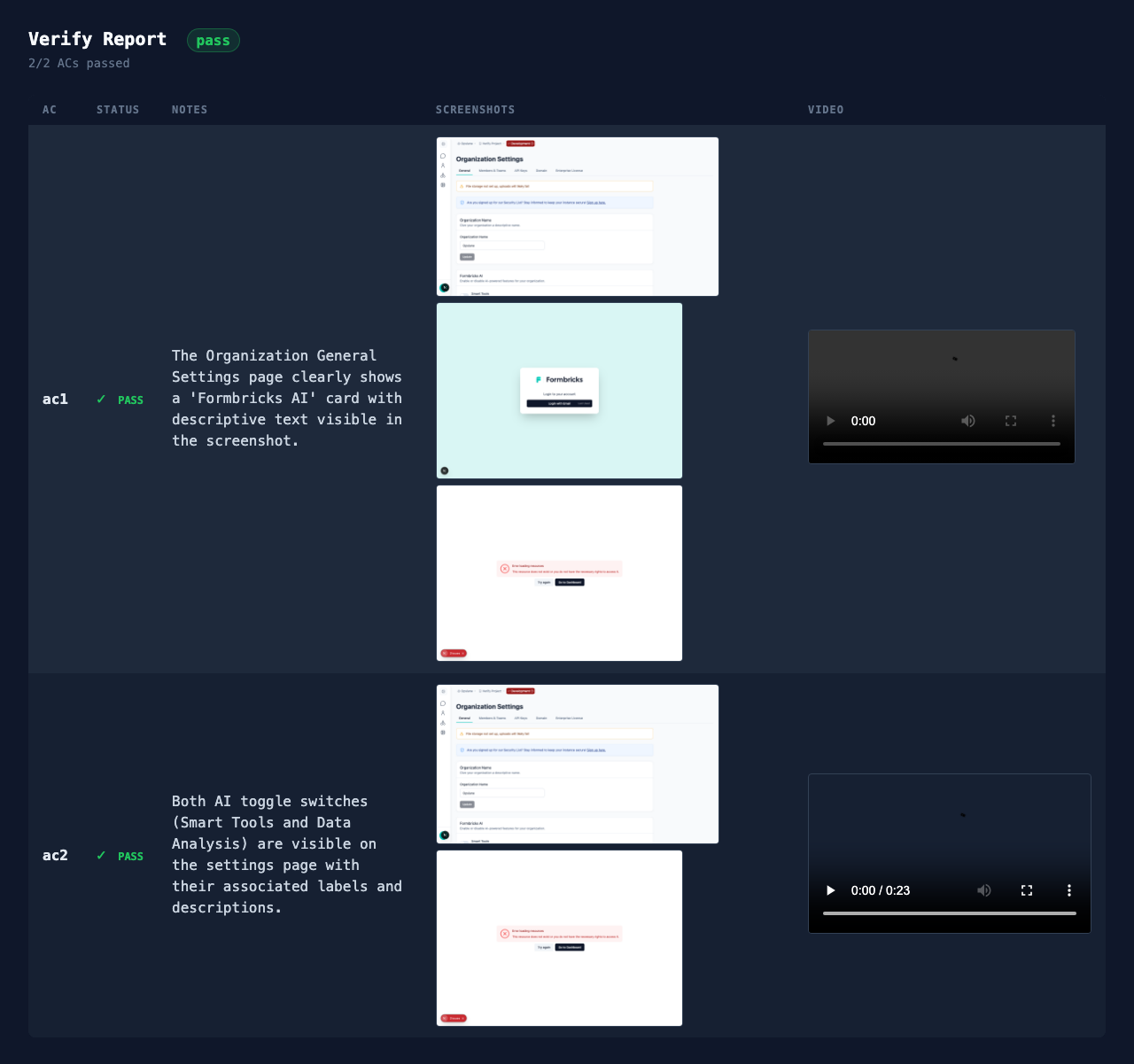
When you finish a feature and run /verify, it doesn't just lint the code. It reads the ticket, extracts the concrete acceptance criteria, and asks you about anything ambiguous. Then it drives the actual app via Playwright MCP — clicking, typing, navigating like a person would — and checks each AC against what it sees. You get a per-AC verdict with screenshots, and a Playwright video + trace on anything that didn't pass.
This is the sanity pass you'd otherwise do manually with the PM ticket open in one tab and your dev server in another. It runs locally, against your real app, with no test code to write and no CI to wire up.
Prerequisites: Claude Code with OAuth login (claude login).
In Claude Code, register the marketplace first:
/plugin marketplace add opslane/verify
Then install the plugin:
/plugin install opslane-verify@opslane-verify-marketplace
That's it. The plugin registers two slash commands — /verify-setup and /verify — and wires up the Playwright MCP server automatically. No separate claude mcp add step.
/verify-setupRun this once per repo from your repo root, with your dev server running:
/verify-setup
It does the following inline (no npm install, no CLI binary):
.verify/ in your repo and adds it to .gitignore if missing.package.json scripts (dev/start/serve flags), then .env* files, then framework configs (vite.config.*, next.config.*). Falls back to 3000 and tells you. If it picks the wrong one, you can correct it (e.g. "my dev server runs on 5173")..verify/config.json with the resolved baseUrl.app/, pages/), Remix (routes/), React Router (<Route> / createBrowserRouter), SvelteKit (routes/), Nuxt (pages/), and Express/Hono/Fastify route definitions. Skips /api/*. Handles monorepos.*.spec.ts) or Cypress (*.cy.ts) tests and extracting the URLs they navigate to and the selectors they use. Prefers data-testid and role-based selectors..verify/app.json — a single JSON map of routes + per-page selectors that /verify reads later for grounded AC extraction.Re-run /verify-setup any time your routes change or you've added new tests — the index gets refreshed.
/verifyOnce setup is done, verify any change with:
/verify                          # auto-discovers a likely spec file
/verify path/to/spec.md          # or point it at a specific spec
Here's what happens, turn by turn:
*spec*, *plan*, *requirements*, *acceptance* and either suggests one or asks you to pick. You can also paste the ticket inline.credentials field in .verify/config.json (path must live under .verify/), then asks you to paste creds inline. Logs you in via the browser; the session persists in .verify/auth.json for next time..verify/app.json routes and any seed data you've stashed in .verify/seed-data.txt. Splits multi-behavior ACs apart. Skips ACs that need external services (Stripe, email, OAuth).pass, fail, blocked, unclear, error, timeout, auth_expired, spec_unclear) → write result.json. Recordings get deleted on pass (no clutter) and kept on every non-pass verdict (so you can replay exactly what happened).verdicts.json (machine-readable) + report.html (single-file, embeds verdict cards, screenshots, and inline video) to .verify/runs/<run_id>/, and prints an inline pass/fail summary in Claude Code with npx playwright show-trace commands for any failures.Hard limits keep runs tight: ~12 Playwright commands per AC, bail after 3 nav attempts, one retry per failed command, no source-code reads, no data mutation.
You paste a ticket like this:
As a user, I want to save a draft of my document.
Acceptance criteria:
- The "Save Draft" button appears on the document edit page
- Clicking it persists the document state without publishing
- A confirmation toast appears with text "Draft saved"
Verify drives the browser through each AC and produces a verdict for every one:
{
  "ac_1": { "verdict": "pass", "confidence": "high", "reasoning": "Save Draft button visible on /docs/edit", "screenshots": ["save_draft_button.png"] },
  "ac_2": { "verdict": "pass", "confidence": "high", "reasoning": "Draft persisted; reload shows the saved state", "screenshots": ["draft_persisted.png"] },
  "ac_3": { "verdict": "fail", "confidence": "high", "reasoning": "Toast text was 'Saved' not 'Draft saved'", "screenshots": ["toast_mismatch.png"] }
}
You see the failing AC inline with the screenshot — before you push.
After a run, evidence lives in .verify/runs/<run_id>/:
# Open the HTML report in a browser
open .verify/runs/*/report.html

# Or browse raw evidence for a specific AC
ls .verify/runs/*/evidence/<ac_id>/
Each AC's evidence directory contains:
result.json — verdict, confidence, reasoning, steps taken, screenshot filenames*.png — screenshots captured during execution{run_id}-{ac_id}.webm (video) + trace.zip (Playwright trace) — replay the run with npx playwright show-trace .verify/runs/<run_id>/evidence/<ac_id>/trace.zipBuilt this because I kept shipping PRs that passed my eyeball check but failed the PM's check. Verify is the sanity pass I always did manually, automated against a real browser — not a mock, not a unit test, the actual app.
See CHANGELOG.md for the full release history.
Latest (v1.1.0 — 2026-04-23):
/verify-setup skill (no CLI binary)/verify (one-command install via /plugin install)How is this different from Playwright alone? Playwright is a browser library — you still write tests, run them, maintain them. Verify takes a PM ticket and executes intent-level checks via Claude + Playwright MCP. No test code to write, no selectors to maintain, no CI to wire up.
What about auth?
The plugin launches Playwright with --storage-state .verify/auth.json --isolated. On first /verify run, the skill walks you through logging in once and re-uses the session for every subsequent run.
What about flaky selectors?
The browser agent navigates by intent (clicks "the submit button" via the accessibility tree), not brittle CSS selectors. If something does break, .verify/runs/<run_id>/evidence/<ac_id>/ has the video + trace so you can see exactly what happened.
See CLAUDE.md for dev commands, conventions, and test instructions.
MIT — see LICENSE.
1000+ skills curated from Anthropic, Vercel, Stripe, and other engineering teams
Design enforcement with memory — keeps your UI consistent across a project
Detects 37 AI writing patterns and rewrites text with human rhythm across 5 voice profiles
WCAG accessibility audit — automated scanning, manual review, remediation