

Are you the author? Sign in to claim
A beautiful, zero-config visual CVE dashboard for npm & Python. One command: npx osv-ui. 100% Local & Secure.
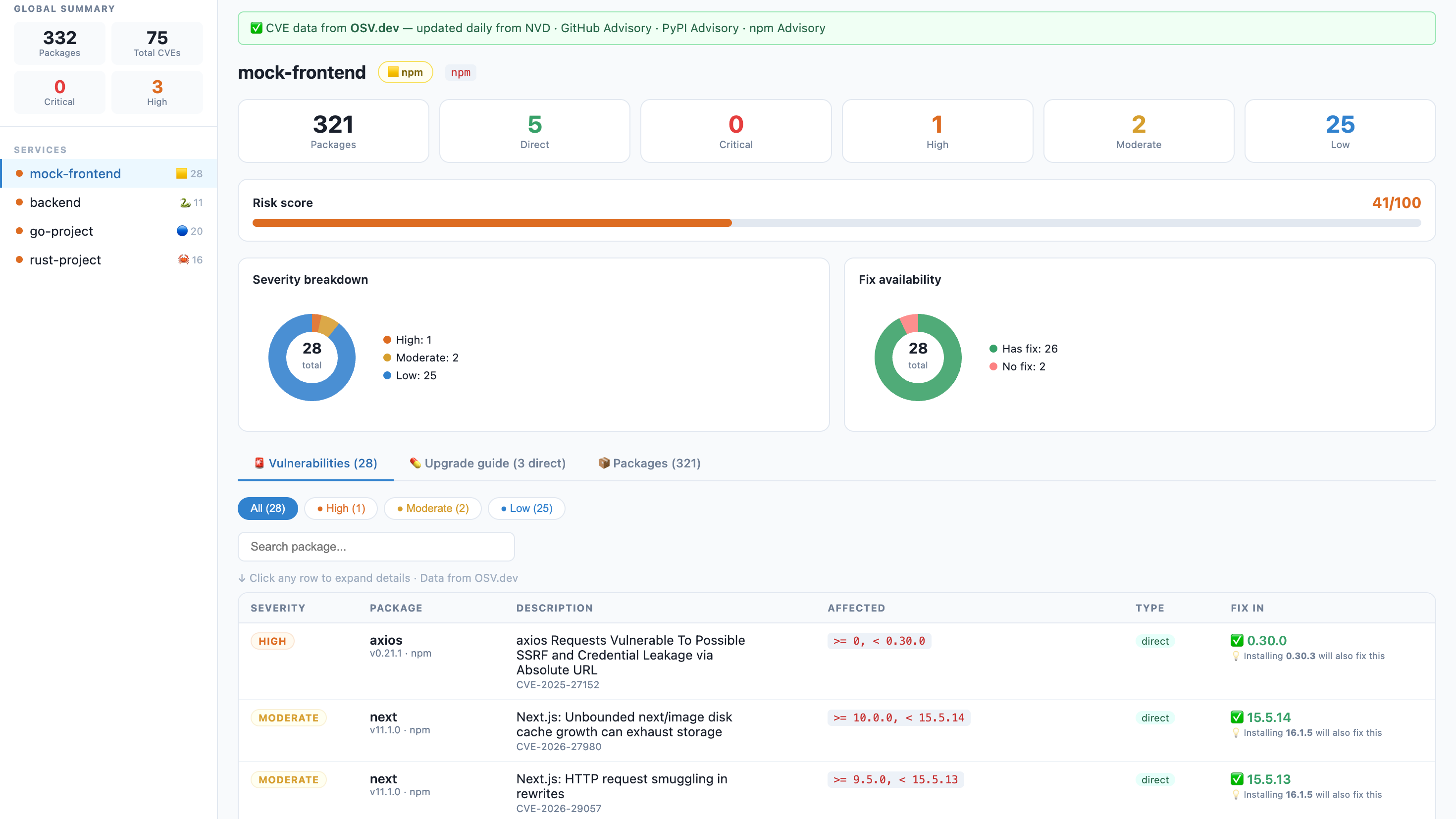
A beautiful, zero-config visual CVE dashboard for npm, Python, Go, Rust, Java, PHP, and Ruby projects.
One command. No signup. No API key. Runs 100% locally — your code never leaves your machine.





🇻🇳 Tiếng Việt · 🇺🇸 English · 🇨🇳 中文 · 🇯🇵 日本語
$ npm audit

# ... 300 lines of this ...
# moderate  Regular Expression Denial of Service in semver
# package   semver
# patched in >=7.5.2
# ...
# 12 vulnerabilities (3 moderate, 6 high, 3 critical)
Nobody reads that. Security gets ignored. Dependencies stay vulnerable.
npx osv-ui
→ Opens a dashboard. Every CVE, every fix, all your services. Done.
| 🌐 Multi-Ecosystem | Scans package-lock.json, pnpm-lock.yaml, yarn.lock, Pipfile.lock, poetry.lock, requirements.txt, go.sum, Cargo.lock, pom.xml, composer.lock, Gemfile.lock |
| 📡 Live CVE data | Powered by OSV.dev — updated daily from NVD, GitHub Advisory, PyPI Advisory. No API key. |
| 🏢 Multi-service | Scan your entire monorepo in one command — frontend, backend, workers, ML services |
| 💊 Fix guide | Dependabot-style upgrade table: current version → safe version + one-click copy command |
| 🔌 Built-in REST API | Power your own security dashboards with GET /api/data or CLI export flags |
| 🎯 Risk score | 0–100 per service so you know where to focus first |
| 🔍 CVE drill-down | Click any row — CVSS score, description, NVD link, GitHub Advisory link |
| 🌙 Dark Mode | Eye-friendly security audits, day or night |
Scan current directory:
npx osv-ui
Scan a monorepo (multiple services at once):
npx osv-ui ./frontend ./api ./worker ./ml-service
Auto-discover all services under the current directory:
npx osv-ui -d
Add to your package.json scripts:
{
  "scripts": {
    "audit:ui":  "npx osv-ui",
    "audit:all": "npx osv-ui ./frontend ./api ./worker"
  }
}
--discover, -d    Auto-find service dirs that contain a supported manifest
--port=2003       Use a custom port (default: 2003)
--json[=file]     Save report as JSON without opening browser (defaults to osv-report.json)
--html[=file]     Save report as HTML without opening browser (defaults to osv-report.html)
--cyclonedx[=file] Save CycloneDX SBOM JSON (defaults to osv-sbom.cdx.json)
--spdx[=file]     Save SPDX SBOM JSON (defaults to osv-sbom.spdx.json)
--baseline=file   Compare with a previous --json report
--markdown[=file] Save a Markdown PR/comment report (defaults to osv-report.md)
--fail-on=level   Exit non-zero for critical/high/moderate/low findings
--webhook-url=url POST matching findings to a webhook
--webhook-severity=level Webhook threshold (default: critical)
--watch           Keep dashboard running and re-scan when manifests change
--no-open         Don't auto-open the browser
--offline         Skip OSV.dev lookup — parse manifests only
-h, --help        Show help message
osv-ui is now a Model Context Protocol (MCP) server. This allows AI agents like Claude Desktop, Cursor, and Claude Code to:
Quick setup (npx):
{
  "mcpServers": {
    "osv-ui": {
      "command": "npx",
      "args": ["-y", "osv-ui-mcp"]
    }
  }
}
See the MCP Package README for detailed setup instructions.
osv-ui isn't just a dashboard; it's a security data engine.
Once the dashboard is running, you can pull the raw security data for your whole project:
# Get full JSON payload for all services
curl http://localhost:2003/api/data

# Use it in your custom scripts
curl -s http://localhost:2003/api/data | jq '.[0].vulns'
Generate machine-readable reports without opening the browser:
npx osv-ui -d --json=osv-report.json --markdown=osv-report.md --cyclonedx=sbom.cdx.json --spdx=sbom.spdx.json --no-open
Compare a PR scan against a baseline report and fail on newly introduced high+ findings:
npx osv-ui -d --json=current.json --baseline=main-osv-report.json --markdown=osv-pr.md --fail-on=high --no-open
Minimal GitHub Actions flow:
name: osv-ui
on: [pull_request]
jobs:
  scan:
    runs-on: ubuntu-latest
    steps:
      - uses: actions/checkout@v4
      - uses: actions/setup-node@v4
        with:
          node-version: 20
      - run: npx osv-ui -d --json=current.json --markdown=osv-pr.md --cyclonedx=sbom.cdx.json --fail-on=high --no-open
      - uses: actions/upload-artifact@v4
        if: always()
        with:
          name: osv-ui-report
          path: |
            current.json
            osv-pr.md
            sbom.cdx.json
Send new critical findings to a webhook:
npx osv-ui -d --baseline=main-osv-report.json --webhook-url="$SECURITY_WEBHOOK_URL" --webhook-severity=critical --json=current.json
| Ecosystem | Files |
|---|---|
| npm / JS | package-lock.json · pnpm-lock.yaml · yarn.lock |
| Python | requirements.txt · Pipfile.lock · poetry.lock · pyproject.toml · uv.lock |
| Go | go.sum |
| Rust | Cargo.lock |
| Java | pom.xml (Maven) |
| PHP | composer.json · composer.lock |
| Ruby | Gemfile · Gemfile.lock |
More ecosystems coming — see Roadmap.
Your project files
    │
    ├─ package-lock.json   ──┐
    ├─ Pipfile / poetry    ──┤──► parser ──► package list
    ├─ go.sum / Cargo.lock ──┘
                                    │
                                    ▼
                             OSV.dev batch API  (free, no key)
                                    │
                                    ▼
                             CVE matches + fix versions
                                    │
                                    ▼
                         Express server → browser dashboard
                              http://localhost:2003
CVE data comes from OSV.dev — a free, open database maintained by Google that aggregates:
Updated daily. No account. No rate limit. No vendor lock-in.
osv-ui and osv-scanner use the same OSV.dev data source. osv-ui adds the visual layer that osv-scanner lacks:
| osv-ui | npm audit | Snyk | Dependabot | |
|---|---|---|---|---|
| Visual dashboard | ✅ | ❌ terminal only | ✅ | ✅ |
| npm support | ✅ | ✅ | ✅ | ✅ |
| Python support | ✅ | ❌ | ✅ | ✅ |
| Multi-service in one view | ✅ | ❌ | ✅ paid | ✅ |
| No signup required | ✅ | ✅ | ❌ | ❌ |
| Works on GitLab Free | ✅ | ✅ | ❌ | ❌ |
| Self-hosted / local | ✅ | ✅ | ❌ | ❌ |
| Fix commands | ✅ | partial | ✅ | ✅ |
| Open source | ✅ | ✅ | ❌ | ❌ |
No Dependabot on GitLab Free? Add this to .gitlab-ci.yml:
audit:
  stage: test
  image: node:20-alpine
  script:
    - npm audit --json > /tmp/audit.json || true
    - |
      node -e "
        const r = require('/tmp/audit.json');
        const crit = Object.values(r.vulnerabilities || {})
          .filter(v => v.severity === 'critical').length;
        if (crit > 0) {
          console.error('BLOCKED: ' + crit + ' critical CVE(s). Run: npx osv-ui');
          process.exit(1);
        }
        console.log('OK: no critical vulnerabilities');
      "
  artifacts:
    paths: [/tmp/audit.json]
    when: always
--offlinenpm install first so package-lock.json existsAll contributions are welcome. If you want to work on something, open an issue first so we can coordinate.
go.sum / go.modCargo.lockpom.xmlcomposer.lockGemfile.lockThis project is built by the community. All skill levels welcome.
Good first issues:
# Clone and run locally
git clone https://github.com/toan203/osv-ui
cd osv-ui
npm install

# Run against your own project
node bin/cli.js /path/to/your/project

# Run against multiple services
node bin/cli.js ./frontend ./backend
Please read CONTRIBUTING.md for code style and PR process.
MIT — use it, fork it, embed it, build on it. Attribution appreciated but not required.
Did osv-ui catch a real CVE in your project?
A ⭐ helps other developers find this tool.
Run Claude Code as an MCP server so any agent can delegate coding tasks to it
 @microsoft✓ Official
Browser automation using accessibility snapshots instead of screenshots
 @googleapis✓ Official
Google's universal MCP server supporting PostgreSQL, MySQL, MongoDB, Redis, and 10+ databases
 @github✓ Official
Official GitHub integration for repos, issues, PRs, and CI/CD workflows

