

Are you the author? Sign in to claim
Overture is an open-source, locally running web interface delivered as an MCP (Model Context Protocol) server that visua

See the plan before the code. Approve it. Then watch it execute.





Problem • Solution • Install • Features • Marketplace • Config • Discussions
https://github.com/user-attachments/assets/eeb9c4cb-c80d-42da-bf63-c0c4ecb1e5d6
Every AI coding agent today — Cursor, Claude Code, Cline, Copilot — works the same way:
What Happens Now
|
Text Plans Don't HelpSome agents show plans as text in chat. But text fails to show:
|
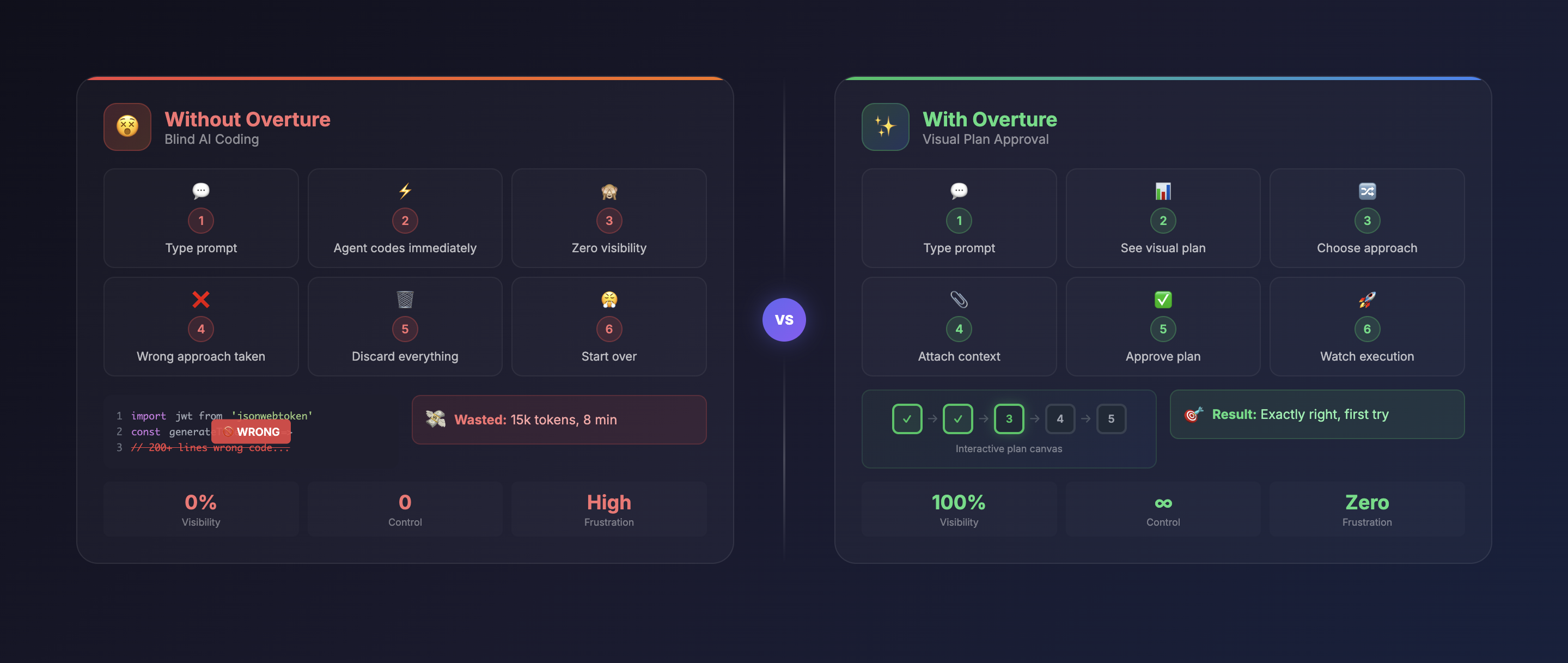
Overture intercepts your AI agent's planning phase and renders it as an interactive visual flowchart — before any code is written.
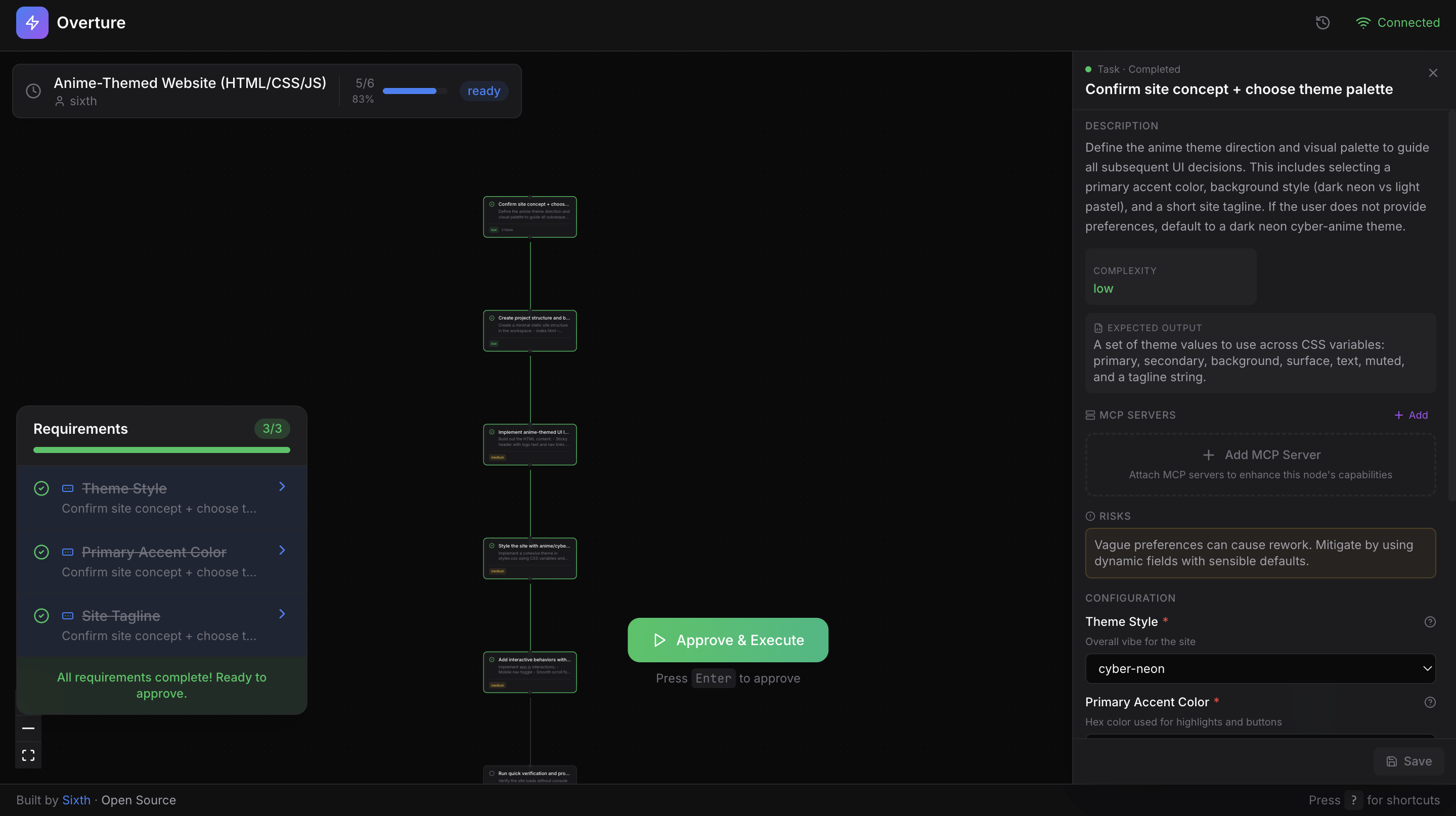
 Visual Plans Interactive flowchart with pan, zoom, and click-through navigation |
 Attach Context Files, API keys, instructions per step |
 Choose Approaches Compare pros/cons of different paths |
 Real-time Execution Watch nodes light up with progress |
 MCP Marketplace Browse & attach tools per node |
Overture is an MCP server that works with any MCP-compatible AI coding agent. One command to install.
claude mcp add overture-mcp -- npx overture-mcp
Add to ~/.cursor/mcp.json:
{
  "mcpServers": {
    "overture": {
      "command": "npx",
      "args": ["overture-mcp"]
    }
  }
}
Open VS Code settings → search "Cline MCP" → add:
{
  "mcpServers": {
    "overture": {
      "command": "npx",
      "args": ["overture-mcp"]
    }
  }
}
Create .vscode/mcp.json in your project root:
{
  "servers": {
    "overture": {
      "command": "npx",
      "args": ["overture-mcp"]
    }
  }
}
Note: GitHub Copilot MCP requires VS Code 1.99+ and uses
serversinstead ofmcpServers.
Add to your Sixth AI MCP settings file:
| Platform | Path |
|---|---|
| macOS | ~/Library/Application Support/Code/User/globalStorage/sixth.sixth-ai/settings/sixth-mcp-settings.json |
| Windows | %APPDATA%\Code\User\globalStorage\sixth.sixth-ai\settings\sixth-mcp-settings.json |
| Linux | ~/.config/Code/User/globalStorage/sixth.sixth-ai/settings/sixth-mcp-settings.json |
{
  "mcpServers": {
    "overture": {
      "command": "npx",
      "args": ["overture-mcp"],
      "disabled": false
    }
  }
}
npm install -g overture-mcp
Give your agent any task. Overture automatically opens at http://localhost:3031 with your plan ready for approval.
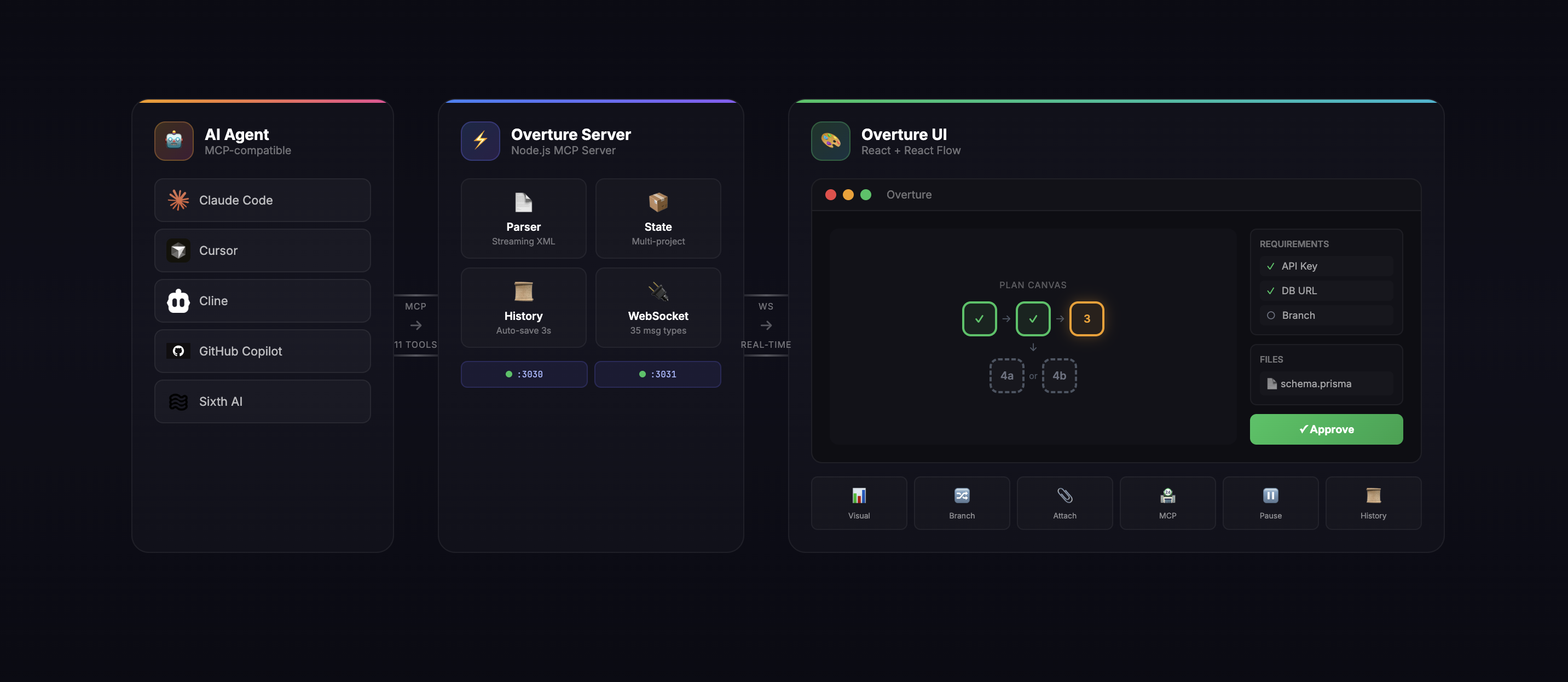
The Flow:
| Step | What Happens |
|---|---|
| 1. Prompt | You give your agent a task: "Build a REST API with auth" |
| 2. Plan | Agent generates a detailed plan with steps, branches, and requirements |
| 3. Visualize | Overture renders the plan as an interactive graph |
| 4. Enrich | You click nodes, attach files, select branches, fill in API keys |
| 5. Approve | You click "Approve & Execute" (or press Enter) |
| 6. Execute | Watch real-time as nodes pulse, complete, or fail |
| 7. Control | Pause (Spacebar), resume, re-run nodes, or modify the plan mid-flight |
| Feature | Description |
|---|---|
| React Flow Canvas | Full pan, zoom, drag with smooth animations |
| Streaming Parser | Plan nodes appear in real-time as the agent generates them |
| Dagre Auto-Layout | Intelligent automatic positioning of nodes |
| Visual Status | Pending (gray) → Active (pulsing yellow) → Completed (green) / Failed (red) |
| Next Node Indicator | Blue pulse shows which node executes next |
| Complexity Badges | Low (green), Medium (yellow), High (red) at a glance |
| Glow Effects | Shadow glows highlight active and upcoming nodes |
| Insertable Edges | Hover over edges to insert new nodes mid-plan |
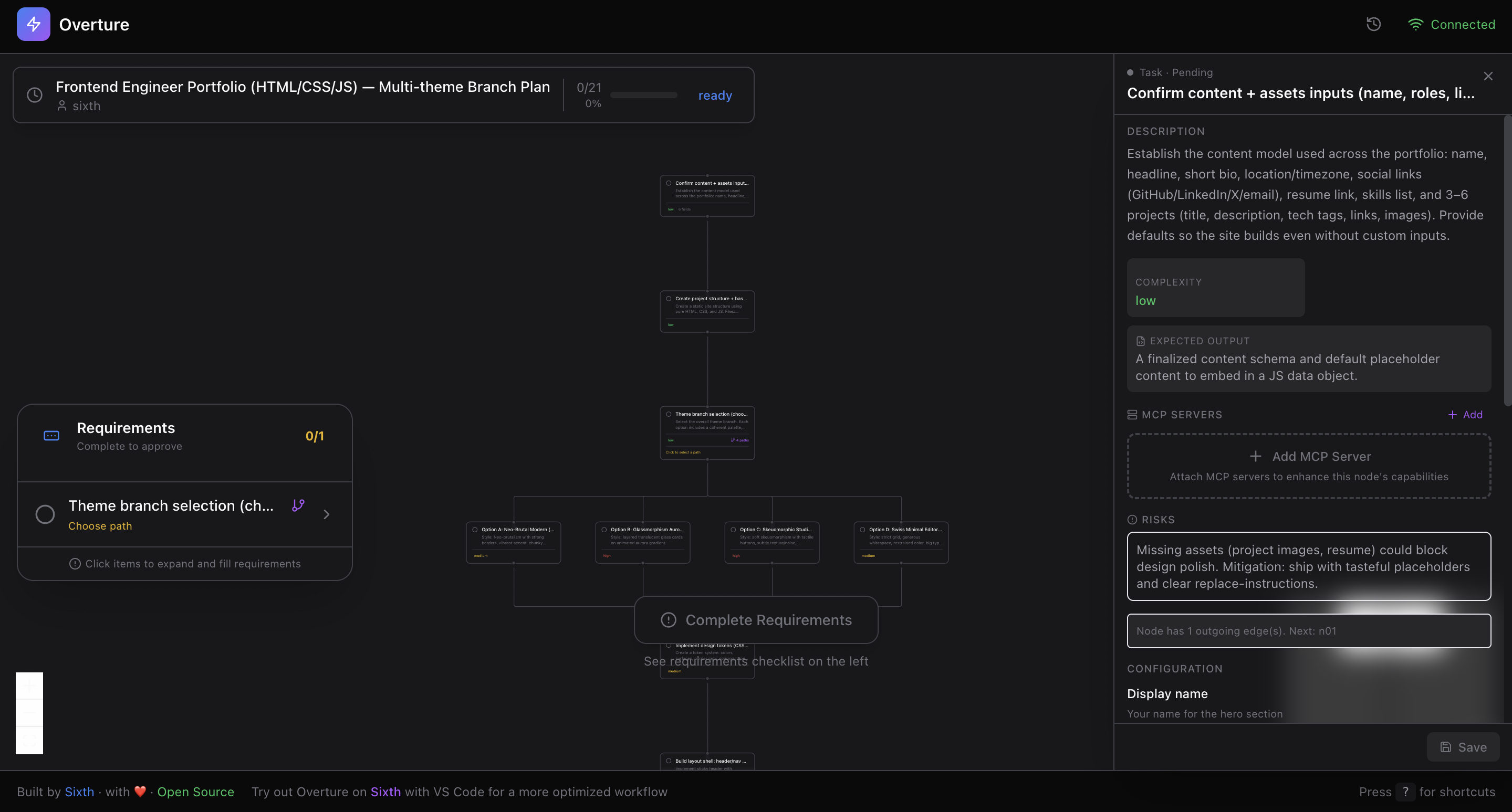
Click any node to reveal its full details:
| Info | What You See |
|---|---|
| Title & Description | Full context for what this step does |
| Complexity Level | Low / Medium / High with visual indicator |
| Expected Output | What the step should produce |
| Risks & Edge Cases | Potential issues to watch for |
| Pros & Cons | For branch options, compare trade-offs |
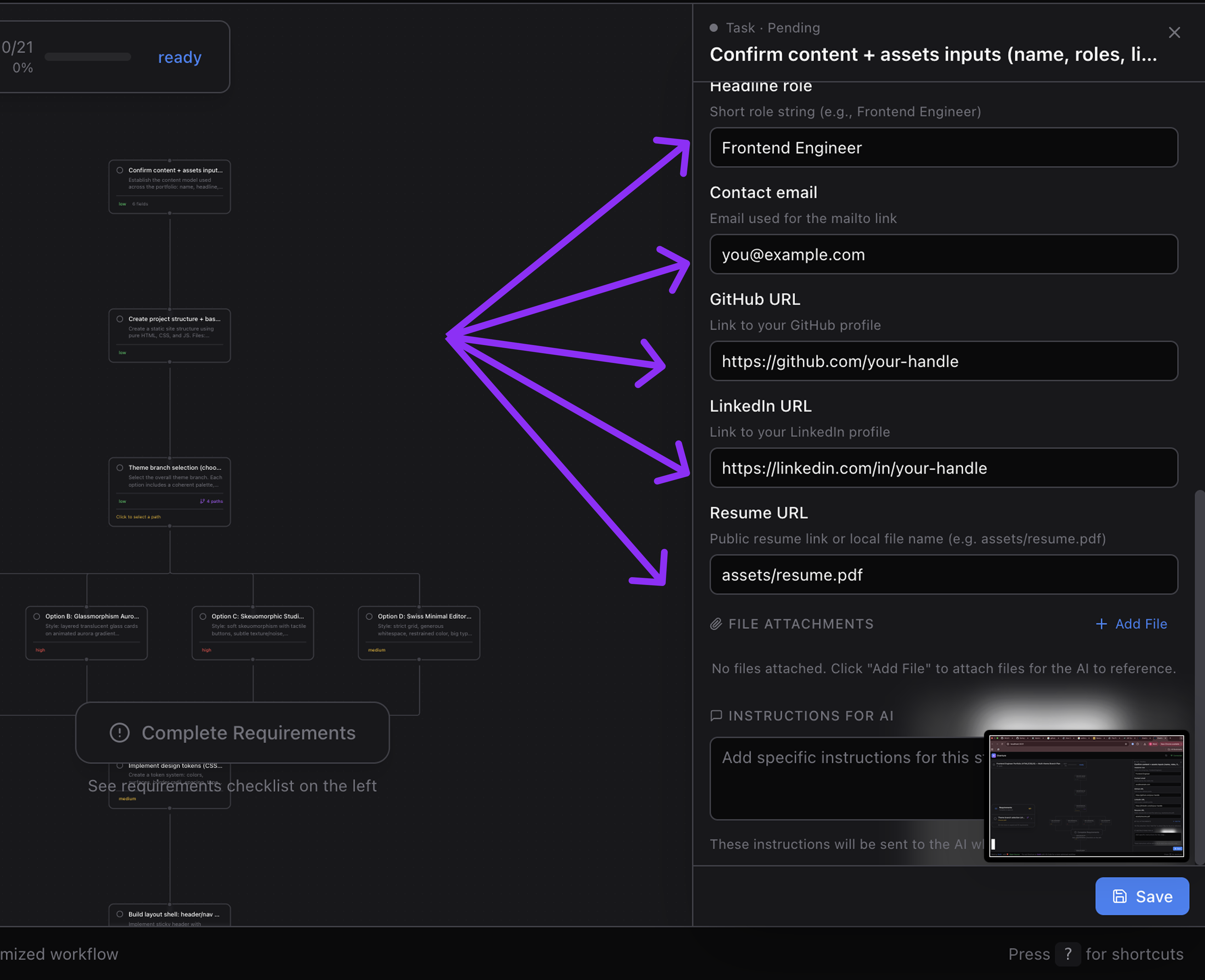
Nodes can request input from you before execution:
| Field Type | Use Case |
|---|---|
| String | Project names, URLs, custom values |
| Number | Port numbers, limits, counts |
| Boolean | Yes/No toggles for options |
| Select | Dropdown with predefined choices |
| Secret | API keys, tokens (masked input) |
| File | File paths to attach context |
Each field includes:
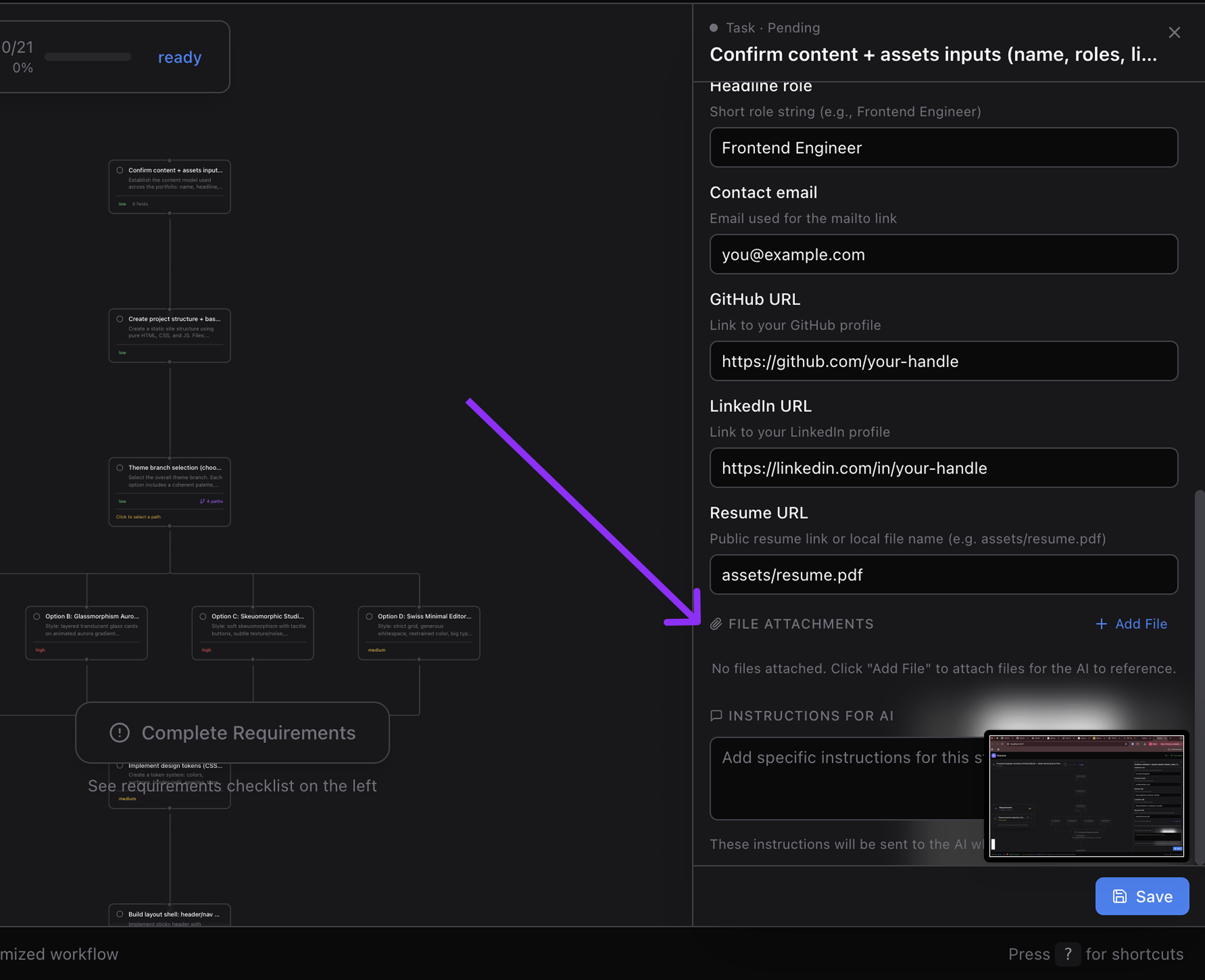
Attach context files to specific nodes:
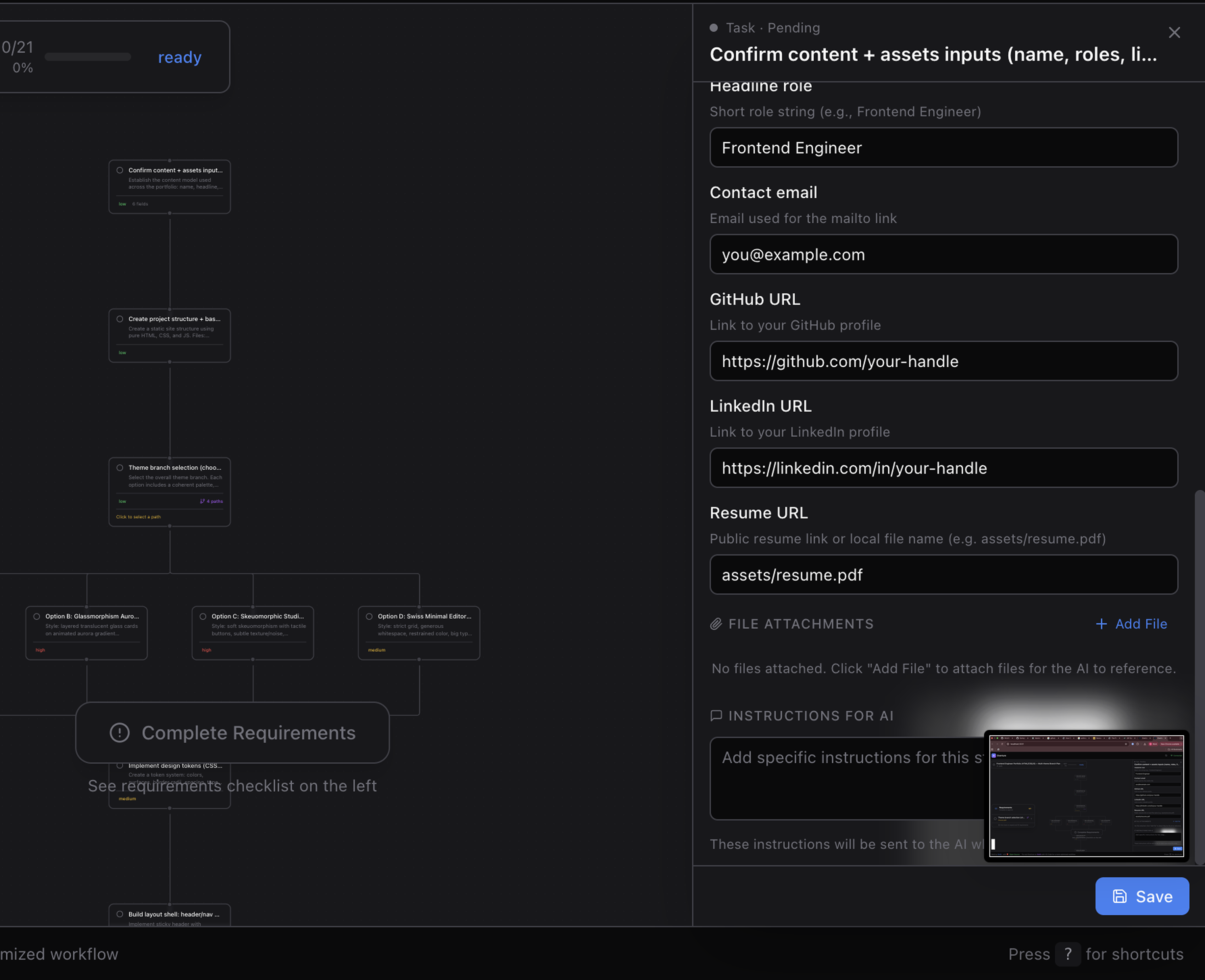
Add custom LLM instructions to any node:
"Pay special attention to error handling here" "Use the existing auth pattern from src/auth.ts" "Make sure to add tests for edge cases"
Instructions are sent to the agent right before that node executes.

When the agent proposes multiple approaches:
| Feature | Description |
|---|---|
| Auto-Detection | Branches detected from graph structure (no special markup) |
| Branch Points | Nodes with multiple outgoing edges become decision points |
| Selection Modal | Side-by-side comparison with pros/cons |
| Complexity Comparison | See difficulty level for each option |
| Visual Indicator | Selected branch highlighted on canvas |
| Skip Unselected | Only your chosen path executes |
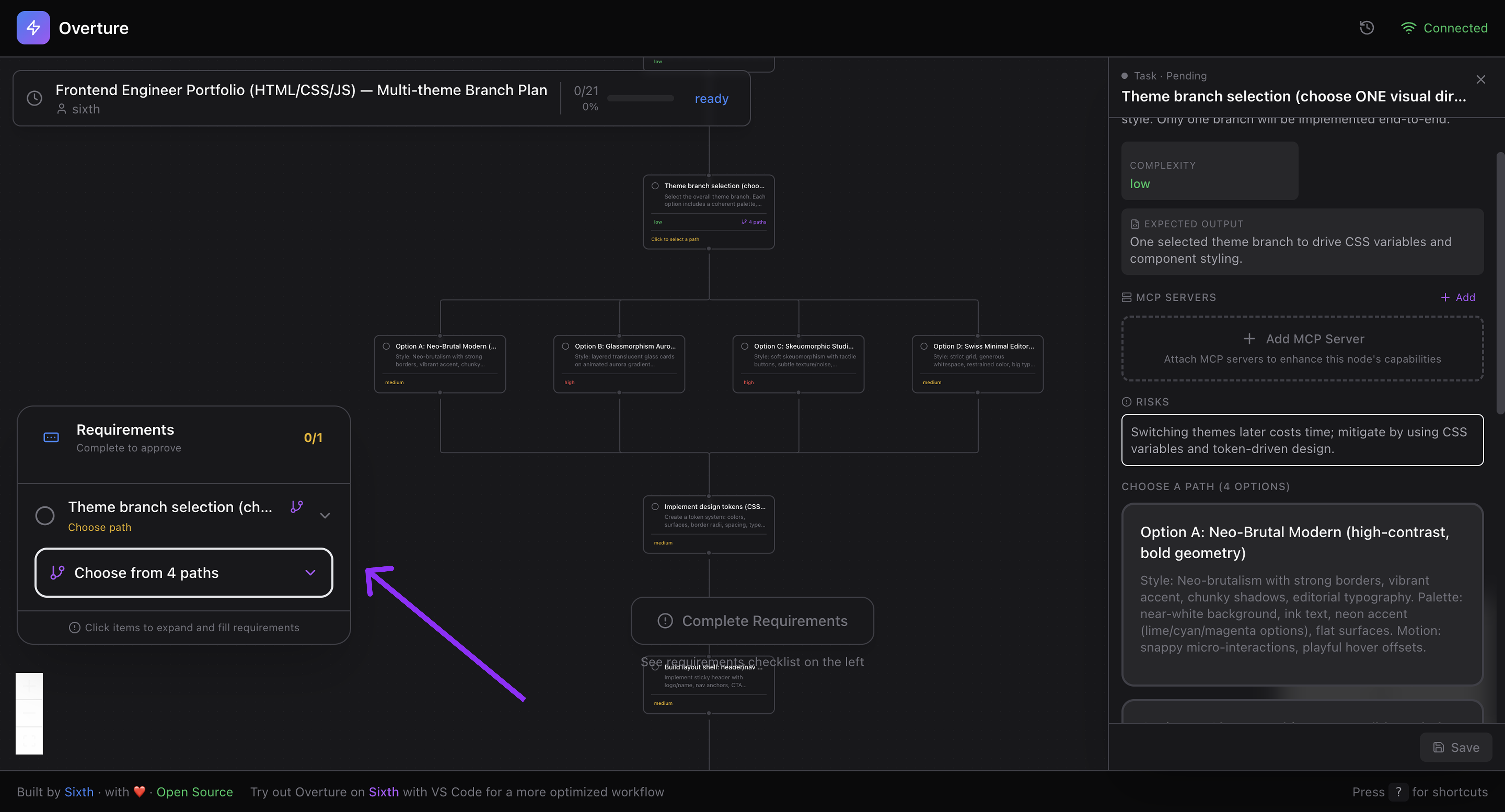
Before you can approve, Overture shows what's needed:
The Approve button stays disabled until all requirements are met.
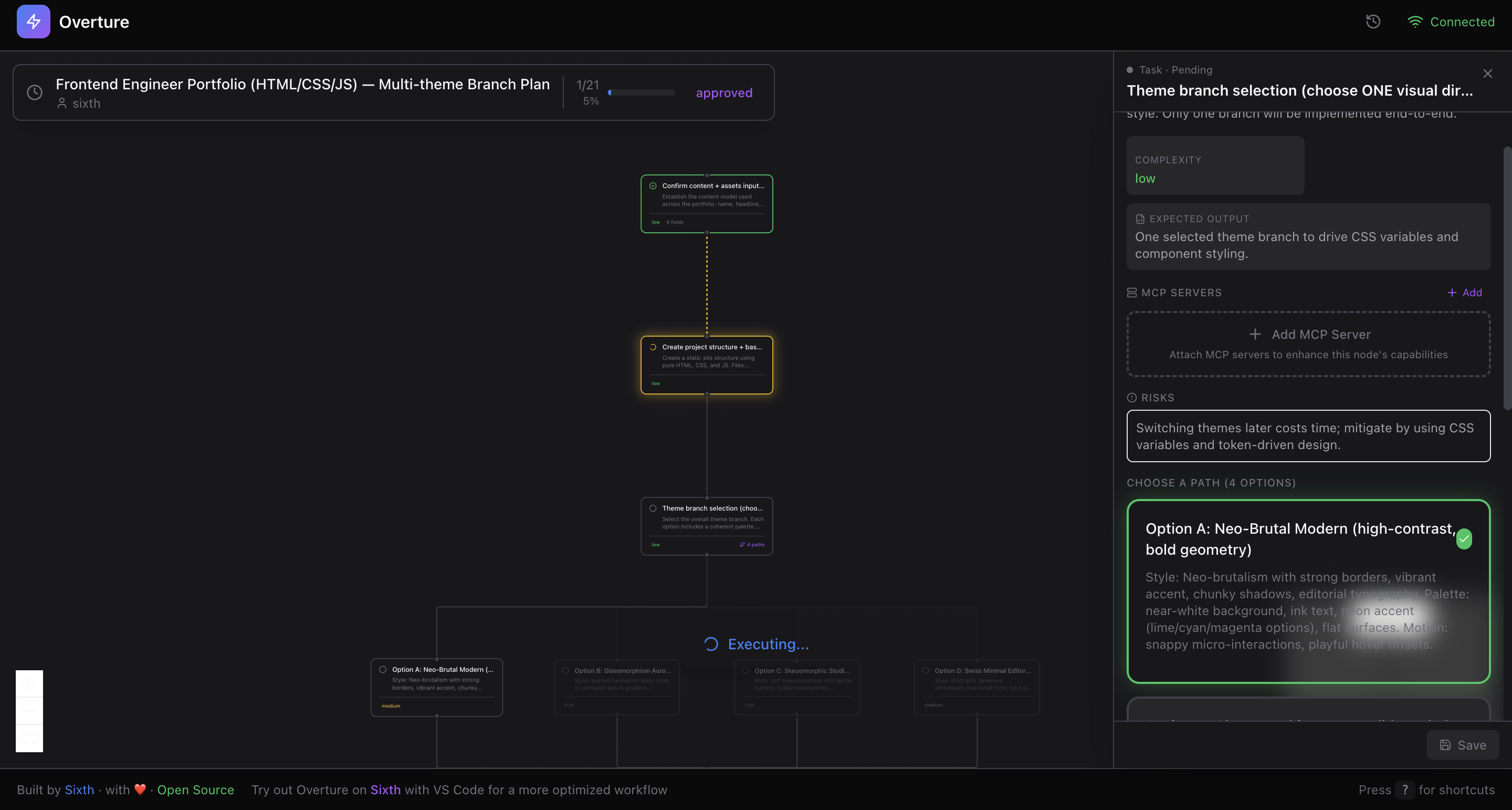
| Control | How |
|---|---|
| Approve | Click button or press Enter |
| Pause | Press Spacebar mid-execution |
| Resume | Press Spacebar again |
| Re-run Node | Click failed node → "Re-run" |
| Re-run From Here | Re-execute from any node to the end |
The approval button is smart:
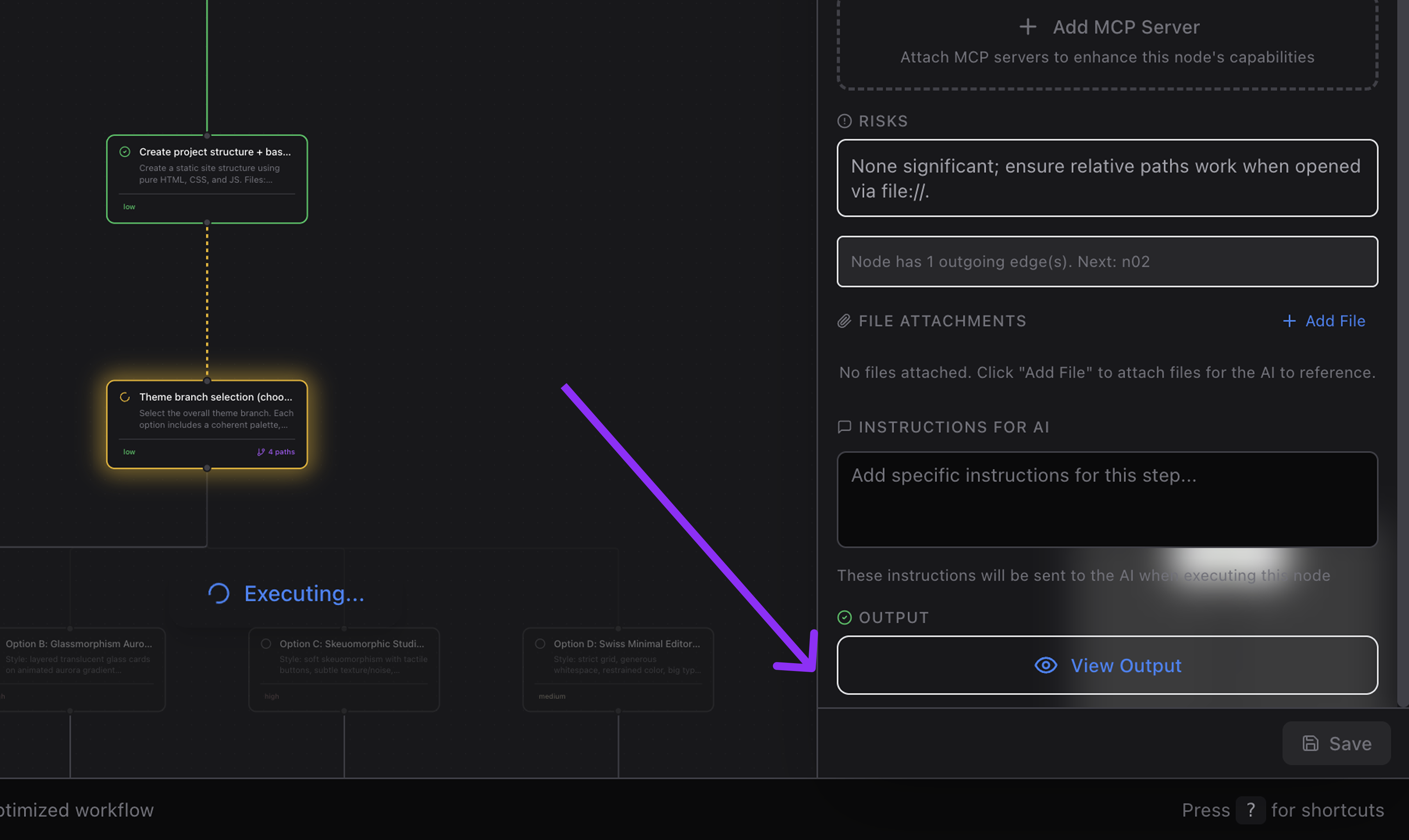
After each node executes, see rich structured output:
| Category | What It Shows |
|---|---|
| Overview | Summary of what was accomplished |
| Files Changed | Paths, lines added/removed, diffs |
| Files Created | New files with line counts |
| Files Deleted | Removed files |
| Packages Installed | npm packages with versions |
| MCP Servers Setup | Installation status (installed/configured/failed) |
| Web Searches | Queries performed, results used |
| Tool Calls | Which tools were used and how often |
| Preview URLs | Links to deployed sites or previews |
| Notes | Info, warnings, errors |
Each category is expandable — drill in without visual overload.
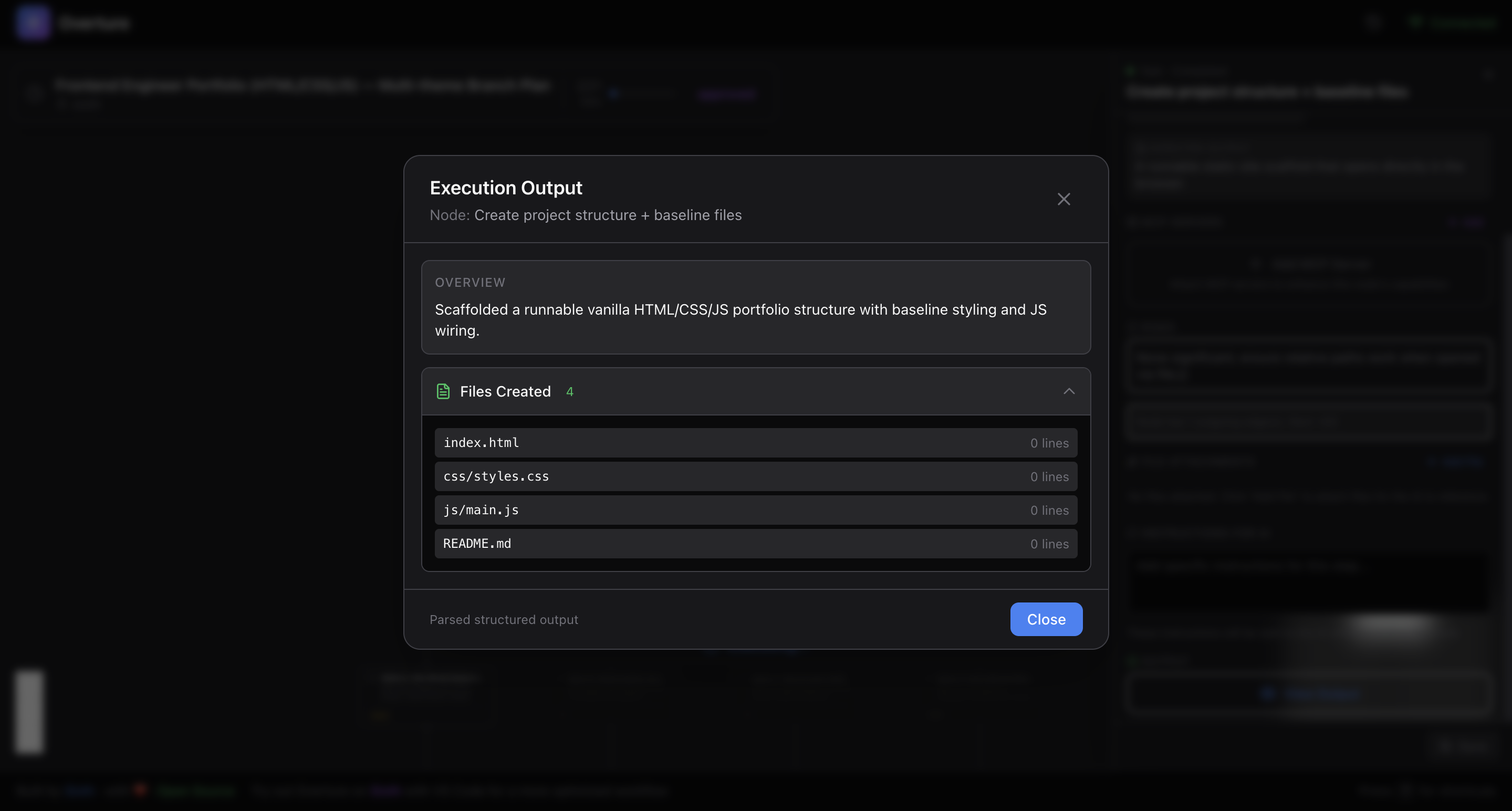
Click any completed node to see full output:
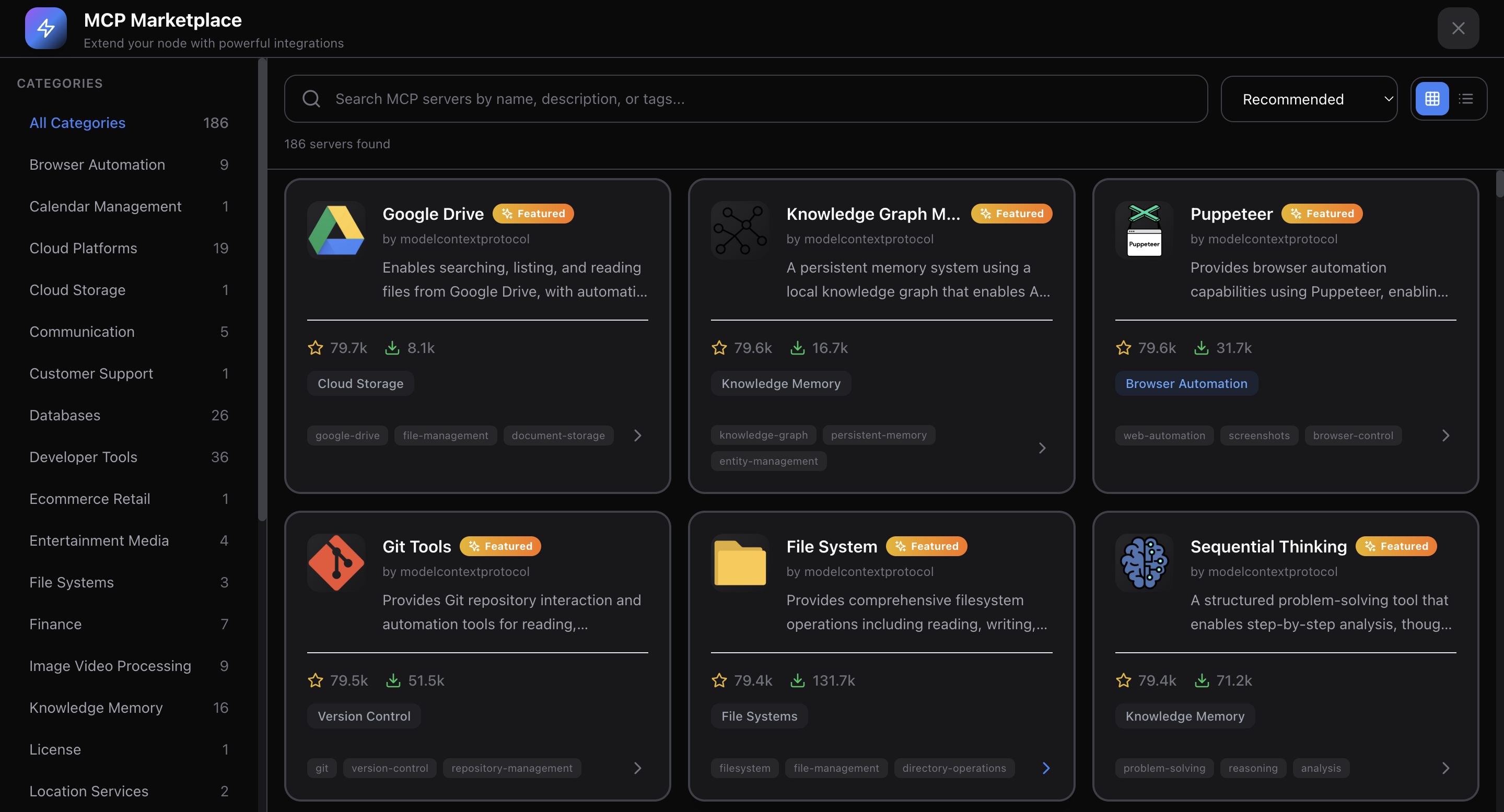
Browse and attach MCP servers directly from the Overture UI.
| Feature | Description |
|---|---|
| Built-in Marketplace | Search and discover MCP servers |
| Server Details | Descriptions, authors, GitHub links, stars |
| Category Browsing | Filter by use case |
| Per-Node Attachment | Attach specific tools to specific steps |
| Setup Instructions | See how to configure each server |
| Recommended Servers | Curated list for common tasks |
When you attach an MCP server to a node, the agent gains access to those tools only for that step.
Work on multiple projects simultaneously:
| Feature | Description |
|---|---|
| Tab Navigation | Switch between projects instantly |
| Auto Registration | Projects register on first agent contact |
| Isolated State | Each project has separate plans, nodes, configs |
| Unread Badges | Know when other projects have updates |
| Project Context | See project name, path, and agent type |
Single project? Tab bar hides automatically for a cleaner UI.
Never lose your work:
| Feature | Description |
|---|---|
| Auto-Save | Plans saved every 3 seconds |
| Local Storage | Stored in ~/.overture/history.json |
| History Browser | Slide-in panel with all past plans |
| Status Icons | Completed, failed, executing, paused |
| Progress Bars | Visual completion percentage |
| One-Click Resume | Load and continue any past plan |
| Full Context | All field values, branch selections, attachments preserved |
When resuming, you get complete context:
Modify plans even during execution:
| Operation | Description |
|---|---|
| Insert Nodes | Add new steps mid-execution |
| Remove Nodes | Delete steps (edges auto-reconnect) |
| Replace Content | Update node title/description in-place |
| Batch Operations | Multiple changes in one request |
When a plan changes, see exactly what's different:
Overture exposes 11 MCP tools for agents to interact with:
| Tool | Purpose |
|---|---|
submit_plan | Submit complete plan as XML |
get_approval | Wait for user approval (blocks until approved) |
update_node_status | Update node status + output during execution |
plan_completed | Mark plan as successfully completed |
plan_failed | Mark plan as failed with error message |
check_rerun | Check if user requested a node re-run |
check_pause | Check if user paused execution |
get_resume_info | Get full context for resuming a paused plan |
request_plan_update | Request incremental plan modifications |
create_new_plan | Signal creation of a new plan |
get_usage_instructions | Get agent-specific instructions |
19 server-to-client message types:
connected • plan_started • node_added • edge_added • plan_ready • plan_approved • node_status_updated • plan_completed • plan_failed • plan_paused • plan_resumed • nodes_inserted • node_removed • project_registered • projects_list • history_entries • plan_loaded • resume_plan_info • plan_updated
16 client-to-server message types:
approve_plan • cancel_plan • rerun_request • pause_execution • resume_execution • insert_nodes • remove_node • register_project • subscribe_project • unsubscribe_project • get_history • load_plan • get_resume_info • save_plan • request_plan_update • create_new_plan
When the WebSocket port is already in use, Overture automatically operates as a relay client, forwarding messages through the existing server. Multiple agent instances can share a single UI.
| Variable | Default | Description |
|---|---|---|
OVERTURE_HTTP_PORT | 3031 | Port for the web UI |
OVERTURE_WS_PORT | 3030 | Port for WebSocket |
OVERTURE_AUTO_OPEN | true | Auto-open browser on start |
claude mcp add overture-mcp -e OVERTURE_HTTP_PORT=4000 -e OVERTURE_AUTO_OPEN=false -- npx overture-mcp
{
  "mcpServers": {
    "overture": {
      "command": "npx",
      "args": ["overture-mcp"],
      "env": {
        "OVERTURE_HTTP_PORT": "4000",
        "OVERTURE_WS_PORT": "4001",
        "OVERTURE_AUTO_OPEN": "false"
      }
    }
  }
}
{
  "servers": {
    "overture": {
      "command": "npx",
      "args": ["overture-mcp"],
      "env": {
        "OVERTURE_HTTP_PORT": "4000",
        "OVERTURE_WS_PORT": "4001",
        "OVERTURE_AUTO_OPEN": "false"
      }
    }
  }
}
| Key | Action |
|---|---|
Enter | Approve plan (when ready) |
Space | Pause / Resume execution |
Escape | Deselect current node / Close modal |
| Agent | Status | Notes |
|---|---|---|
| Claude Code | ✅ Full | Native MCP support |
| Cursor | ✅ Full | Via mcp.json config |
| Cline | ✅ Full | Via VS Code settings |
| GitHub Copilot | ✅ Full | VS Code 1.99+ required |
| Sixth AI | ✅ Full | Built-in, zero config |
Each agent has custom-tailored prompts for optimal plan generation.
For Users
|
For AI Coding
|
# Clone the repo
git clone https://github.com/SixHq/Overture.git
cd Overture

# Install dependencies
npm install

# Build all packages
npm run build

# Start MCP server (in one terminal)
cd packages/mcp-server && npm start

# Start UI dev server (in another terminal)
cd packages/ui && npm run dev
| Layer | Technologies |
|---|---|
| MCP Server | Node.js, TypeScript, Express, WebSocket (ws), SAX XML Parser |
| UI | React 18, React Flow, Zustand, Framer Motion, Tailwind CSS, Vite |
| Layout | Dagre (automatic graph positioning) |
Overture is open source and we welcome contributions!
All contributions are appreciated, no matter how small.
MIT License - see LICENSE for details.

Built by Sixth
For the best experience, try Sixth for VS Code
Overture is built-in with zero configuration required.
Stop flying blind. See the plan. Approve it. Execute with confidence.
Run Claude Code as an MCP server so any agent can delegate coding tasks to it
 @microsoft✓ Official
Browser automation using accessibility snapshots instead of screenshots
 @googleapis✓ Official
Google's universal MCP server supporting PostgreSQL, MySQL, MongoDB, Redis, and 10+ databases
 @github✓ Official
Official GitHub integration for repos, issues, PRs, and CI/CD workflows