

Are you the author? Sign in to claim
AI-powered QA pipeline: Playwright tests + Claude API agent that classifies failures, auto-heals broken locators via PR,
AI-powered QA pipeline: Playwright tests + an LLM-driven failure agent that classifies failures and (in later phases) reports bugs or opens healing PRs.
CI License: MIT Node
When an end-to-end test fails, teams lose time deciding whether the problem is a broken locator, a real regression, flaky timing, or a CI/environment issue. This project turns that decision into a repeatable pipeline step. GitHub Actions runs Playwright and preserves artifacts. The local/dev agent reads failure context from test-results/results.json and classifies failures using a configurable provider.
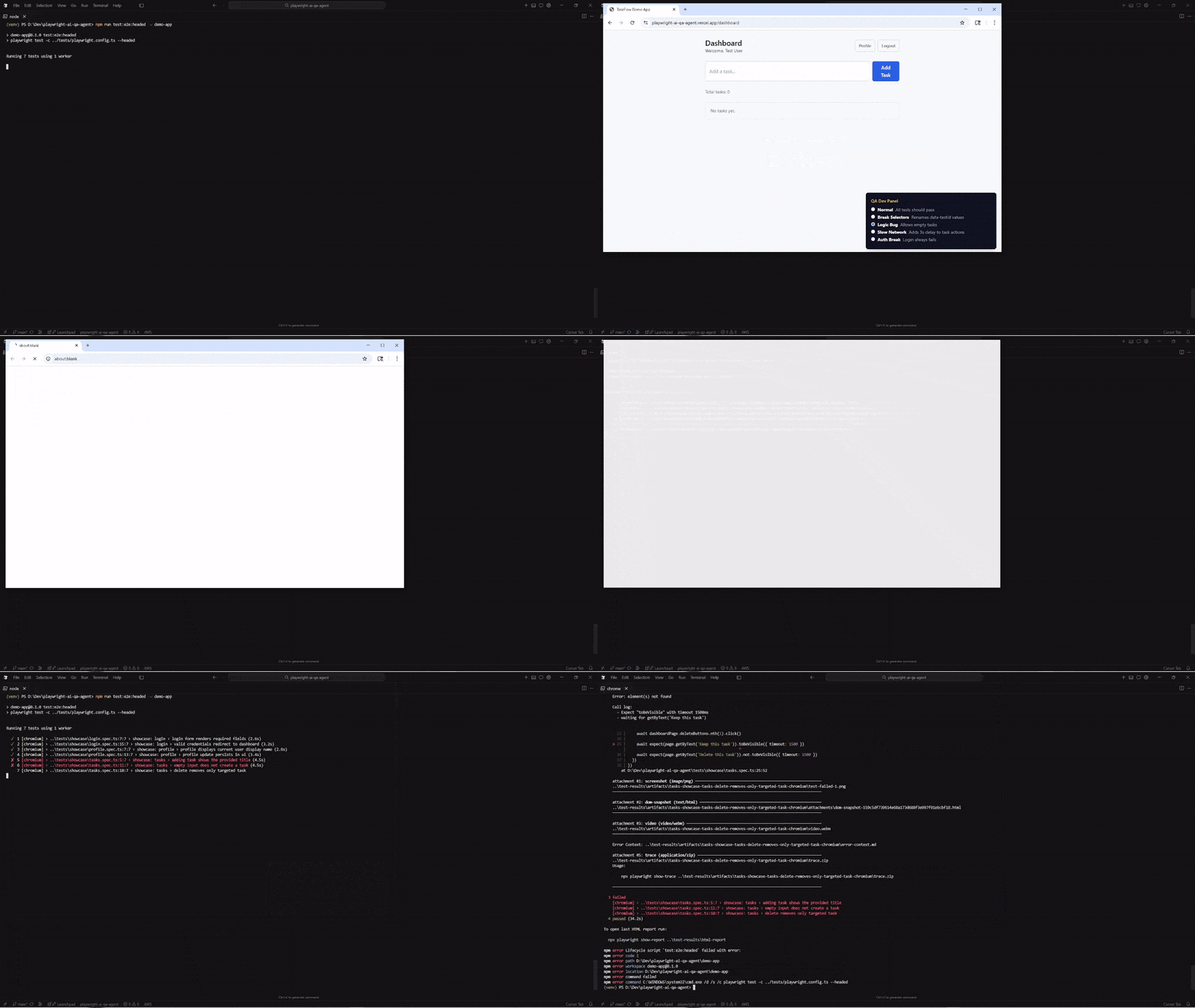
Headed Playwright run against TaskFlow with slow motion so the flow is easy to follow.
GitHub Actions
  |
  v
Run Playwright tests (JSON + HTML reports, screenshots/traces)
  |
  +-- success ------------------------------> ✅ Job passes
  |
  +-- failure
       |
       v
   Agent reads Playwright results.json + failure context
       |
       v
   Claude API classifies failure
       |
  +--> BROKEN_LOCATOR  ---> create `AUTOMATION_BUG` Issue (+ optional linked healer PR)
       |
       +--> REAL_BUG        ---> create GitHub Issue with failure context
       |
       +--> FLAKY           ---> log only (no automated write action)
       |
       +--> ENV_ISSUE       ---> log only (no automated write action)
       |
       v
   CI ends failed (PR checks are red, artifacts preserved)
| Layer | Technology |
|---|---|
| Test framework | Playwright (@playwright/test) |
| Language | TypeScript (Node runtime) |
| CI | GitHub Actions |
| AI model | Configurable (mock, anthropic, openai, google, ollama) |
| Bug tracking | GitHub Issues + Pull Requests |
| Deployment | Vercel (demo app target) |
test-results/results.json, extracts failed test cases, and loads the failing test source from the repo.BROKEN_LOCATOR and confidence is above a threshold, the agent creates a GitHub Issue titled with AUTOMATION_BUG and includes the locator that needs an update plus suggested fix direction.REAL_BUG and confidence is above a threshold, the agent creates a GitHub Issue with the error details and CI run link.This README is organized into four sections: Demo app → Playwright tests → LLM failure agent → CI (GitHub Actions).
TaskFlow is a small Next.js task manager (localStorage, no DB) used as the system under test. It ships Break Modes so you can simulate locator bugs, logic bugs, flaky timing, and auth failures.
| Resource | Link |
|---|---|
| Production | playwright-ai-qa-agent.vercel.app |
| Playwright HTML report (GitHub Pages) | nirarad.github.io/playwright-ai-qa-agent |
Build and run locally (Node 20+; from repository root after git clone and npm ci):
cd demo-app
npm install
npm run dev
Production build: npm run build and npm run start inside demo-app/, or from the repo root npm run build / npm run start (workspace scripts target demo-app).
Break modes (also passed to Playwright as QA_MODE):
| Break Mode | What it simulates |
|---|---|
selector-change | data-testid / DOM changes → automation locators break |
logic-bug | Wrong app behavior → product bug |
slow-network | Artificial latency → timing-sensitive failures |
auth-break | Login always fails |
Optional browser-only preset: add ?qaMode=… to the URL (none, selector-change, logic-bug, slow-network, auth-break). The value is stored in sessionStorage for that tab.
tests/playwright.config.tsnpm run … -w demo-appdemo-app/: same npm run test:e2e / test:e2e:headed without -w demo-appExecution parameters:
| Variable | Role |
|---|---|
BASE_URL | Target app (default http://localhost:3000). Set to the Vercel URL to test production without a local server. |
QA_MODE | Break mode: none, selector-change, logic-bug, auth-break, slow-network. |
PLAYWRIGHT_SLOW_MO | Optional milliseconds between actions (slowMo). Omit or 0 for full speed; use e.g. 400 with headed runs when recording. |
Headless run: use npm run test:e2e -w demo-app instead of test:e2e:headed. PowerShell does not support VAR=value cmd; use $env:VAR='…' below.
PowerShell — one session, all parameters, headed run against production:
$env:BASE_URL='https://playwright-ai-qa-agent.vercel.app'
$env:QA_MODE='none'
$env:PLAYWRIGHT_SLOW_MO='400'
npm run test:e2e:headed -w demo-app
Bash / Git Bash / WSL / macOS / Linux — same parameters on one invocation:
BASE_URL=https://playwright-ai-qa-agent.vercel.app QA_MODE=none PLAYWRIGHT_SLOW_MO=400 npm run test:e2e:headed -w demo-app
For a local dev server, drop BASE_URL or set BASE_URL=http://localhost:3000. $env: / shell exports last for that terminal session. Built-in video is retain-on-failure; set video: 'on' in the config if you want a clip per test, or record the headed window externally.
The agent reads Playwright’s JSON report at the repository root (test-results/results.json; the agent process uses ../test-results/results.json because npm run agent runs with cwd agent/), builds failure context, and calls a configurable LLM to classify the failure.
Setup
npm ci (workspaces install agent/ and demo-app/)..env as needed — see Environment Variables (ANTHROPIC_API_KEY, OPENAI_API_KEY, GOOGLE_API_KEY, Ollama URL, etc.). The agent loads repository root .env first, then agent/.env if present; variables already set in the shell are left unchanged. Put GITHUB_TOKEN and GITHUB_REPOSITORY in the root .env for local issue/PR actions.Run (after a test run has produced results; failures are the usual case):
npm run agent
npm run agent:local-results (root) runs the agent with debug logs and sets AGENT_RESULTS_JSON_PATH to the repo-root Playwright output (../test-results/results.json from the agent/ package cwd). It uses cmd set syntax. In PowerShell, set $env:AGENT_LOG_LEVEL='debug', then npm run agent (the default path already points at the repo test-results/results.json).
PowerShell — mock provider and explicit results path:
$env:AI_PROVIDER='mock'
$env:AGENT_RESULTS_JSON_PATH='../test-results/results.json'
npm run agent
PowerShell — Ollama on localhost:
$env:AI_PROVIDER='ollama'
$env:AI_MODEL='qwen2.5:7b'
$env:OLLAMA_BASE_URL='http://127.0.0.1:11434'
$env:AGENT_LOG_LEVEL='debug'
$env:AGENT_RESULTS_JSON_PATH='../test-results/results.json'
$env:AGENT_ENABLE_BUG_ISSUE='true'
$env:AGENT_ENABLE_HEAL_PR='true'
npm run agent

# Optional — GitHub Issues for REAL_BUG / BROKEN_LOCATOR / ENV_ISSUE when confidence clears the threshold (token needs `issues:write`):
# $env:AGENT_ENABLE_BUG_ISSUE='true'
# $env:GITHUB_TOKEN='<personal access token>'
# $env:GITHUB_REPOSITORY='owner/repo'
# Optional — healer PR for BROKEN_LOCATOR (same token needs `contents` + `pull-requests`):
# $env:AGENT_ENABLE_HEAL_PR='true'
By default no issue or PR is created; set the optional GITHUB_* variables when enabling issue or healer actions. 401 Bad credentials from the GitHub API means GITHUB_TOKEN is missing, expired, or not allowed to access GITHUB_REPOSITORY—use a token with repo (classic PAT) or fine-grained access including Issues (and Contents / Pull requests for the healer) on that repository.
Ollama in Docker (optional): docker build -t qa-agent-ollama ./ollama then docker run … or docker compose -f ollama/docker-compose.yml up --build -d. See ollama/ and the NVIDIA / CPU-only notes in that folder’s compose files. Point OLLAMA_BASE_URL at the container (http://127.0.0.1:11434 by default).
Failure classification (what the LLM returns):
| Category | Typical cause | Automated follow-up (when features are enabled in CI and confidence passes gates) |
|---|---|---|
BROKEN_LOCATOR | Locator / DOM mismatch (data-testid, etc.) | AUTOMATION_BUG issue; optional healer PR |
REAL_BUG | App logic / assertion failure | GitHub Issue with failure context |
FLAKY | Timing / ordering | Log only |
ENV_ISSUE | Missing env, connectivity, CI config | Log only |
Workflow: .github/workflows/playwright.yml.
Triggers
main / developqa_mode (none | selector-change | logic-bug | auth-break | slow-network), optional toggles enable_agent_reporter / enable_agent_healer, optional llm_provider (anthropic | openai | google)What runs
npm ci, install Playwright Chromium (npx playwright install chromium --with-deps)npx playwright test -c tests/playwright.config.ts with BASE_URL set to the public demo and QA_MODE from the dispatch input (or none). Step uses continue-on-error: true so artifacts always upload when tests fail.test-results/ as an artifact; on pushes to main / develop (not on pull_request events), publish the HTML report to GitHub Pages — see workflow if: conditions.AGENT_ENABLE_IN_CI=true, secrets for LLMs, and repo variables / dispatch inputs controlling issue and healer behavior.Configure GitHub Secrets (e.g. ANTHROPIC_API_KEY, provider keys) and repository Variables as described in the workflow and in Environment Variables. Phase 1 may keep some agent write paths off by default; see AGENT_ENABLE_IN_CI and related flags in the tables below.
Manual run: Actions → Playwright + AI QA Agent → Run workflow, choose qa_mode and optional agent/LLM inputs, then inspect artifacts and the agent step log.
.
├── .cursor/rules/          # Editor / agent conventions
├── .github/workflows/    # CI (Playwright + agent)
├── agent/                  # LLM failure agent (TypeScript)
├── demo-app/               # Next.js TaskFlow app
├── tests/                  # Playwright config + showcase tests
├── ollama/                 # Optional Docker image for local Ollama
└── docs/                   # Design and phase plans
| Variable | Required | Default | Description |
|---|---|---|---|
AGENT_RESULTS_JSON_PATH | No | ../test-results/results.json (relative to agent/ when using npm run agent) | Path to Playwright JSON results file |
AGENT_CONFIDENCE_THRESHOLD | No | 0.75 | Minimum confidence gate for downstream decisions |
AGENT_MAX_FAILURES_PER_RUN | No | 3 | Maximum failures to process per run |
AGENT_ENABLE_IN_CI | No | false | Enable agent execution in CI (Phase 1 default is disabled) |
AGENT_ENABLE_BUG_ISSUE | No | false | Enable GitHub Issue creation when confidence is above threshold |
AGENT_ENABLE_HEAL_PR | No | false | Enable healer PR creation for BROKEN_LOCATOR when confidence is above threshold |
AGENT_ISSUE_LABELS | No | bug,automated-qa | Comma-separated labels applied to created issues |
AGENT_GITHUB_BASE_BRANCH | No | main | Base branch for healer PRs |
AGENT_INTER_REQUEST_DELAY_MS | No | 750 | Delay between processing failures |
AGENT_LOG_LEVEL | No | info | Log level: debug, info, warn, error |
AGENT_LOG_PRETTY | No | false | Pretty-print logs with multiline context |
GITHUB_API_URL | No | https://api.github.com | GitHub API base URL override (useful for GHES) |
DEMO_APP_URL | Yes (CI) | n/a | Public URL of the deployed TaskFlow app used by Playwright in GitHub Actions |
BASE_URL | No | http://localhost:3000 | Playwright target (local dev server or deployed URL) |
QA_MODE | No | none | Optional mode for showcase test runs (none, selector-change, logic-bug, auth-break, slow-network) |
PLAYWRIGHT_SLOW_MO | No | unset | Milliseconds between browser operations (launchOptions.slowMo) for slower, easier-to-record headed runs |
GITHUB_TOKEN | Yes (CI, provided) | provided by Actions | Used for Issues/PRs GitHub API calls |
GITHUB_REPOSITORY | Yes (CI, provided) | provided by Actions | owner/repo used for GitHub API calls |
GITHUB_RUN_ID | Yes (CI, provided) | provided by Actions | Used to construct the CI run URL for linking in Issues/PRs |
GITHUB_REF_NAME | Yes (CI, provided) | provided by Actions | Branch name used in issue context |
GITHUB_SHA | Yes (CI, provided) | provided by Actions | Commit SHA used in issue context |
| Variable | Required | Description |
|---|---|---|
AI_PROVIDER | No | Provider selection: mock, anthropic, openai, google, ollama (default: mock) |
AI_MODEL | No | Model name passed to the selected provider |
AGENT_MAX_TOKENS_CLASSIFY | No | Token budget for classification calls (default: 600) |
AGENT_TEMPERATURE_CLASSIFY | No | Temperature for classification calls (default: 0) |
AGENT_MAX_TOKENS_HEAL | No | Token budget for healer generation calls (default: 14000) |
AGENT_TEMPERATURE_HEAL | No | Temperature for healer generation calls (default: 0) |
AGENT_LLM_MAX_ATTEMPTS | No | LLM request retry attempts (default: 3) |
AGENT_LLM_RETRY_INITIAL_DELAY_MS | No | Initial retry delay (default: 1000) |
AGENT_LLM_RETRY_MAX_DELAY_MS | No | Max retry delay cap (default: 8000) |
| Variable | Required | Description |
|---|---|---|
ANTHROPIC_API_KEY | Conditionally | Required when AI_PROVIDER=anthropic |
| Variable | Required | Description |
|---|---|---|
OPENAI_API_KEY | Conditionally | Required when AI_PROVIDER=openai |
OPENAI_BASE_URL | Optional | Override OpenAI API base URL (default: https://api.openai.com/v1) |
| Variable | Required | Description |
|---|---|---|
GOOGLE_API_KEY | Conditionally | Required when AI_PROVIDER=google |
GOOGLE_BASE_URL | Optional | Override Google API base URL (default: https://generativelanguage.googleapis.com/v1beta/models) |
| Variable | Required | Description |
|---|---|---|
OLLAMA_BASE_URL | Conditionally | Ollama base URL when AI_PROVIDER=ollama (default: http://127.0.0.1:11434) |
OLLAMA_REQUEST_TIMEOUT_MS | Optional | Abort Ollama /api/generate after this many ms (0 or unset = no limit). Large prompts on CPU can take many minutes |
AGENT_CLASSIFY_MAX_DOM_CHARS | Optional | Cap DOM snapshot chars in classification prompts for any LLM (default 8000; unset falls back to AGENT_OLLAMA_MAX_DOM_CHARS) |
AGENT_CLASSIFY_MAX_ERROR_CONTEXT_CHARS | Optional | Cap error-context / Playwright error messages in classification prompts (default 6000; fallback AGENT_OLLAMA_MAX_ERROR_CONTEXT_CHARS) |
AGENT_CLASSIFY_MAX_TEST_SOURCE_CHARS | Optional | Cap test file source in classification prompts (default 10000; fallback AGENT_OLLAMA_MAX_TEST_SOURCE_CHARS) |
AGENT_OLLAMA_MAX_DOM_CHARS | Optional | Legacy alias when AGENT_CLASSIFY_MAX_DOM_CHARS is unset (default 8000) |
AGENT_OLLAMA_MAX_ERROR_CONTEXT_CHARS | Optional | Legacy alias when AGENT_CLASSIFY_MAX_ERROR_CONTEXT_CHARS is unset (default 6000) |
AGENT_OLLAMA_MAX_TEST_SOURCE_CHARS | Optional | Legacy alias when AGENT_CLASSIFY_MAX_TEST_SOURCE_CHARS is unset (default 10000) |
AGENT_OLLAMA_MAX_CLASSIFY_PREDICT | Optional | Max decode tokens per classify call for ollama (default 384; lowers latency vs AGENT_MAX_TOKENS_CLASSIFY) |
AGENT_OLLAMA_NUM_CTX_MIN | Optional | Lower bound for Ollama num_ctx (default 4096) |
AGENT_OLLAMA_NUM_CTX_MAX | Optional | Upper bound for Ollama num_ctx (default 16384; trim prompts before raising) |
OLLAMA_API_KEY | Optional | Optional key if Ollama endpoint is behind auth/proxy |
REAL_BUG and repeated FLAKY failuresMIT
⚠️ Experimentelle Skill-Sammlung für deutsches Recht (Arbeits-, Gesellschafts-, Insolvenz-, Datenschutz-, Prozessrecht u
Manage multiple Claude Code agents from TUI or Web with tmux and git worktrees
Project management using GitHub Issues + Git worktrees for parallel agent execution
Core skills library for Claude Code with 20+ battle-tested skills including TDD, debugging, and brainstorming