

Are you the author? Sign in to claim
Build portable agent teams across models and harnesses, with shared memory, skills, tools, and workflows — then bring th

English | 简体中文
Build Your Agent Team Once. Use It Everywhere.
Build portable AI agent teams across models and harnesses — combine the right models, tools, context, and workflows for each task. Run them directly through Pragma Desktop or CLI; bring them into Codex, Claude Code, and other tools without changing your workflow; or integrate them into your own AI system with the SDK.




Download · Quick start · Document · Examples
Pragma is a cross-harness platform for turning AI-native working methods into runnable, reusable agent teams. A team can combine Experts, ExpertTeams, Flows, tools, Skills, shared context, memory, permissions, and human checkpoints—not just a prompt.
Unlike a single chat product or Coding Agent, Pragma treats the Agent Team and its working method as the portable unit. Define it as YAML DSL and build it in Desktop. The CLI integration is currently in development and will support direct invocation plus export as MCP or Skills. Or embed the same team in your own application with the SDK.
During a Mission, work can move between specialists without losing decisions, artifacts, or accumulated experience. The same team can coordinate different models and harnesses for different steps while keeping context, permissions, handoffs, and execution under one governance model.
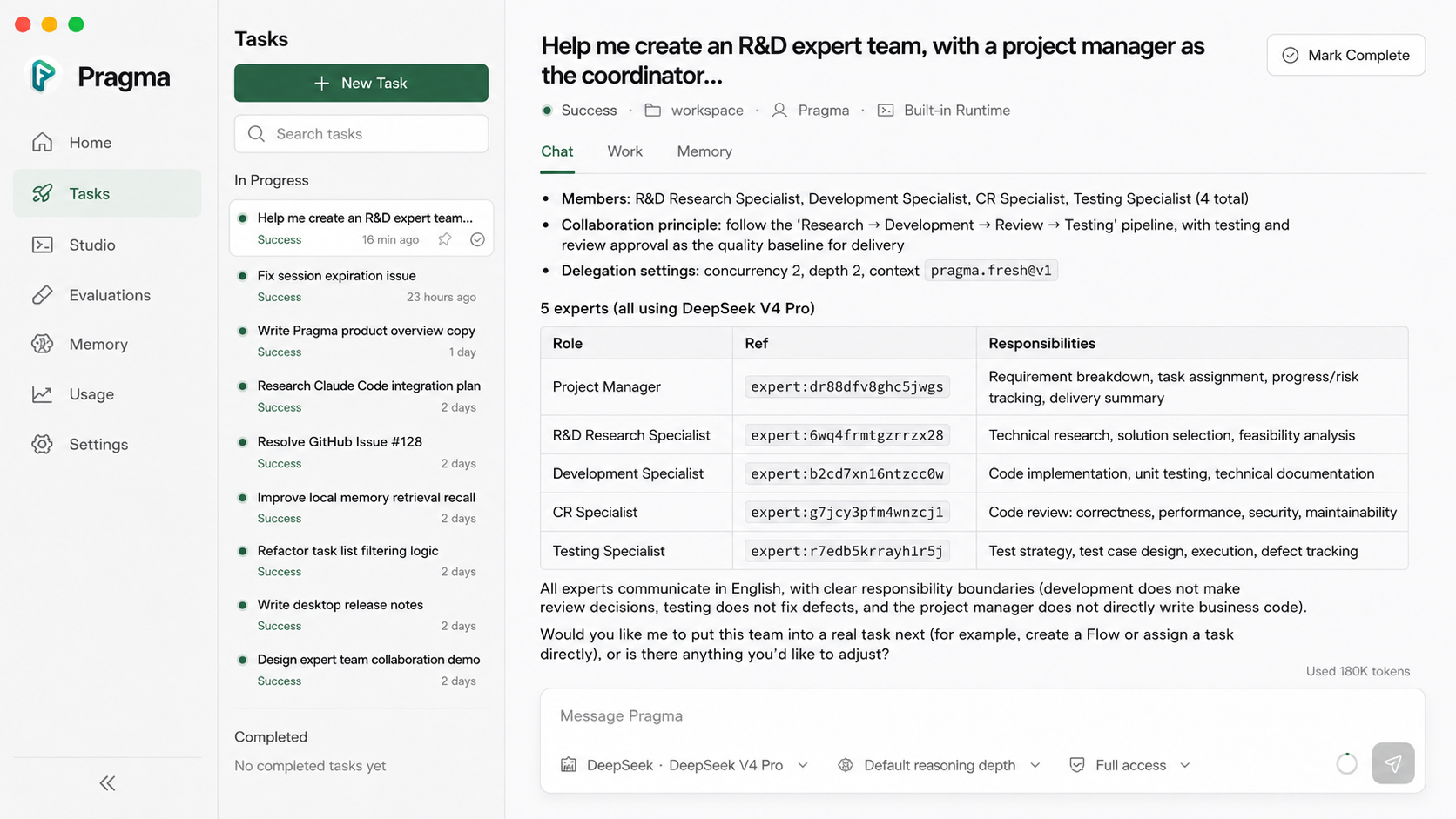
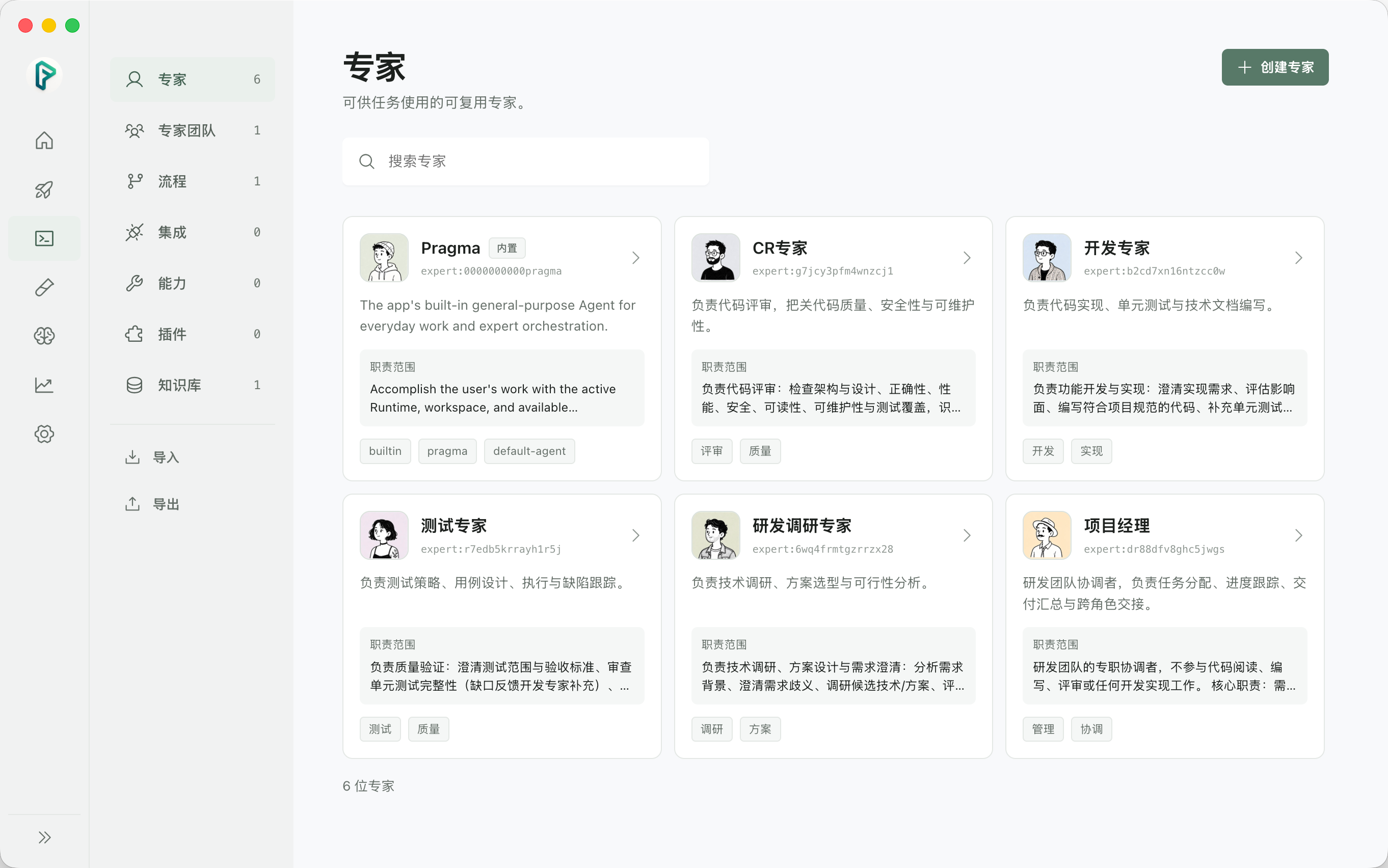
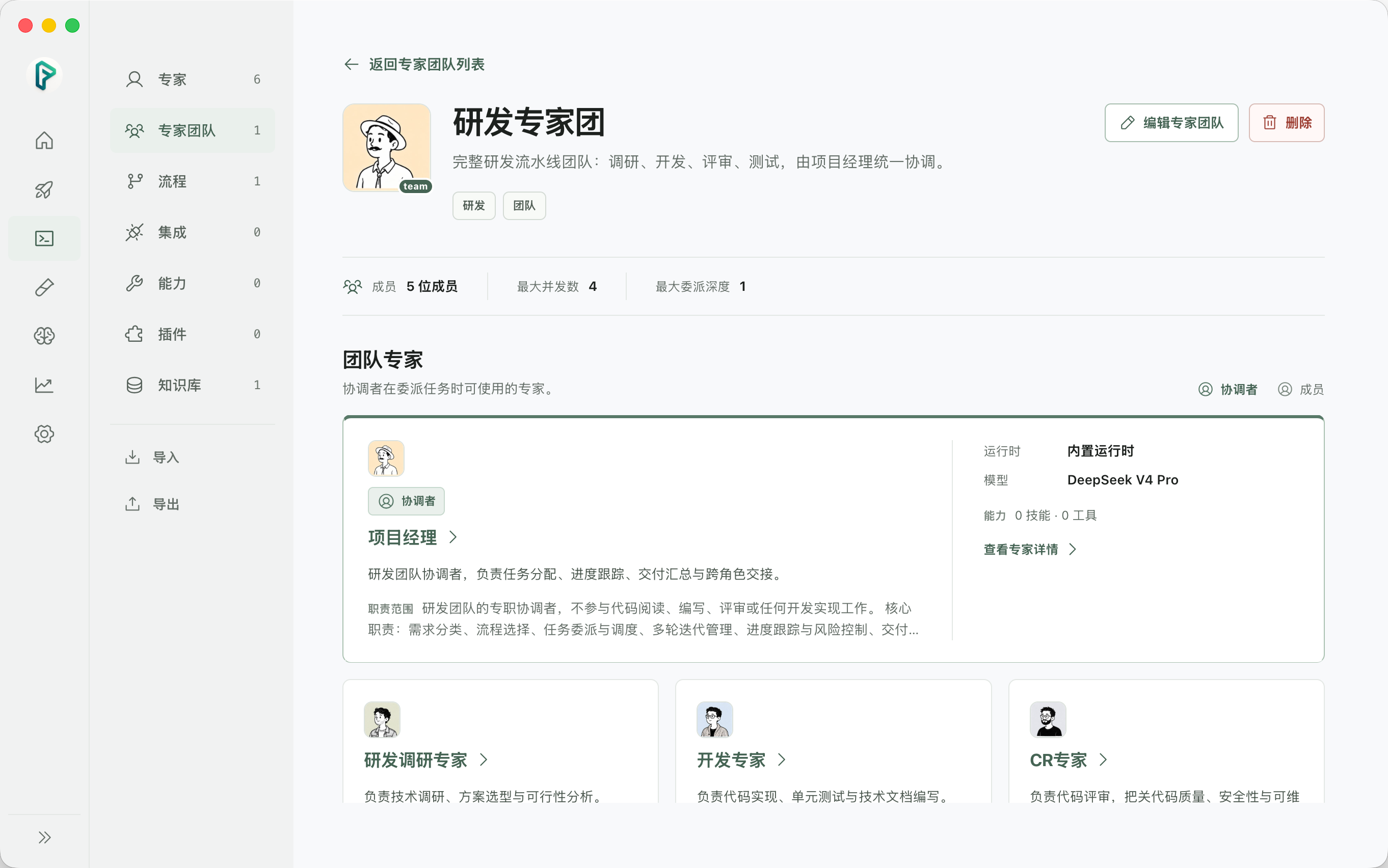
[!IMPORTANT] Pragma is currently a preview. The latest Desktop release provides unsigned builds for macOS Apple Silicon and Intel. See Current status before adopting it for critical work.
Download the package for your Mac from GitHub Releases, install it, and then:
The current app is not code-signed. To open a Desktop release, use this order:
sudo xattr -r -d com.apple.quarantine /Applications/Pragma.app
You do not need to change the global Allow apps downloaded from setting for this unsigned release.
The Desktop distribution guide explains the release contents, checksums, and limitations.
Requirements: Node.js 22 or later and pnpm 10.12.1.
git clone https://github.com/pqpo/pragma.git
cd pragma
pnpm install --frozen-lockfile
pnpm --filter @pragma/desktop dev
Development builds use ~/.pragma-development/ by default so unreleased storage migrations cannot
modify data owned by the installed Desktop app. Set PRAGMA_HOME explicitly only when a task
intentionally needs another isolated data root.
The repository includes runnable examples rather than abbreviated API fragments:
# ContextStore operations; no model credentials required
pnpm --filter @pragma/examples example:context

# Use an installed and authenticated local agent CLI
pnpm --filter @pragma/examples example:runtime-codex
pnpm --filter @pragma/examples example:runtime-claude-code
See the examples guide for Expert sessions, delegation, ExpertTeams, Flows, human review gates, MCP, Skills, plugins, memory, recovery, and portable bundles.
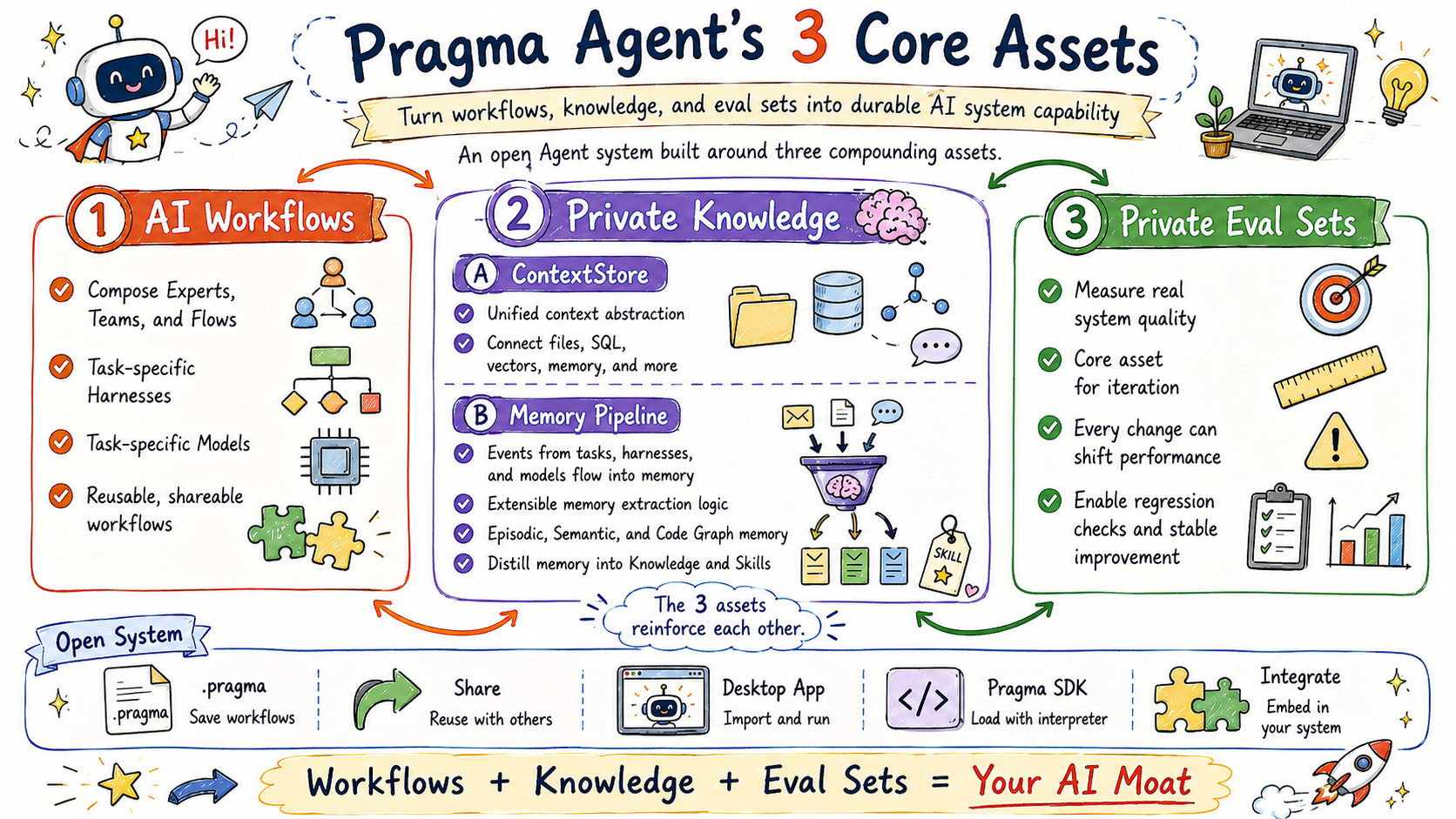
Compose Experts, ExpertTeams, Flows, subflows, tools, and human checkpoints. Each step can bind the model, agent harness, permissions, and context that fit the task. The resulting method can be versioned, evaluated, exported, and shared.
Pragma treats context as a Host-owned ContextStore instead of trapping it inside one chat product. Events from different tasks, harnesses, and models enter a shared Memory Pipeline and become evidence-backed episodic and semantic memory. As that dynamic memory accumulates, background work can automatically start a policy-controlled promotion workflow that turns it into stable knowledge or reusable Skills; authoritative changes are activated only after the required review.
The ContextStore contract is extensible. This repository currently includes in-memory, JSON, filesystem, Mission Board, and Memory-backed implementations; other databases or retrieval systems can be added through Host adapters.
Reusable workflows need regression signals. Evaluations capture the tasks and expectations that matter to you, so changes to a prompt, Flow, model, runtime, or context source can be checked at the system level instead of judged from a single demo.
These assets compound: workflows produce evidence, memory turns evidence into knowledge, and evaluations reveal whether the next revision is actually better.
.pragma bundle can carry portable DSL and selected project assets. Desktop can import it, while another Host can load it through @pragma/interpreter and run the compiled object through @pragma/core.Flow = Expert + ExpertTeam + SubFlow + Human checkpoints
Expert tools = Expert + ExpertTeam + Flow
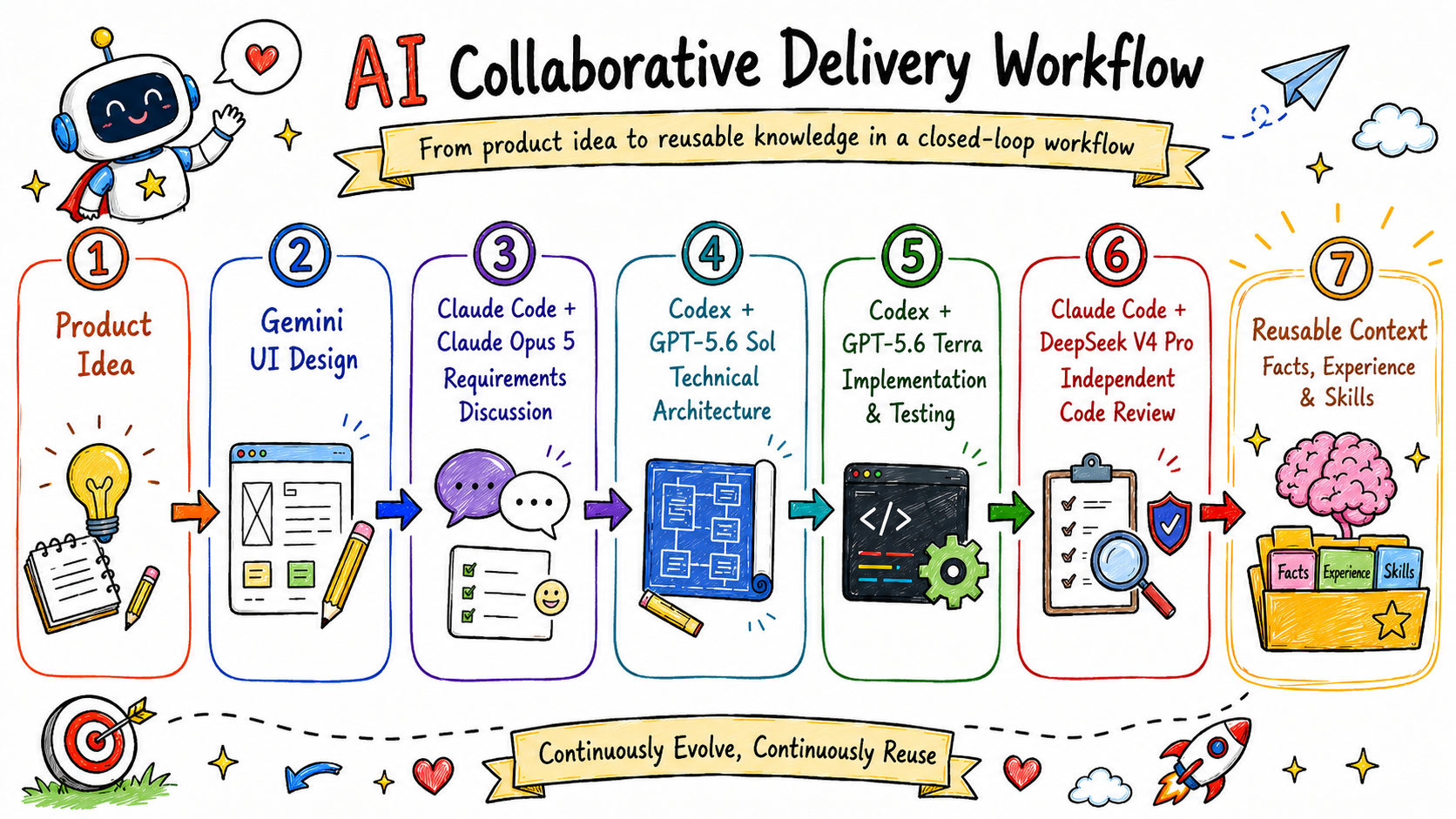
In this example configuration, UI design, requirements, architecture, implementation, and independent review use different specialists. Accepted decisions and artifacts flow between stages, and useful facts, experience, and Skills remain available to the next Mission.
The model and runtime names in the diagram are illustrative. Routing is a Host binding: the reusable method is not coupled to those exact providers.
Pragma meets you at three levels: a full-featured Desktop workspace, direct CLI invocation, or SDK integration into your own system.
Use Pragma Desktop as the most intuitive and configurable way to build and run teams. Configure model providers, local runtimes, permissions, context, memory, tools, and evaluations; create Experts and Flows in Studio; run Missions; inspect results; and import or export .pragma bundles.
Call an Agent Team directly from the terminal and connect it to scripts, local workflows, and automation. CLI support is currently in development. The CLI will also be able to expose a team as MCP or Skills, bringing its full capabilities—including experts, shared context, tools, memory, workflows, and governance—to the AI tools you already use, such as Codex, Claude Code, or a system you build yourself.
Save an Agent Team as versioned YAML DSL, load and compile it with @pragma/interpreter, and invoke the compiled team directly from your own application through @pragma/core. This path lets you embed Agent Team execution into a product or AI system while keeping the team definition portable and reviewable. Start with the portable bundle example and the DSL architecture guide; runnable integrations live in examples/src.
| Area | Current status |
|---|---|
| Project maturity | Preview; breaking changes are still possible |
| Desktop release | macOS Apple Silicon and Intel; unsigned |
| Windows / Linux Desktop | Not included in the current public release |
| Runtime adapters | Claude Code, Codex, PI, and Qoder CLI packages are implemented |
| Composition | Expert, ExpertTeam, Flow, SubFlow, and HumanTask |
| Context | Host contract plus in-memory, JSON, filesystem, Mission Board, and Memory-backed stores |
| Memory | Evidence pipeline with episodic and semantic modules; knowledge and Skill refinement are preview features |
| Evaluation | Versioned evaluations and Flow Run Dry execution |
| Portability | .pragma bundle import, export, validation, binding, and compilation |
| Distribution | No code signing or automatic updates yet |
For detailed implementation boundaries, see the current architecture overview.
Read the Contributing Guide before opening a pull request. Use GitHub Issues for reproducible bugs and feature proposals, and follow the Security Policy for vulnerability reports.
Pragma uses the Pragma Source Available License 1.0, a custom source-available license that is not OSI-approved. The full license controls: in particular, third-party hosted services and commercial embedding require prior written authorization. Use of the Pragma name, logo, and official identity is also governed by the Trademark Policy.
Run Claude Code as an MCP server so any agent can delegate coding tasks to it
 @microsoft✓ Official
Browser automation using accessibility snapshots instead of screenshots
 @googleapis✓ Official
Google's universal MCP server supporting PostgreSQL, MySQL, MongoDB, Redis, and 10+ databases
 @github✓ Official
Official GitHub integration for repos, issues, PRs, and CI/CD workflows