

Are you the author? Sign in to claim
A guide on Professional Agentic Product Engineering with Claude Code — from tier 1 to tier 8
[!NOTE] 🧭 Agentic Shift — Join a professional learning community for builders and leaders — Apply now →

"The purpose of knowledge is action, not knowledge." — Aristotle
Professional agentic engineering is not prompt engineering — it's engineering the system around the model. As the work gets harder, the effort moves up the ladder: the prompt shrinks while the system around it grows.
This repo — a tutor mode and an Agentic Coach — is based on the Professional Agentic Product Engineering Guide. These materials and harness nudge you to the right tip of your growing product engineering skills.
[!TIP] Formats of the Guide — read it in whichever form fits how you work; all three stay in sync with this repo:
- 📄 Markdown —
guide.md, the canonical source. Best for reading in your editor, feeding to an agent, or sending a PR.- 📖 Online — agentic-engineering.guide — a browsable web version: one page per tier, dark/light mode, easy to share. Built from
guide.mdby the static-site generator inweb/and rebuilt on every change, so it never drifts.- 🕸️ Obsidian vault — the
wiki/folder is a wikified version: the guide split into[[wikilink]]-cross-referenced pages (one per tier, concept, and entity). Openwiki/as an Obsidian vault to navigate by graph and study the material, not just read it top-to-bottom.
The Guide is kept up-to-date to track how the best teams operate coding agents — the full range, from "fix bug xyz" to autonomous engineering loops in production.
Calibrated for the current frontier class — Opus 4.8+, GPT-5.5-class+, Gemini 3.x+.
Professional agentic engineering is not prompt engineering — it's engineering the system around the model. That system isn't a line; it's three nested loops (the value-factory model) — a tight coding loop (red → green → refactor) inside a feature loop (specify → refine → verify), inside an impact loop (opportunities → hypothesis → impact):
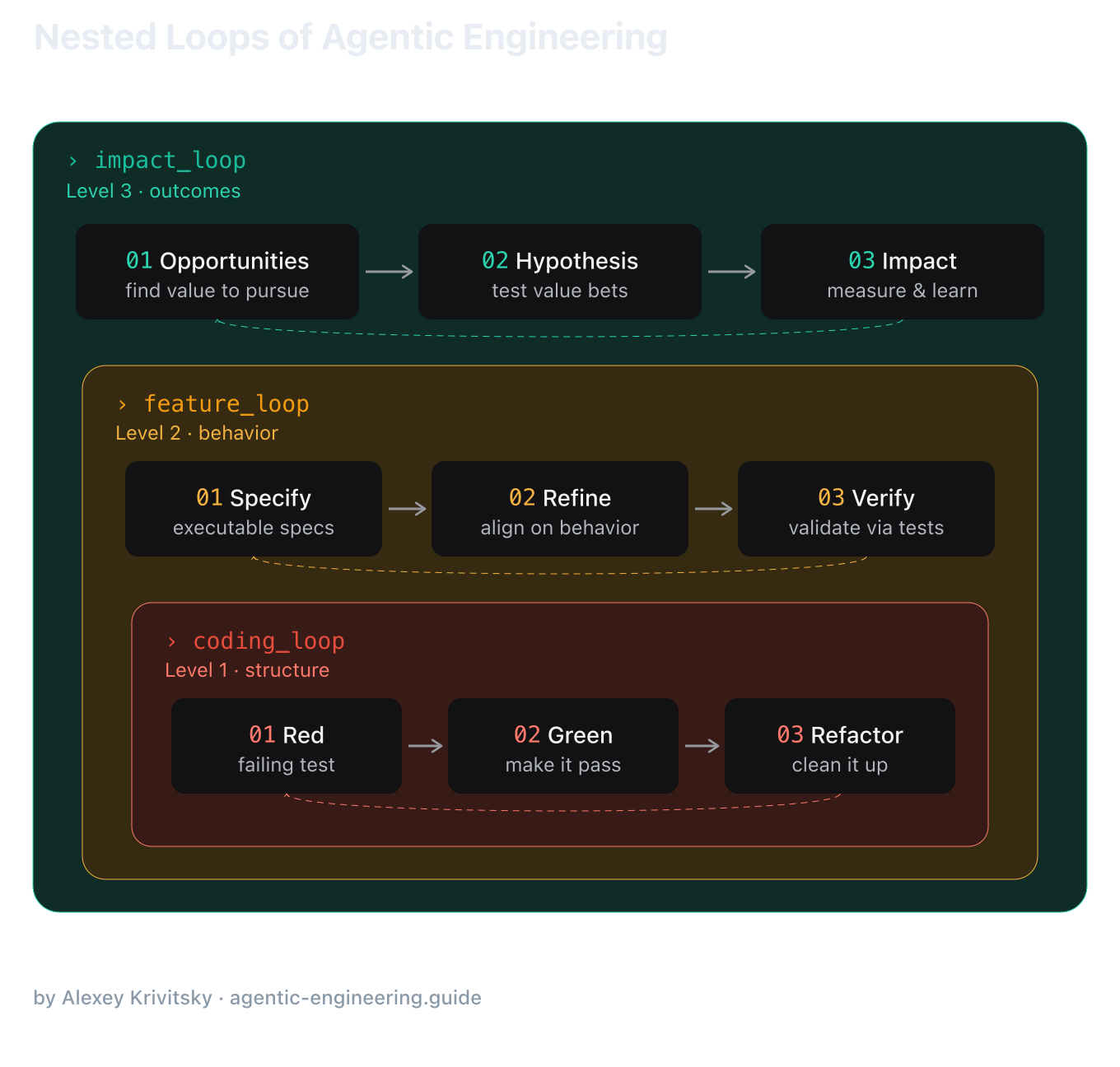
The eight tiers are how you make these loops close on their own — from wording a single prompt (T1) to whole loops running autonomously in production (T8). The prompt shrinks; the system grows.
Three in one — the same material in three forms: read it, get tutored through it, or get coached while you work.
guide.mdOne ladder of eight tiers, simple → hard, where the work shifts from wording the prompt to engineering the system around the model:
| Tier | You learn to… |
|---|---|
| T1 Professional Prompting | Write prompts the agent can act on |
| T2 Shaping & Slicing | Plan and slice before you build |
| T3 Context Management | Give the agent the right context and tools |
| T4 Loop Until Done | Make the agent prove it's done (the heart of it) |
| T5 Checkpointing & Hardening | Checkpoint in git; wire tests & CI into the harness |
| T6 Orchestration | Run many agents at once |
| T7 Fleet Ops | Operate your agents as a fleet |
| T8 Agent Execution Layer | Put agents into production (the execution layer) |
Climb only as high as your work demands. New to this? Start at T1; already fluent? jump straight to the tier that matches you.
Every tip is a concrete Instead → Prefer pair — the anti-example, then the fix. E.g. Tip 1.2:
❌ "Clean up the auth code."
✅ "Extract token refresh in
session.tsinto the existingRetryPolicyclass."
CLAUDE.mdTurns Claude Code into an interactive tutor for the Guide: one small concept at a time, you do each one, and a separate quizmaster checks that it stuck.
Use it — clone the repo, open Claude Code in the folder, and say hi. It diagnoses your level and starts teaching:
git clone https://github.com/krivitsky/professional-agentic-product-engineering
cd professional-agentic-product-engineering
claude        # then type:  hi
Shown with Claude Code, the example harness used throughout — but the Guide and Tutor are harness-agnostic; this repo ships both CLAUDE.md and AGENTS.md, so any agent that reads them works.
It reads your real prompts first (with consent). Instead of interrogating you, the tutor offers to glance at your past Claude Code prompts across your local projects and build a portrait — your stack, your prompting habits, the tier those imply.
Then it tailors each lesson's examples to your stack and repos — and aims its advice at the prompting habits it actually saw in your history — instead of a generic textbook example.
Read-only and local — nothing leaves your machine.
"First impressions? Good :) It reads my history and estimates my current level, but is also transparent and asks me for my self assessment. Tell tell sign of quality — right there." — Magnus Vestin
agentic-coachAn ambient coach — install it once, then work in Claude Code as you normally would. It watches silently; most turns it says nothing. It speaks up only when it catches a learning opportunity, and links you straight to the fix.
You're mid-task, about to take a shortcut:
You → Claude: "Delete these failing tests — I just need the build green."
🧭 Agentic Coach — catching a learning opportunity:
💡 Red test? Find out why before you delete it. Code regressed → fix the code (deleting it buries a live bug); feature gone or test stale → cleanup's fine. → Tier 4 — make the agent prove it's done
It catches the thinking, not the syntax — one catch, one nudge, one click to the Guide, then quiet again.
Install it — add the marketplace, install, reload:
/plugin marketplace add krivitsky/professional-agentic-product-engineering
/plugin install agentic-coach@pae
/reload-plugins
Then just work — it nudges when it catches something. Say coach me to ask it directly, or stop coaching to silence it. (Needs jq on your PATH.)
"Nice! Thank you for the compact guide where all the basics are in one place." — Michal Svoboda, Security & Engineering Mentor
⭐ Star the repo if it helps.
Found a better example, a fix, or a new tip? Submit an issue or PR — or just ask your harness (Claude, etc.) to open one for you. Help yourself and the next person learn better.

Maintainer: Alexey Krivitsky (alexey@krivitsky.com)
Upstream: https://github.com/krivitsky/professional-agentic-product-engineering
Design enforcement with memory — keeps your UI consistent across a project
Create animation-rich HTML presentations using a coding agent's frontend skills
1000+ skills curated from Anthropic, Vercel, Stripe, and other engineering teams
Detects 37 AI writing patterns and rewrites text with human rhythm across 5 voice profiles