

Are you the author? Sign in to claim
Voice-based AI interview coach — feed it any job description in your language, practice in a fully controlled session, a
Friends who tried this said it was scary good. If it helped you too, buy me a beer 🍺 or sponsor me on GitHub — I promise to drink it while fixing your GitHub issues.
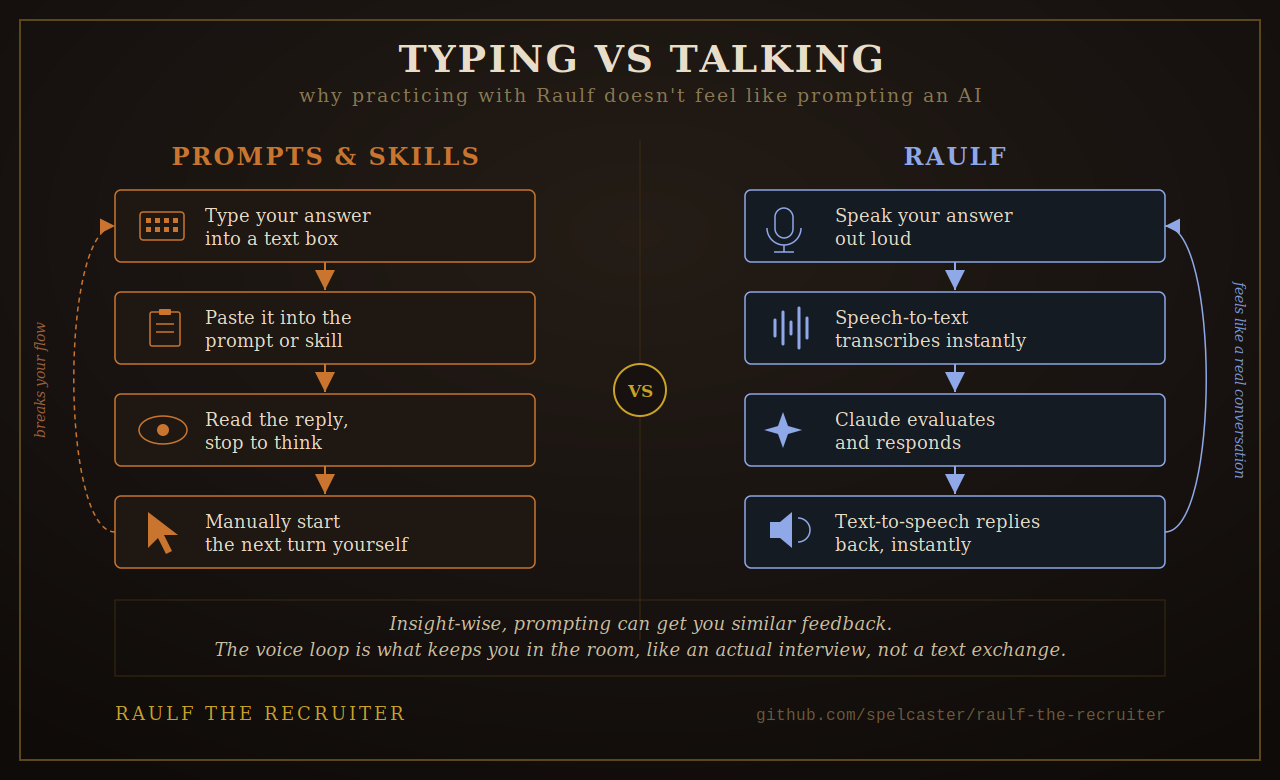
A voice-based CLI for practicing interviews and spoken English. An LLM plays the Interviewer: its replies are spoken aloud via TTS, you answer by talking into the mic, and your speech is transcribed and fed back into the conversation. When the session ends, an LLM evaluates the full transcript on two dimensions: your spoken English and the quality of your answers.
The interview is always conducted in English, regardless of the language of the instruction that seeds it.
sounddevice)ANTHROPIC_API_KEY — Interviewer turns and Evaluation (Claude Opus 4.8)OPENAI_API_KEY — TTS (gpt-4o-mini-tts) and STT (gpt-4o-transcribe)Put your API keys in a .env file rather than exporting them in your shell.
Exported keys are prone to leaking — they linger in shell history, dotfiles,
and the environment of every process you spawn. A .env file stays in the
project directory and is already gitignored.
Copy the shipped example and fill in your keys:
cp .env.example .env
Then open .env and set the values:
ANTHROPIC_API_KEY=sk-ant-...
OPENAI_API_KEY=sk-...
All commands below load it with uv run --env-file .env.
Start a session with a Seed Instruction — the scenario, role, or question set for the interview:
uv run --env-file .env interview start --seed "Senior backend engineer interview, focus on system design"
or load it from a file:
uv run --env-file .env interview start --seed-file ./seeds/backend.md
Options:
--interviewer-name NAME — what the Interviewer is called, on screen and in character (default: Raulf)--voice NAME — TTS voice (default: alloy)--output-dir DIR — where session directories are created (default: sessions)The opening question is generated, spoken aloud, and saved. Then a menu loop runs until you quit:
| Key | Action |
|---|---|
r | Print the latest Interviewer text |
a | Replay the latest Interviewer audio |
t | Record an answer (Enter stops recording, 6-minute cap) |
q | End the session and run the Evaluation |
After recording, the transcript is shown with a confirmation gate: press
Enter to accept and send it to the Interviewer, or r to discard the take
and re-record. Only accepted takes are persisted as turns.
Quitting with q writes evaluation.md into the session directory: a
qualitative assessment (no numeric scores) covering your English — CEFR
grade, incorrect word usage, filler words, recurring grammar patterns — and
your content — per-question assessment, strongest and weakest answer — plus
a short summary with the top things to practice next.
A session that ended without q (crash, Ctrl-C) can still be evaluated
afterwards with the standalone subcommand:
uv run --env-file .env interview evaluate <session-id>
uv run --env-file .env interview evaluate --last
--last picks the most recently modified session directory. Use
--output-dir if sessions were created somewhere other than the default
sessions directory.
Each session gets its own directory named by a unique ID:
<output-dir>/<session-id>/
  metadata.json        # seed instruction, interviewer name, voice, providers, ended_cleanly
  interviewer_001.txt  # Interviewer turn text
  interviewer_001.wav  # its TTS audio
  speaker_001.txt      # accepted transcript
  speaker_001.wav      # your recorded audio
  ...
  evaluation.md        # end-of-session Evaluation
Speaker audio is kept alongside transcripts so sessions can be re-listened to or re-transcribed later.
Providers (LLM, TTS, STT, recorder, player) sit behind protocols in
src/interview/environment.py, with fake implementations for testing and
real ones wired up in Environment.build_anthropic. This keeps the door
open for local backends (e.g. Whisper for STT, Piper for TTS) later. Audio
is WAV/PCM end to end; sounddevice + soundfile are the only audio
dependencies.
The full spec lives in specs/cli.md and the domain
vocabulary in CONTEXT.md.
uv run python -m unittest discover tests
⚠️ Experimentelle Skill-Sammlung für deutsches Recht (Arbeits-, Gesellschafts-, Insolvenz-, Datenschutz-, Prozessrecht u
Manage multiple Claude Code agents from TUI or Web with tmux and git worktrees
Project management using GitHub Issues + Git worktrees for parallel agent execution
Core skills library for Claude Code with 20+ battle-tested skills including TDD, debugging, and brainstorming