

Are you the author? Sign in to claim
Typed, versioned design records for engineering projects — decisions, rationale, and the roads not taken, kept as plain

AI-assisted project development and tracking: a typed, versioned design record for engineering projects, driven by your agent over MCP.
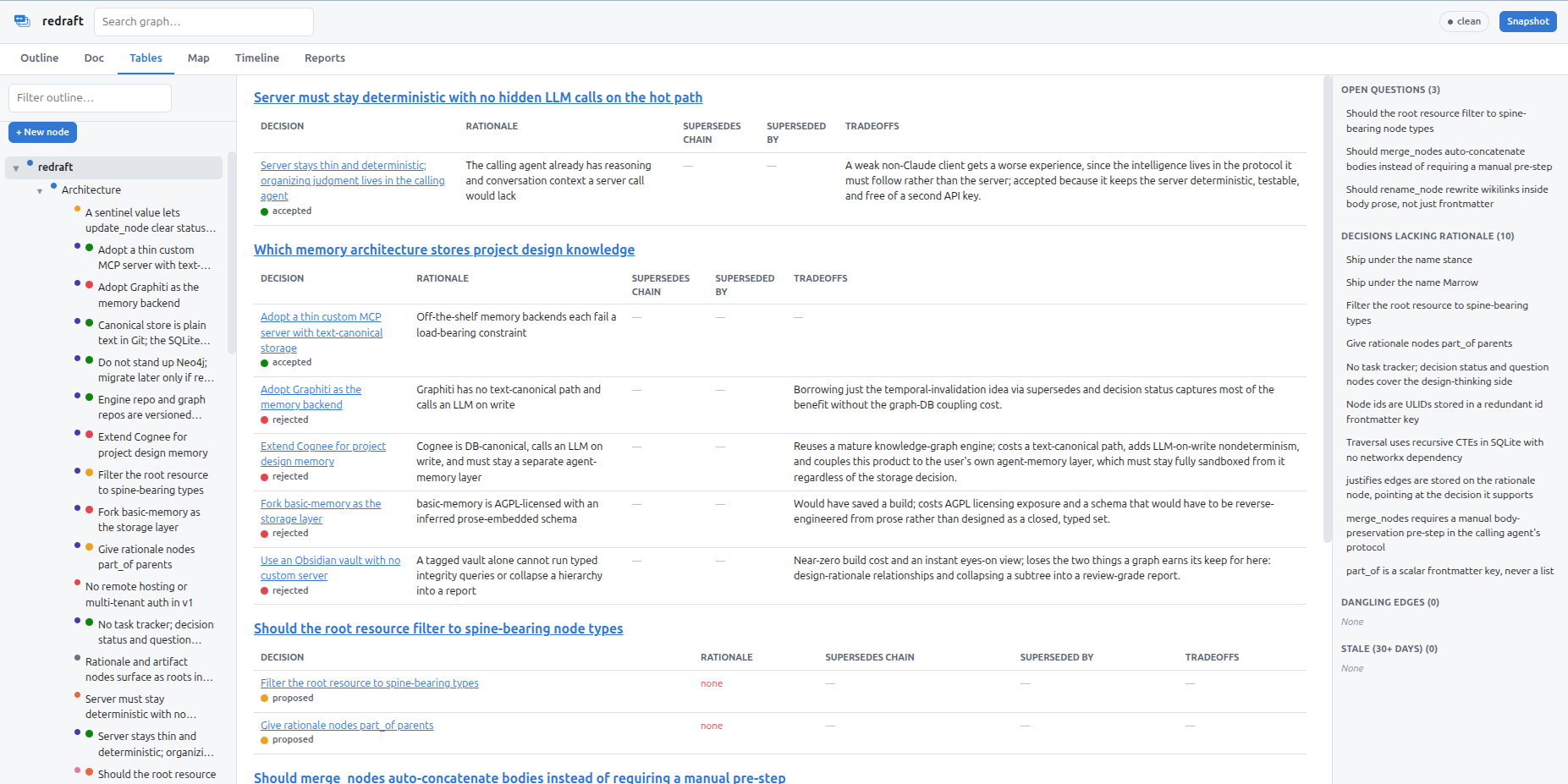
The decision record, as the operator UI renders it: every decision grouped under the question it addresses — accepted and rejected alternatives side by side, with rationale and tradeoffs. The road not taken stays part of the record.
Most project documentation is written as a design book: a linear narrative, drafted once, read rarely, stale within a sprint. That is not how engineering projects actually produce knowledge. Decisions, rationale, requirements, and open questions show up as sparse pieces at wildly different levels of a project's hierarchy, at different times, and they only become useful once linked back to what they addressed, what they ruled out, and what they later superseded. redraft treats that as the real shape of the data instead of fighting it: typed nodes and typed edges, stored as plain Markdown so git stays the source of truth. An MCP server gives your agent the tools to organize the graph as the project evolves; reports collapse it back into review-grade documents on demand -- including the roads not taken.
Why not an ADR folder, a wiki, or plain Obsidian? All three store prose; none store structure an agent can act on. ADRs are linear, append-only files -- the rejected alternative lives in a paragraph nobody can query, and nothing links a decision to the requirement it satisfies or the question it answered. A wiki adds links but lives outside git, away from the code and the agent's hands. Obsidian gets the storage format right -- which is why a redraft graph is an Obsidian-compatible vault -- but a vault alone has no typed schema, no integrity checks, and no tools an agent can call. redraft is that missing layer: a closed type system, structural invariants the server actually enforces (cycles, collisions, dangling links), hybrid retrieval built for an agent, and reports that put accepted and rejected alternatives in the same table.
1. Clone and install the engine.
git clone https://github.com/KaelinGraf/redraft.git redraft
cd redraft
uv tool install --from . redraft
This puts one command, redraft, on your PATH (run uv tool update-shell once if it
warns the bin directory isn't there yet). Working on the engine itself instead of just using
it? Skip the tool install and run uv sync -- uv run redraft then resolves to your local
checkout.
2. Birth a graph.
redraft init ~/my-project
Writes graph/nodes/ (empty), a CLAUDE.md (the organizing protocol, verbatim), a
.mcp.json pointing at this graph (location-independent -- it keeps working if the graph
repo is later cloned to a different path or device), and, by default, its own independent
git history.
redraft init --help lists every option (--no-git, --project-name). Already have a
graph repo from another device? A plain git clone is all it takes -- see "Engine and graph
are separate repos" below.
3. Start working.
cd ~/my-project
claude
.mcp.json tells Claude Code how to launch redraft serve for this graph -- the tools
(create_node, search_nodes, assemble_report, and the rest) appear automatically once
the session starts.
redraft speaks standard MCP over stdio, so any MCP client can drive it the same way --
point yours at redraft serve with REDRAFT_DIR set. Claude Code is the documented path
because the shipped skills and the SessionStart hook target it.
redraft serve needs a uv-managed Python 3.12 (pinned in .python-version): the retrieval
stack requires a sqlite3 build with FTS5 and extension-loading support, which a
python-build-standalone interpreter has and many system/distro Pythons don't -- it fails
fast with a clear error at startup if yours is missing either, rather than failing
confusingly inside a later tool call.
The graph doesn't need to live inside a code project, and most of the time it shouldn't --
birth it as a sibling directory, then register it at Claude Code's project scope instead of
hand-writing a .mcp.json:
claude mcp add --scope project -e REDRAFT_DIR=<abs graph dir> -e PYTHONPATH= --transport stdio redraft -- redraft serve
PYTHONPATH= matters in any shell where something else (a ROS workspace is a common culprit)
has already polluted it -- an inherited entry can shadow redraft's own dependencies or
autoload an incompatible plugin.
redraft ui serves a local web app over the same graph: an outline-first three-pane
view for reading and full authoring (create with live duplicate-detection hints, link,
batch-link, reparent, merge, upload, snapshot), plus a live document render, the
decision tables above, a dependency-aware milestone timeline, and a force-directed map.
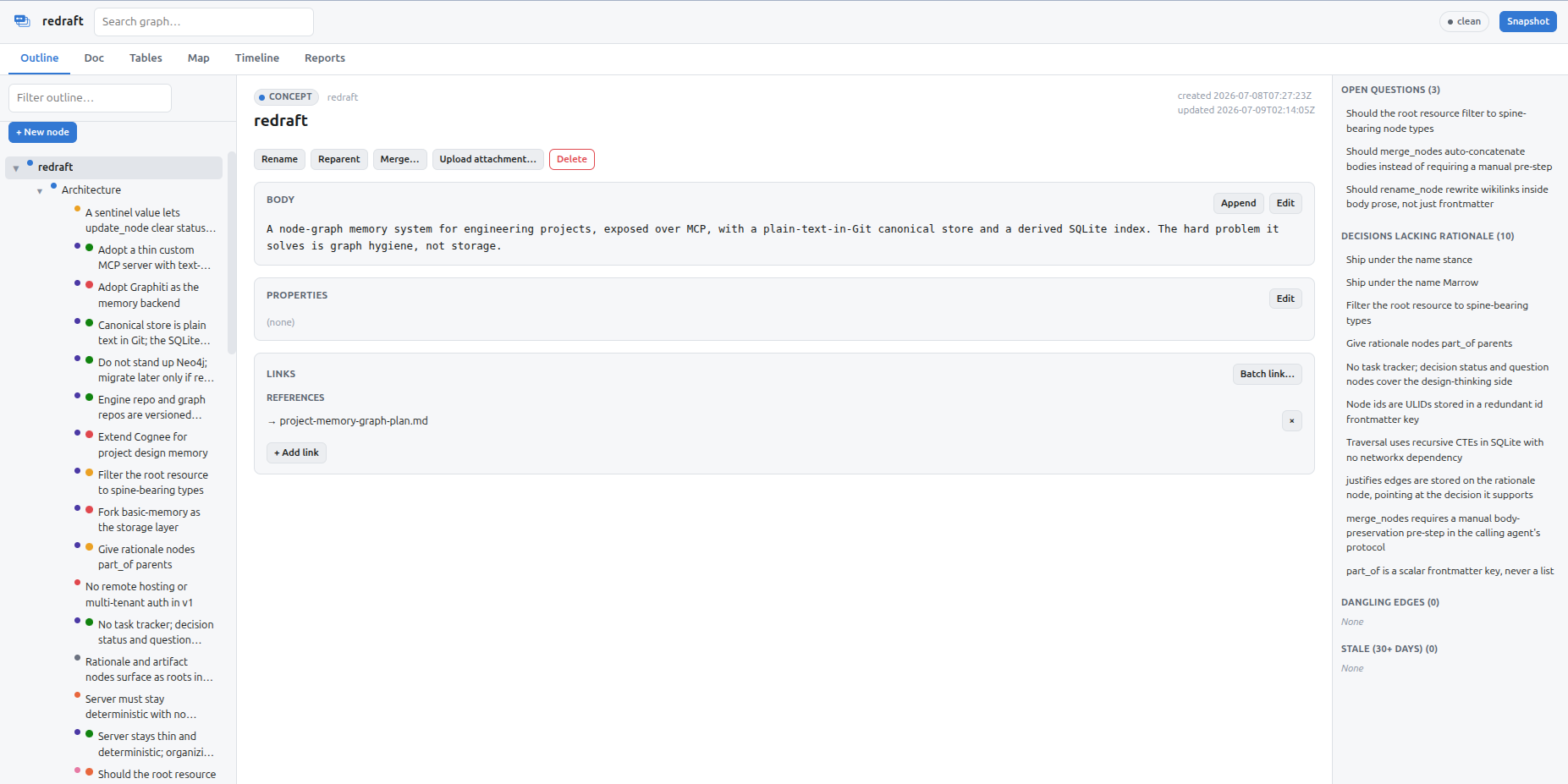 Outline — spine tree, node detail, attention strip Outline — spine tree, node detail, attention strip | 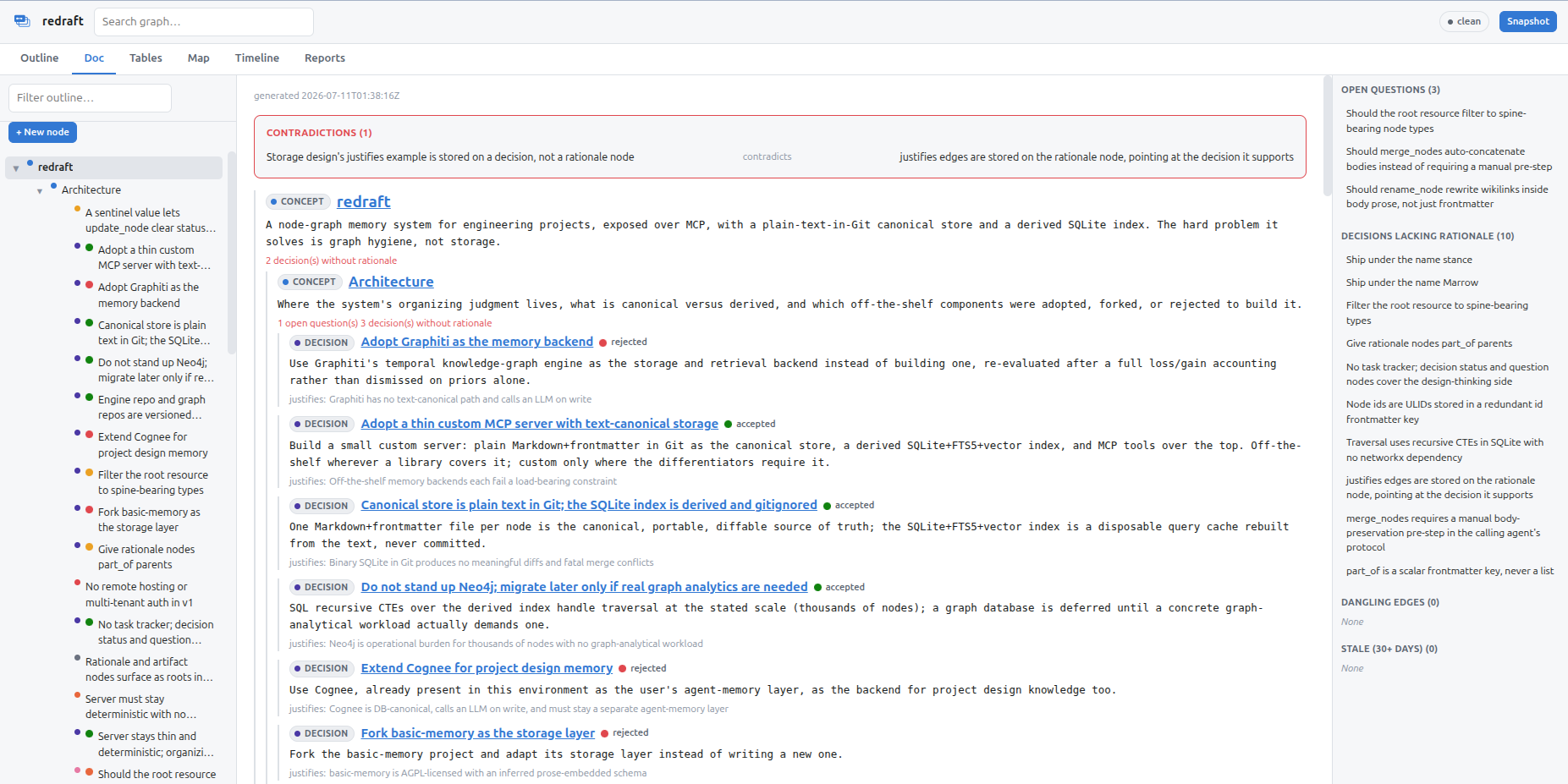 Doc — the graph, rendered as a design document Doc — the graph, rendered as a design document |
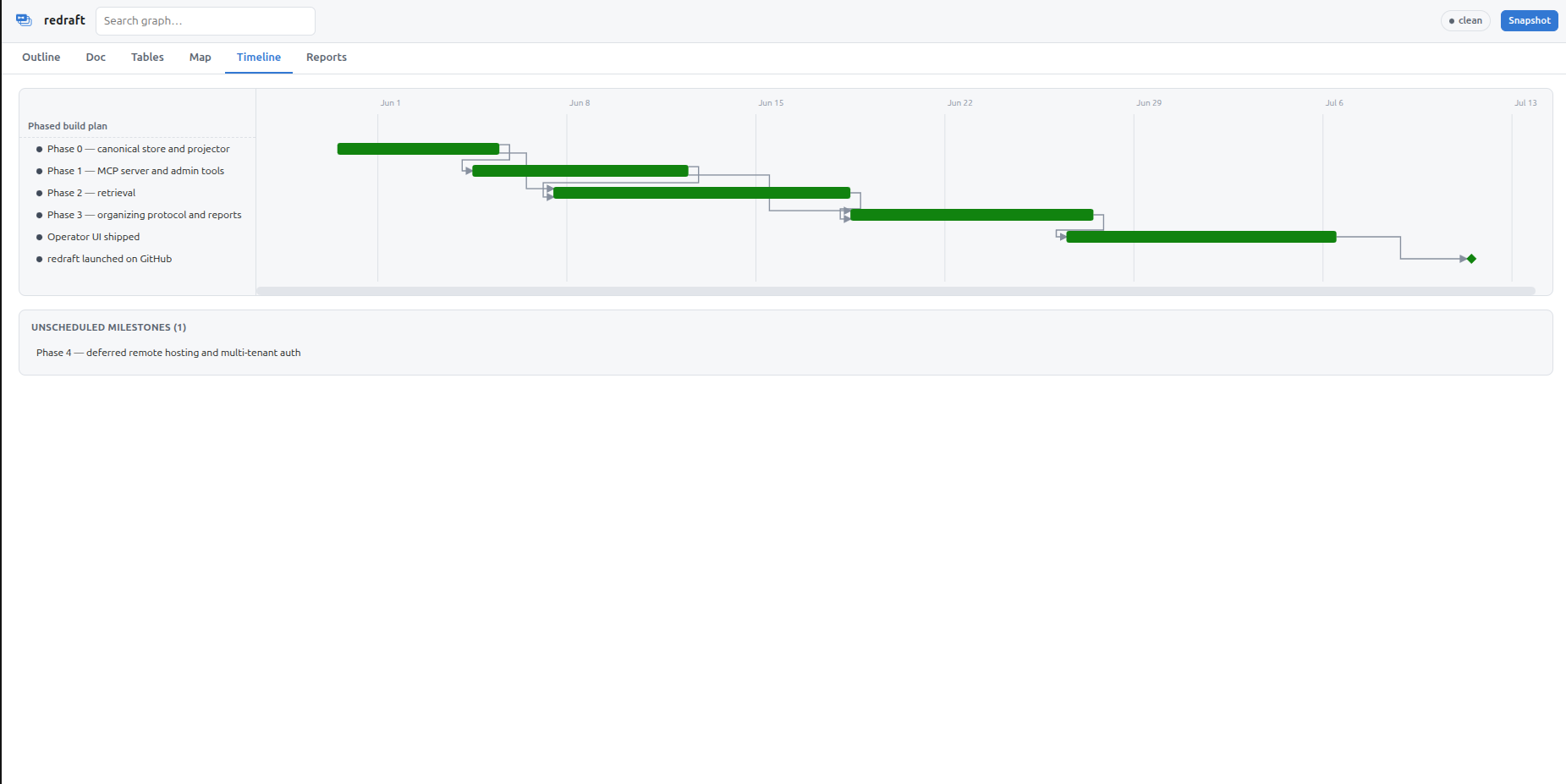 Timeline — milestones with real dependencies Timeline — milestones with real dependencies | 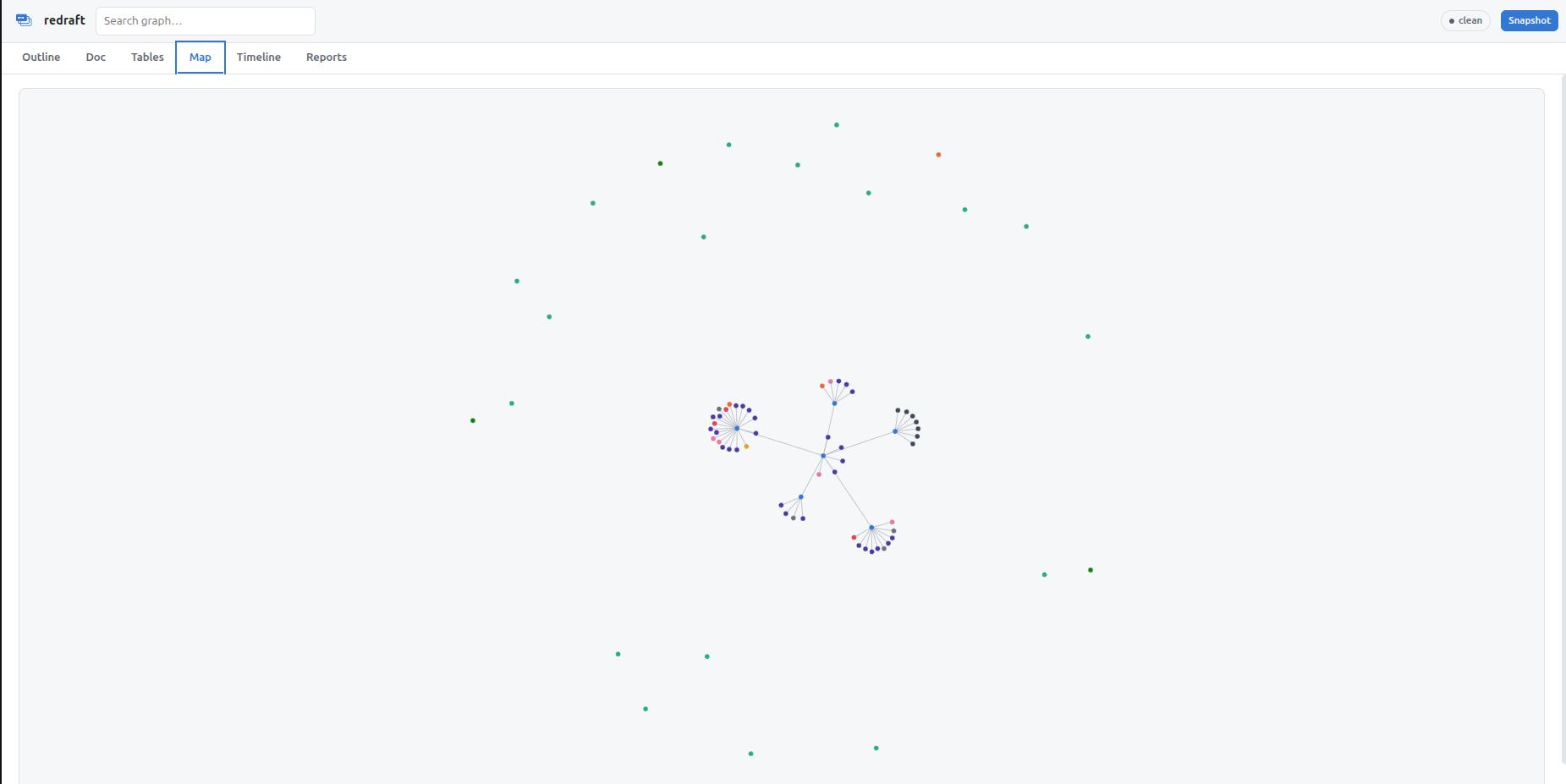 Map — the whole project, one connected graph Map — the whole project, one connected graph |
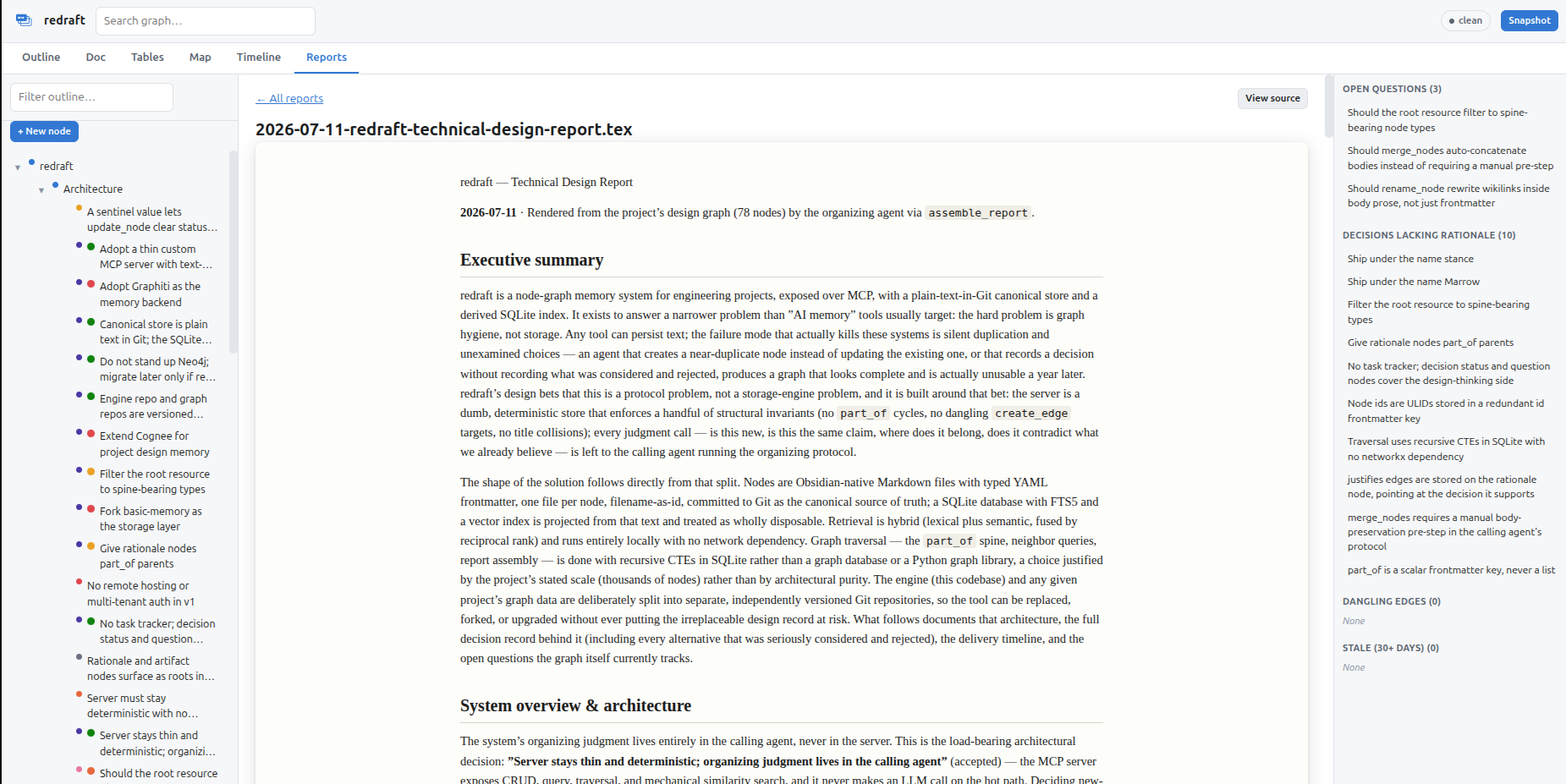
Ask your assistant for a technical report and it renders the graph into a review-grade
LaTeX document — decision tables, open questions, and all — saved under reports/ and
displayed typeset in the Reports tab:
Every graph redraft init births ships with a Claude Code SessionStart hook
(.claude/settings.json) alongside CLAUDE.md/.mcp.json. It runs redraft overview --
the same cheap, embedding-free query the overview MCP tool and the graph://project/overview
resource expose -- and injects the resulting markdown map (spine roots, their major branches,
and per-branch tallies for open questions and unjustified decisions) straight into context at
the start of every new session, so the first real call is targeted instead of a blind guess.
It's on by default because that's the point of the feature; to turn it off, delete
.claude/settings.json (or just its one SessionStart entry, if you've since added other
hooks to that file) from the graph repo.
This repo (the engine) is the MCP server, the storage/index code, and the CLI. It holds
no project data. A project's graph -- its node files, its CLAUDE.md (the organizing
protocol, written verbatim by redraft init), and its .mcp.json -- lives in its own repo,
with its own git history and its own remote, versioned entirely separately from the engine.
Why split them: the engine is replaceable tooling that gets upgraded, reinstalled, or forked; the graph is the irreplaceable design record. Coupling their lifecycles would mean every engine change risks the data, and every device would need the full engine source checked out just to read a graph.
Reinstalling a newer engine doesn't reach out and touch a graph you already have -- an
existing graph's CLAUDE.md (the organizing protocol) and .claude/settings.json (the
SessionStart hook) were written once, back when you ran redraft init, and stay exactly as
they were even after the engine that ships newer versions of both is installed. Run
redraft sync inside the graph to catch it up: it refreshes those two files (plus
.gitignore's required lines) to whatever the newly installed engine ships, commits the
refresh if the graph is a git repo, and never touches graph/nodes/, docs/, or reports/
-- your project data is untouched either way. CLAUDE.md is engine-managed for exactly this
reason: don't hand-edit it, since the next sync overwrites it -- project-specific content
belongs in the graph's nodes, not the protocol file.
uv tool install --reinstall --no-cache --from . redraft
cd ~/my-project
redraft sync
Restart your Claude Code session afterward so it picks up the refreshed protocol and hook.
concept, decision, rationale, requirement, constraint, idea,
question, artifact, observation, milestone -- a closed set, each with its own
narrow status lifecycle where one applies (only decision, question, and milestone
carry a status at all).part_of is the one scalar edge -- the hierarchy spine -- plus eight
typed list edges: justifies, supersedes, addresses, depends_on, contradicts,
references, derived_from, relates_to. docs/protocol/organizing-protocol.md is the
full vocabulary and the rules an agent follows to use it well.assemble_report walks a part_of subtree and groups
every decision (any status) under the question or requirement it addresses, with
rationale, tradeoffs, and supersession chains already resolved -- accepted and rejected
alternatives rendered side by side, so the road not taken is part of the record instead of
lost to it.snapshot —
a pathspec-scoped commit in the graph repo's own git history. Local commits are the
version history (diffable, revertable, blameable node-by-node); adding a remote and
pushing is optional and entirely yours to decide.assemble_report
for the full spine with decision tables, briefing(query) for topical context — saved
as LaTeX under reports/ and rendered in the operator UI. The redraft-report skill
packages the flow so "generate a technical report" is a one-liner.docs/ is a local, gitignored cache of referenced research —
re-fetchable on any device from the source_url recorded on its artifact node via the
redraft-fetch-docs skill — not versioned, so it doesn't travel with the graph and keeps the
repo lean. graph/attachments/, which holds files uploaded onto a specific node through the
operator UI, remains the committed option for files that must persist with the graph.The graph is plain Markdown with YAML frontmatter and [[wikilink]]-style edges under the
hood -- open a graph repo directly in Obsidian and it renders and navigates natively.
redraft is only required to organize the graph, never to read it.
skills/redraft-init/SKILL.md walks Claude Code through birthing a graph for a project and
registering it, so you can just ask instead of following the Quickstart by hand. Symlink or
copy it into ~/.claude/skills/:
ln -s "$(pwd)/skills/redraft-init" ~/.claude/skills/redraft-init
skills/redraft-fetch-docs/SKILL.md re-fetches a graph's local docs/ cache (see above) from
each artifact node's recorded source_url; symlink it the same way (ln -s "$(pwd)/skills/redraft-fetch-docs" ~/.claude/skills/redraft-fetch-docs).
skills/redraft-report/SKILL.md packages the report flow: assemble the graph, write a
grounded LaTeX technical report into reports/, snapshot it — so "generate a technical
report" is a one-liner in any session with a redraft graph connected
(ln -s "$(pwd)/skills/redraft-report" ~/.claude/skills/redraft-report).
env -u PYTHONPATH uv run pytest -q
Apache-2.0. See LICENSE.
Run Claude Code as an MCP server so any agent can delegate coding tasks to it
 @microsoft✓ Official
Browser automation using accessibility snapshots instead of screenshots
 @googleapis✓ Official
Google's universal MCP server supporting PostgreSQL, MySQL, MongoDB, Redis, and 10+ databases
 @github✓ Official
Official GitHub integration for repos, issues, PRs, and CI/CD workflows