Are you the author? Sign in to claim
Coordination and context layer for AI coding agents. Shared file locks, live patch sync, and portable project memory acr
Git coordinates humans committing minutes apart. Relay coordinates agents editing the same files right now — file locks, dependency-aware locks, live patch sync, and one shared board.
Twelve agents on one repo, and none of them blind to the others.
Watch the demo · Read the Documentation · Docs in this repo



Works with





Eighteen months ago you had one coding assistant. Today you probably have three running at once — Claude in one terminal, Cursor in another, Copilot in the editor. They all write to the same files, and not one of them knows the others exist.
Now put four people on that repo. That's twelve agents, editing the same code, blind to each other. You find out at the merge. Or you don't find out at all.
Git solved this for humans — but Git assumes people committing at human speed, minutes apart, one branch each. Agents write at machine speed, in parallel, in the same directory. There is no layer for that.
- 12 agents · 12 blind writers · conflicts discovered at merge
+ 12 agents · 1 lock table · conflicts prevented at the edit
Relay sits under every agent as a coordination layer. Pre-tool hooks claim a lock before an agent writes; post-tool hooks release it. If one agent is modifying a component, another cannot silently overwrite those changes.
One host, no backend. One person runs
relay serve— that machine is the server. Everyone else connects over an ngrok tunnel, straight to that laptop. Nothing lives on infrastructure you do not own.
| What it does | |
|---|---|
| File locking | Every agent write goes through a claim/release cycle against a shared lock table (TTL-based, auto-expiring). Destructive overwrites are blocked, not detected after the fact. |
| Dependency-graph locking | Files do not exist independently — one change can affect dozens. Relay parses imports with tree-sitter and asks "does this change affect files another agent is working on?", not just "is this exact file locked?" Agents stay parallel; the blast radius stays safe. |
| Patch sync across machines | Your teammate has their own filesystem, environment, and agents. Relay propagates patches, not whole-project copies — relay push / relay pull keep every clone on the same working state. |
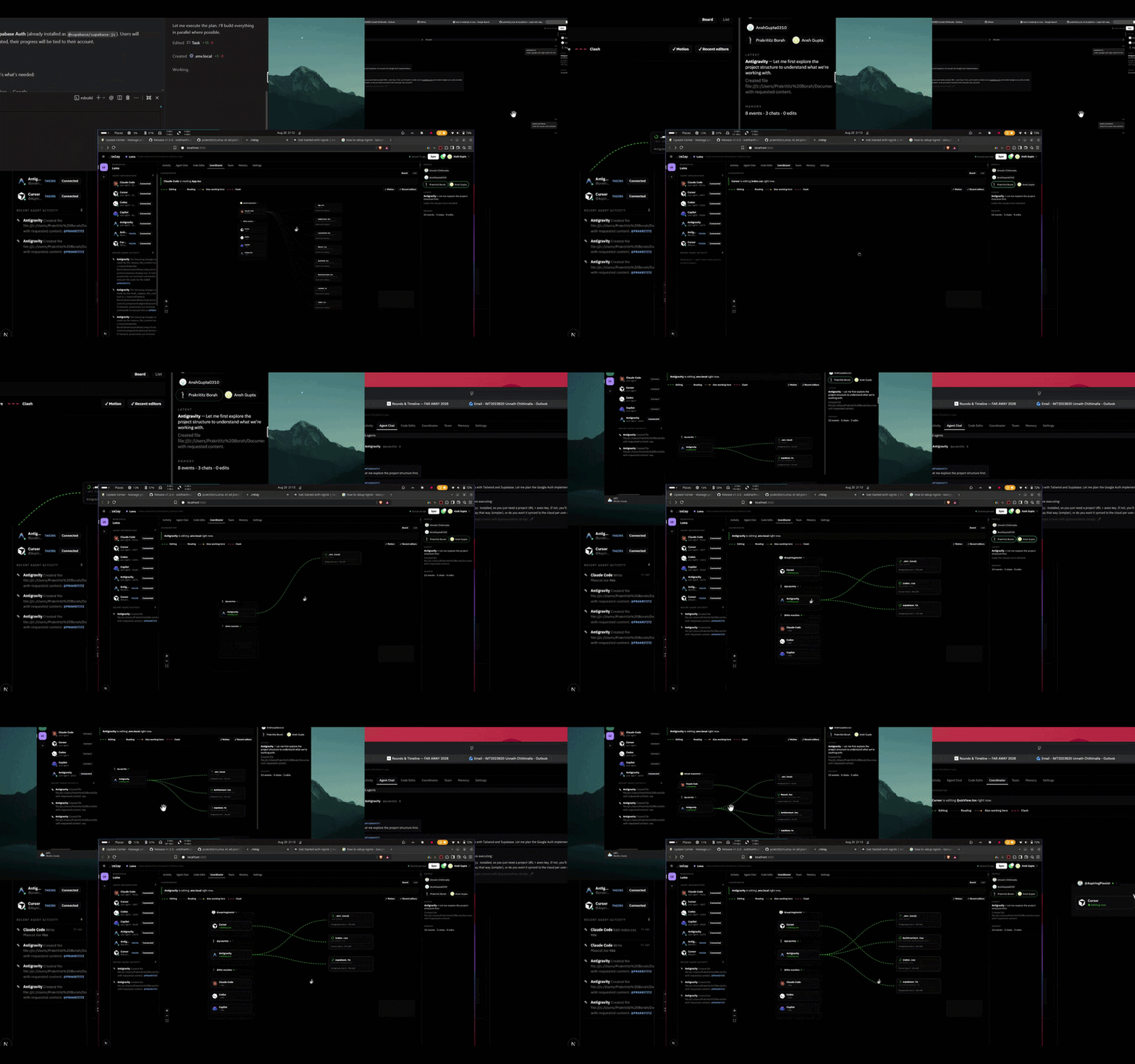
| Mission Control | One board for every agent on every machine: live lock table, lock graph, code edits, unified agent chat history, conflicts, presence. |
Host — the machine everyone else connects to:
relay login              # GitHub identity (uses the gh CLI)
relay clone <repo-url>   # clone + register workspace + install agent hooks
relay serve              # API → 127.0.0.1:3001 · Mission Control → :3002
Then open Mission Control → Team → Share to mint the ngrok invite link.
Teammate:
relay serve              # their own local relay
# join with the host's invite link on the Team tab
relay pull               # take the host's current working state
Now start agents as usual. Hooks claim and release locks automatically — nobody has to remember a command.
| Method | Command |
|---|---|
| local dev | npm i, then npm link in this repo |
| attach an existing repo | relay add /path/to/repo |
| fresh clone | relay clone <url> [dir] |
Requires Node.js 18+ (20+ recommended). No database, no hosted backend, no login server.
  Cursor ──┐  pre-tool hook: claim
  Claude ──┤  post-tool hook: release      ┌──────────────┐
  Copilot ─┼──► lock table ◄── dep graph ──│ relay serve  │──► Mission Control
  Codex ───┤        ▲                      │  (your host) │          ▲
  Antigravity ┘     │                      └──────┬───────┘          │
                    │       ngrok tunnel          │                  │
              teammate's relay ◄──── patches ─────┴──────────────────┘
| Layer | Who runs it | What it guards |
|---|---|---|
| Claim / release | pre- and post-tool hooks | exclusive write access to a file |
| Dependency graph | tree-sitter import scan | files affected by the edit, not just the edit |
| Room | relay serve + ngrok tunnel | one shared lock table across machines |
| Patches | relay push / relay pull | working-tree state without full copies |
| Board | Mission Control (:3002) | who holds what, right now |
Locks and the board are separate subsystems — hooks arbitrate straight against the host, while the board is fed by a mirror.
relay doctorwalks that chain and tells you which link is broken.
| Command | Description |
|---|---|
relay login / logout / whoami | GitHub identity (via gh CLI, or device flow with GITHUB_CLIENT_ID) |
relay clone <url> [dir] | git clone + register workspace + install agent hooks |
relay add <path> | Attach an existing local repo |
relay init [path] | Wire hooks, Relay MCP, and /relay ask instructions for all agents |
relay serve | API on 127.0.0.1:3001 + Mission Control on :3002 |
relay serve --no-ui | API + coordinator only |
relay push | Send your dirty working-tree files to the shared room |
relay pull | Apply the host's current dirty files onto this clone |
relay status | Health check (room, role, host, ports) |
relay mcp-url | Print the MCP config for this room's shared-context endpoint |
relay doctor | Diagnose an empty Coordinator board |
Started by relay serve — runs on your own machine, no hosted account.
| URL | |
|---|---|
| Dashboard | http://localhost:3002 |
| API | http://127.0.0.1:3001/api/health |
Collisions prevented counter (persisted to ~/.relay/data/projects/<id>/collisions.json and mirrored to <repo>/.relay/collisions.json).
Any MCP client can read the room's context, even on a machine with no relay installed:
relay mcp-url # prints a ready-to-paste mcpServers block
Coordination tools (relay_claim_file, relay_release_file, relay_status) run against each member's own local relay. The room endpoint is read-only for anyone off the host machine.
| Tool | Purpose |
|---|---|
relay_claim_file | Acquire an exclusive write lock before editing |
relay_release_file | Release the lock after editing |
relay_status | View the full lock table |
relay_get_conflicts | Overlapping edits in the last 5 minutes |
relay_get_recent_changes | Recent code_edit events |
relay_get_chat_history | Unified agent chat across every room member |
relay_room_brief | Teammate activity brief (for the /relay ask agent pseudo-command) |
relay_get_collision_stats | Lifetime counters for collisions Relay prevented |
relay_report_change | Push a code-change event |
relay_report_decision / relay_get_decisions | Append / read decisions |
relay_update_task / relay_get_active_tasks | Append / read tasks |
relay_get_project_context | Full JSON project context |
relay_sync | Re-read agent transcripts into unified history |
relay clone / relay add / relay init install pre-tool (claim), post-tool (release), pre-read, stop hooks, Relay MCP (relay_room_brief for /relay ask), and the relay-os instruction block into every agent surface:
| Agent | Hooks | Instructions | Relay MCP (relay_room_brief) |
|---|---|---|---|
| Claude Code | .claude/settings.json | CLAUDE.md | .claude/settings.json → mcpServers.relay |
| Cursor | .cursor/hooks.json | .cursor/rules/relay.mdc, AGENTS.md | .cursor/mcp.json |
| Codex | .codex/hooks.json | AGENTS.md | .codex/config.toml → [mcp_servers.relay] |
| Copilot CLI | .github/hooks/relay-os.json | .github/copilot-instructions.md | .github/mcp.json |
| Antigravity | .agents/hooks.json | AGENTS.md | .agents/mcp_config.json |
Languages parsed for the dependency graph: TypeScript/JavaScript, Python, Go, Rust, Java, C#, C/C++, PHP, Ruby.
| Required | Node.js 18+ (20+ recommended), npm |
| Bundled | express, cors, ws, @vscode/tree-sitter-wasm · next, react (Mission Control) |
| Not needed | MongoDB, Redis, Docker, a hosted backend, an account |
| Optional | gh CLI for relay login · ngrok for cross-machine rooms |
Env vars: RELAY_PORT (3001) · RELAY_UI_PORT (3002) · RELAY_UI_ORIGIN
Full documentation lives in docs/.
| Quickstart | Coordinating in about five minutes |
| Installation | Requirements, install methods, what gets written where |
| Concepts | Workspace, project, agent ID, lock, room, patch |
| Rooms and teams | Hosting, invites, member tokens, joining, leaving |
| Architecture | Process model, the two planes, one edit end to end |
| Locking | The lock table, TTLs, ownership, dependency-graph soft locks |
| Sync and patches | Patch format, Lamport ordering, transform, transcripts |
| CLI reference | Every command, flag and exit code |
| HTTP API reference | Every endpoint, with auth rules |
| MCP reference | The fifteen tools and the read-only room endpoint |
| Hooks reference | The hook contract per agent |
| Configuration | Environment variables, ports, on-disk layout |
| Troubleshooting | relay doctor and the known failure modes |
We used Relay to build Relay. The problem we were solving was the problem we were having.
The next time you build a hackathon project, do not just add more agents. Just relay.it
MIT licensed · Your machine is the server.
40+ tools for querying dashboards, alerts, datasources, and logs in Grafana
Run Claude Code as an MCP server so any agent can delegate coding tasks to it
 @microsoft✓ Official
Browser automation using accessibility snapshots instead of screenshots
 @googleapis✓ Official
Google's universal MCP server supporting PostgreSQL, MySQL, MongoDB, Redis, and 10+ databases