

Are you the author? Sign in to claim
A new Git tool for researchers and developers to capture features and experiments as reusable semantic units, then let a
A new Git tool for ambitious researchers and developers in the agentic era.
Works with Claude Code, Codex, Gemini CLI, and opencode.


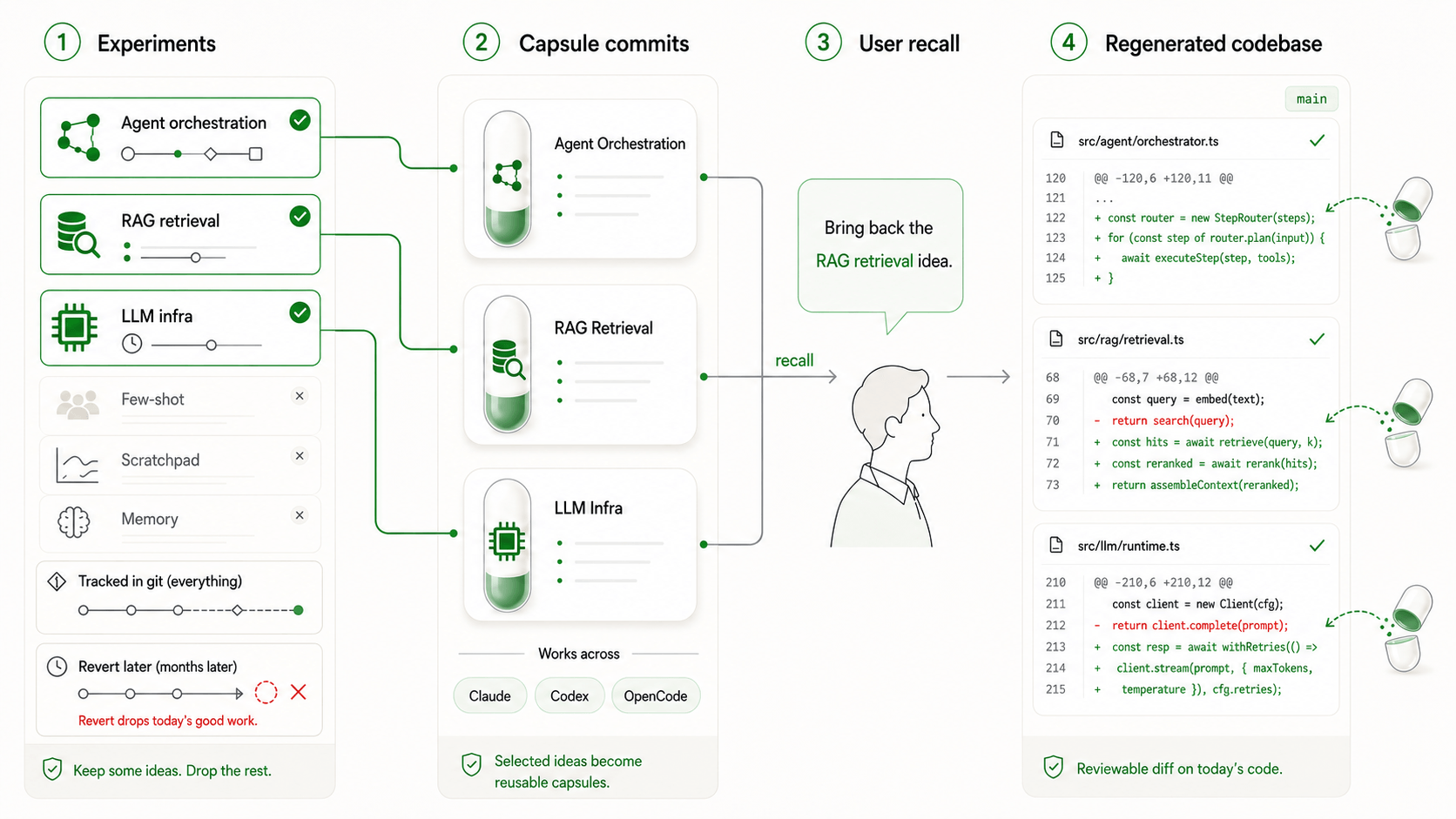
Git remembers commits. research-git remembers ideas.
research-git turns experiments and features into reusable Feature Capsules so coding agents can reapply, adapt, or remove them safely as your code evolves.
Not a rollback. Not hard deletion. Bring back the idea, not the old branch.
One loop: capture each idea into a graph, then regenerate it onto today's code. The engine (blue) is free and deterministic; intelligence happens at exactly two points (green) — subagents dispatched onto your existing subscription, never a paid API.
flowchart LR
    A["edit code /<br/>rgit run -- ..."] -->|"free, deterministic"| B["raw proposal<br/>(diff staged)"]
    B -->|"/rgit-capture"| C{{"capsule-<br/>segmenter"}}
    C --> D[("Feature Capsule<br/>graph (.rgit/)")]
    D -->|"/rgit-recall «query»"| E["compose brief vs<br/>today's code"]
    E --> F{{"capsule-<br/>regenerator"}}
    F --> G["reviewable diff<br/>on today's code"]
    G -.->|"rgit run — freeze + link variant"| D

    classDef engine fill:#eef2ff,stroke:#5b6cff,color:#1e2a78;
    classDef agent fill:#eafff0,stroke:#36a85f,color:#0f5132;
    class A,B,D,E,G engine;
    class C,F agent;
Every idea you keep becomes one capsule — a self-contained unit a future agent can read and bring back:
| Field | What it holds |
|---|---|
| intent | why this change existed — the hypothesis, not a diff restatement |
| code slices | the relevant snippets / files / symbols |
| knobs | parameters / flags / configs |
| dependencies | other capsules it needs + silent assumptions |
| result | metrics / notes / why it worked or didn't, linked to the runs it produced |
| resurrection guide | how to regenerate it onto a changed codebase |
Capsules live in a small graph beside your repo (.rgit/), on top of normal git. Every run you launch through research-git also freezes a byte-exact, content-addressed snapshot of the code that ran — so "the code behind this result" is always a perfect replay, never at the mercy of an agent.
pip install research-git
rgit install        # wires research-git into every agent client on this machine
cd your-project
rgit init           # creates the .rgit/ store in your repo
That's the whole setup. Start a new agent session afterwards so it picks everything up.
Adopting rgit on a repo that already has history? rgit init offers to digest that history into capsules — pick a mode in the prompt, then let your agent run the rgit-digest skill so recall has something to find from day one.
rgit install claude-code (or codex / gemini / opencode / generic) targets one client; --list shows all; --uninstall removes.~/.claude/CLAUDE.md, ~/.codex/AGENTS.md, …) so the agent knows when to save ideas. On an interactive terminal you pick how proactive that should be (default / manual-only / none); pass --guidance <mode> to choose non-interactively.rgit install-hooks (per repo) makes every git commit stage its own snapshot automatically, so nothing slips through even when you forget. It never touches an existing hook, hooks never approve anything, and rgit install-hooks --uninstall removes it. Skip it in CI or shared clones./plugin marketplace add StepzeroLab/research-git then /plugin install research-git@research-git.After install your agent does the remembering. Work as usual — it saves each meaningful idea as a Feature Capsule (asking you before anything is kept). Weeks later, when the code has moved on, just ask:
"bring back the re-ranking retrieval step"
The agent finds the capsule and re-implements the idea onto today's code, leaving you a reviewable diff. No commands to memorize — but if you like being explicit, /rgit-capture saves recent work and /rgit-recall <what you want back> brings an idea home.
rgit run -- python eval_agent.py --retrieval rerank   # run an experiment; freezes a byte-exact snapshot + metrics
rgit review                                           # see what's been captured, approve what's worth keeping
rgit compare rerank                                   # which variant won?
rgit capture saves the current changes (or the last commit) when you're not using rgit run. Bringing an idea back needs an agent session — that's where the intelligence lives; from the terminal you can always browse the memory with rgit features and rgit graph.
More commands as your store grows: More commands.
rgit update
Upgrades the package (via whichever of uv/pipx/pip installed it) and refreshes every installed platform surface: the Claude Code plugin copy, MCP config, and the managed guidance blocks. Guidance blocks you have customized or removed are left alone — the command tells you how to restore them instead.
rgit checks PyPI for a newer release at most once a day (in the background, terminal sessions only). Once one is found, it prints a one-line upgrade notice after every qualifying command until you upgrade or turn the notice off — the check is throttled, the reminder is not. Silence it for good with rgit update --off, or per-environment with RGIT_UPDATE_CHECK=0.
Anywhere you try many variations of one thing and later want a single one back — cleanly, on top of how the code looks now.
Also at home in ML research — different loss terms, attention blocks, augmentations. Same shape: the experiment is the idea, the metrics are the result, and you want one variant back on today's code.
The graph is served over MCP read-only (recall / compose / get, plus the query commands compare / ablation / provenance). Point a teammate's client at your rgit mcp server and they get the same Feature Capsules and the same answers — then their session regenerates an idea onto their code, on their subscription. The memory is shared; the intelligence is local.
The engine owns the durable, deterministic parts — the graph, content-addressed object store, git diffing, and the byte-exact run freeze. The agentic parts are delegated to subagents the host already provides. We don't reimplement an agent loop, and we never call a paid API.
A free, deterministic Phase 1 (libcst maps diff hunks to the functions/classes they touch) produces a rough candidate for every change. Phase 2 is a dispatched capsule-segmenter subagent that clusters the diff into coherent features, drops infrastructure noise, and writes the real intent, knobs, assumptions, and resurrection guide. Once a capsule is approved, the engine deterministically links same-region edges and over-produces depends_on candidates from name overlap, which an edge-judge subagent confirms or rejects.
Recall scores every approved capsule against your query in plain Python — no embeddings, no SQL LIKE traps — and boosts a hit when a connected capsule also matches, so related work surfaces together. Each result carries its related subgraph.
capsule-segmenter, capsule-regenerator, edge-judge) and two skills (rgit-capture, rgit-recall) define how a session acts on those snippets, natively, on its own subscription.The agent helps you author; it is never in the replay path. rgit run freezes the exact bytes that ran, content-addressed and immutable. "The code behind run X" is a byte-identical re-materialization of a stored blob.
The five-step loop above is the core. These show up as your store grows — run rgit <command> --help for any of them:
| Command | What it does |
|---|---|
rgit watch | free, deterministic background capture — stages raw material as you edit, so fleeting in-between states aren't lost |
rgit capture [REV | A..B] | bare: auto-picks the working tree or, when clean, the last commit; pass a commit or an A..B range for precise control |
rgit install-hooks | opt-in: stage every commit's diff via a post-commit hook (not installed by rgit install; won't touch an existing hook) — see install details above |
rgit run --from <capsule> | run a recalled variant and link the new run as a variant_of the original |
rgit compare <query> | which variant won: ranked table, Δ vs baseline, ★ winner |
rgit provenance <run_id> | per-feature clean (capsule) vs agent-adapted (frozen) diff for a run |
rgit mcp | serve the graph read-only so a teammate's client can recall against it |
rgit digest scan [A..B] | cluster a mature repo's git history into a scored digestion plan (rgit init offers this interactively); rgit digest status shows progress, the rgit-digest skill drains the queue into origin=backfill capsules, and rgit digest clear removes them all if you change your mind |
MIT © Stepzero Lab
Core contributors: Yuxiang Lin · Fengrong Wan · Jiajun Sun
191 agents, 155 skills, and 82 plugins cross-compatible with Claude Code, Cursor, and Codex
Core skills library for Claude Code with 20+ battle-tested skills including TDD, debugging, and brainstorming
⚠️ Experimentelle Skill-Sammlung für deutsches Recht (Arbeits-, Gesellschafts-, Insolvenz-, Datenschutz-, Prozessrecht u
Manage multiple Claude Code agents from TUI or Web with tmux and git worktrees