

Are you the author? Sign in to claim
Model Context Protocol server for Roshan AI's Fahm (فهم) platform. Supports chat over documents, translation, summarizat

A self-hostable Model Context Protocol (MCP) server for Roshan AI's Fahm (فهم) Persian language service.
Chat over documents · Translation · Summarization · Text generation · Text correction · Document classification · Information extraction




roshan-fahm-mcp wraps the HTTP API of Fahm (فهم) — Roshan AI's native
Persian language-understanding service — and exposes every one of its endpoints
as MCP tools. Point any MCP client (Claude, an IDE, an agent framework) at it and
give your model first-class Persian chat-over-documents, translation,
summarization, generation, correction, classification, and document Q&A.
It is self-hostable and multi-instance: one process can route to several
self-hosted Fahm deployments (per tenant / data-center / environment) selected
per call via an instance argument. Authentication (SSO via POST /auth/glogin/
→ a Bearer access_token, cached and auto-refreshed on 401) is handled for
you, and secrets are never logged or returned.
This is an independent, community-maintained integration. It is not an official Roshan AI product. See LICENSE.
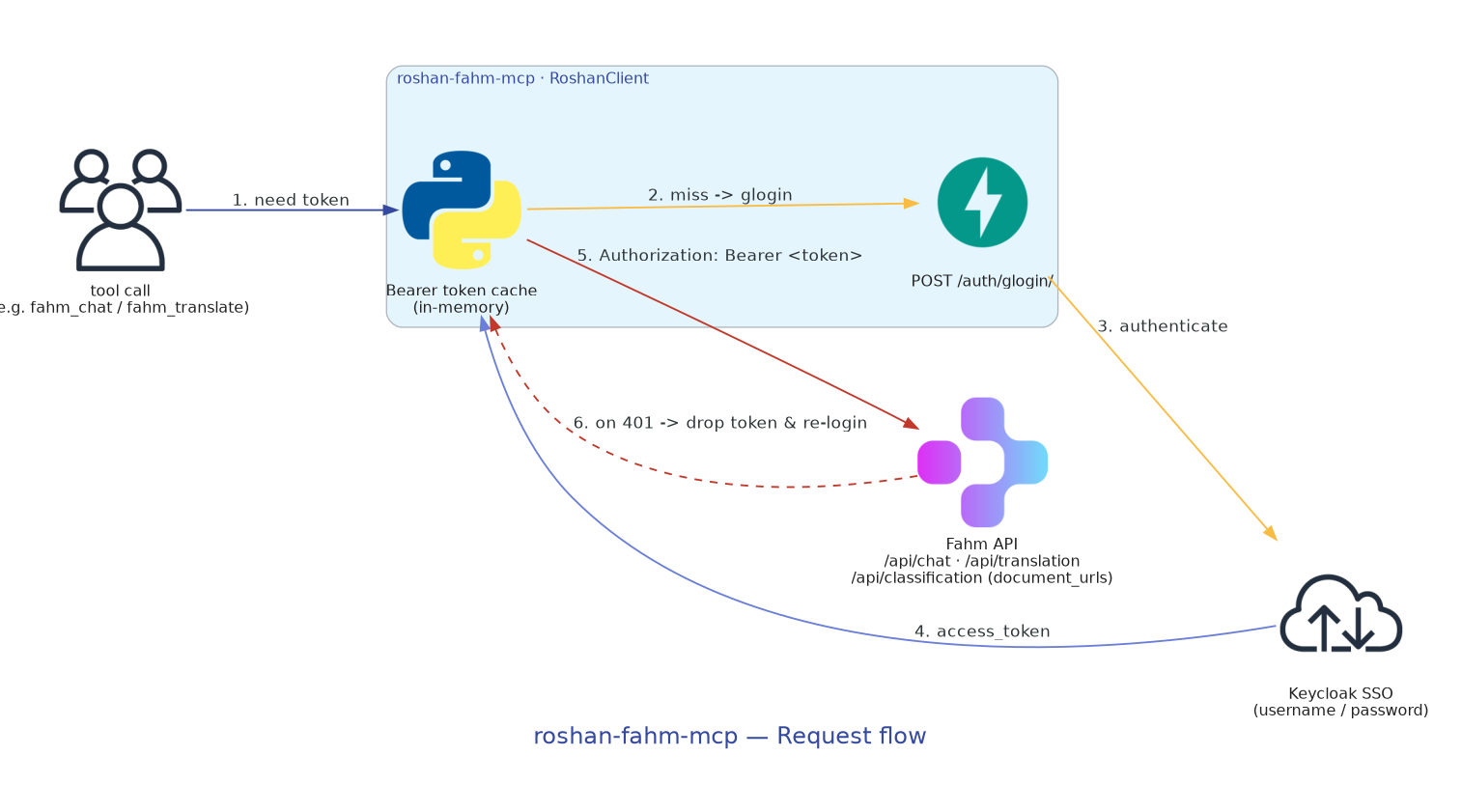
Fahm uses SSO/Bearer auth: a username/password is exchanged for an
access_token via POST /auth/glogin/; the token is then sent as
Authorization: Bearer <access_token> on every request (you may also supply a
static token directly). The client does this transparently, caches the token in
memory, and re-logs-in once on a 401.
The host root is https://fahm.roshan-ai.ir; service endpoints live under
/api/... and login under /auth/glogin/.
| # | Fahm endpoint | Persian | What it does | MCP tool(s) |
|---|---|---|---|---|
| 1 | POST /auth/glogin/ | ورود | Exchange username/password for a Bearer access_token. | handled inside the client |
| 2 | POST /api/chat/ | گفتگو | Chat with the LLM, optionally grounded on documents/media; supports history, deep research and search_mode (e.g. alefba). | fahm_chat |
| 3 | GET /api/chat/list/ | فهرست گفتگوها | List chats / service history, or fetch one chat's history by id. | fahm_list_chats |
| 4 | POST /api/translation/ | ترجمه | Translate text or Alefba documents into Persian (fa) or English (en); source language auto-detected. | fahm_translate_text, fahm_translate_documents, fahm_translate |
| 5 | POST /api/summarization/ | خلاصهسازی | Summarize text or documents — prose (word, متنی) or bullet list (bullet, فهرستوار). Sent as multipart/form-data. | fahm_summarize, fahm_summarize_document |
| 6 | POST /api/letter/ | تولید متن | Generate a piece of text (e.g. a letter) from a topic/instruction. | fahm_generate_letter |
| 7 | POST /api/text-correction/ | ویرایش متن | Correct/edit text following a free-form instruction. | fahm_correct_text |
| 8 | POST /api/classification/ | دستهبندی اطلاعات | Classify several Alefba documents into one of a supplied set of labels. | fahm_classify |
| 9 | POST /api/information-extraction/ | استخراج اطلاعات | Answer a list of questions against each of several Alefba documents. | fahm_extract_information |
| 10 | GET /api/healthcheck | سلامت ایپیآی | Liveness/readiness probe ({status, message, service, version}). | healthcheck |
Alefba document URLs. Several tools accept
document_urlspointing at Roshan's Alefba system. The URL is the part of the panel image URL betweenpage_image/and@page(e.g.http://alefba.roshan-ai.ir/media/files/.../sample_persian_1.pdf).
Every tool accepts an optional instance: str | None = None (omit to use the
default instance). On bad input or an API error, tools return a structured
{"error": ..., "message": ...} payload instead of raising.
| Tool | Endpoint · method | Key parameters | Returns |
|---|---|---|---|
fahm_chat | /api/chat/ · POST | query, history, stream, document_urls[], media_urls[], deep_research, search_mode | response, chat_id, service_history_id |
fahm_list_chats | /api/chat/list/ · GET | id? (a chat id for history) | count, next, previous, services[]{id,name,type,created_at,updated_at} |
fahm_translate_text | /api/translation/ · POST | content, to (fa|en) | result, info{in_token,out_token,language,document_url}, content, chat_id |
fahm_translate_documents | /api/translation/ · POST | document_urls[], to (fa|en) | result, info{…,document_url[]}, chat_id |
fahm_translate | /api/translation/ · POST | content or document_urls[], to | (ergonomic wrapper) same as above |
fahm_summarize | /api/summarization/ · POST | content or document_urls[], type (word|bullet) | result, info{in_token,out_token,type,document_url}, content, chat_id |
fahm_summarize_document | /api/summarization/ · POST | document_urls[], type (word|bullet) | (ergonomic wrapper) same as above |
fahm_generate_letter | /api/letter/ · POST | content (topic) | result, content, chat_id |
fahm_correct_text | /api/text-correction/ · POST | text, description | result, chat_id |
fahm_classify | /api/classification/ · POST | document_urls[], tags[] ({title,description}) | results[]{tags[]}, info, content[], chat_id |
fahm_extract_information | /api/information-extraction/ · POST | document_urls[], questions[] ({title,text,type}) | questions[], answers[][], info, chat_id |
healthcheck | /api/healthcheck · GET | instance | ok, instance, base_url, response|message |
list_instances | (local) | — | default_instance, instances[]{name,base_url,has_credentials} (never secrets) |
roshan_fahm_docs | (local) | topic? | Built-in docs for the service and tools, with links to https://docs.roshan-ai.ir |
Explore everything offline with:
python examples/inspect_server.py
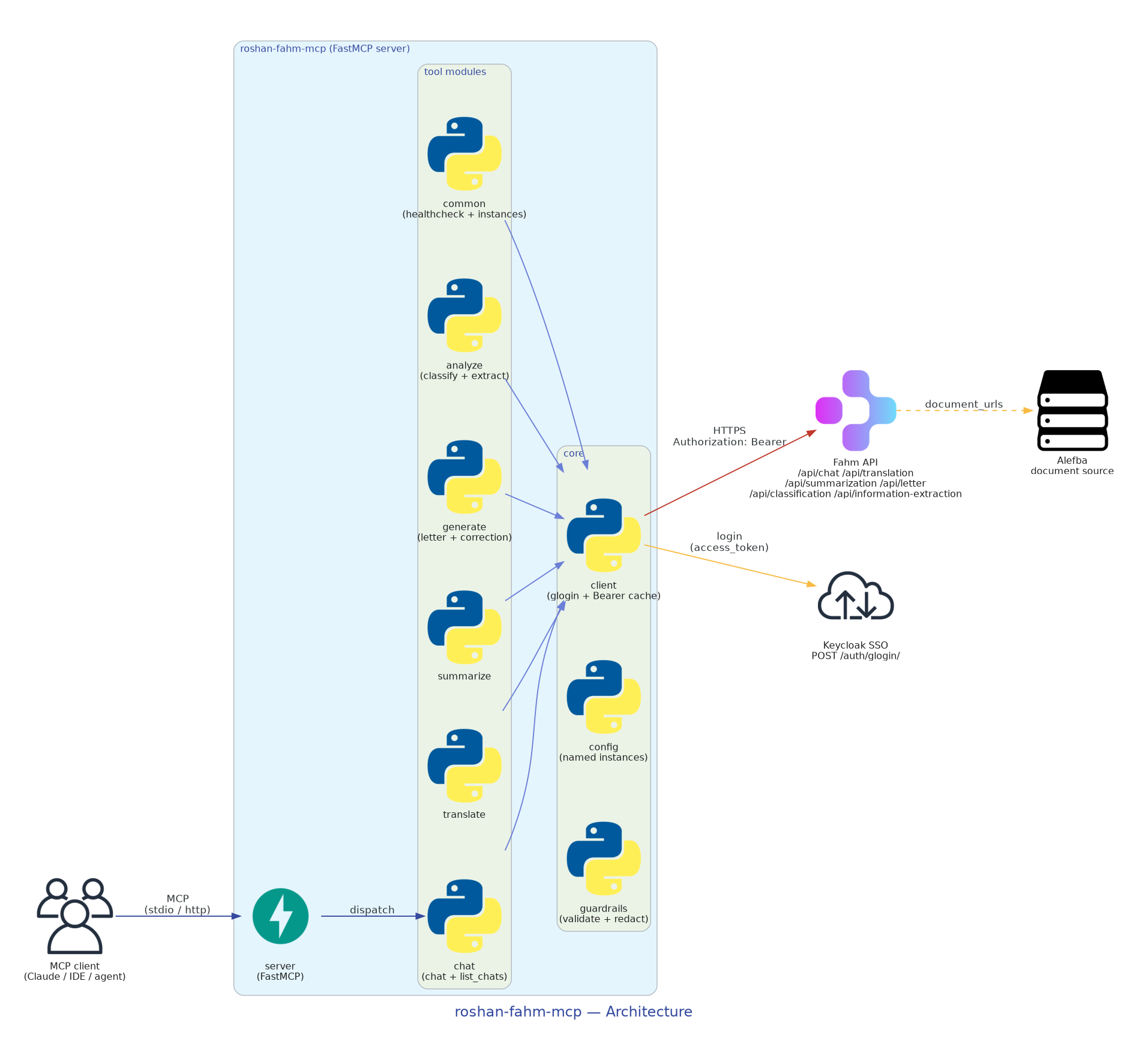
How a client request reaches Fahm through the server's tool modules and HTTP client — including the Keycloak SSO login and the Alefba document source:
The authentication flow — SSO login at /auth/glogin/, in-memory Bearer token
cache, authenticated /api/... calls, and re-login on 401:
Regenerate the diagrams with make diagrams (or
python assets/diagrams/generate_diagrams.py). It rasterizes the official Fahm
icon with cairosvg and renders with Graphviz dot.
Requires Python 3.10+.
git clone <this-repo> && cd roshan-fahm-mcp
python3 -m venv .venv && source .venv/bin/activate
pip install -e ".[dev]"              # runtime + test/lint extras
# (optional, for regenerating diagrams)
pip install diagrams cairosvg        # also needs Graphviz `dot` on PATH
Or with Docker:
docker build -t roshan-fahm-mcp .
docker run --rm -p 8000:8000 \
  -e ROSHAN_FAHM_USERNAME=your-user \
  -e ROSHAN_FAHM_PASSWORD=your-pass \
  roshan-fahm-mcp
A docker-compose.yml with two instances and an
.env.example (referenced via env_file) are provided too:
cp .env.example .env   # fill in credentials
docker compose up
Configuration is entirely environment-driven. There are two styles. base_url
is always the host root (the client appends /api/... and /auth/glogin/).
The quickest way to configure the default instance:
| Variable | Description |
|---|---|
ROSHAN_FAHM_BASE_URL | Fahm host root (default https://fahm.roshan-ai.ir). |
ROSHAN_FAHM_USERNAME | Username for POST /auth/glogin/. |
ROSHAN_FAHM_PASSWORD | Password for POST /auth/glogin/. |
ROSHAN_FAHM_TOKEN | Static Bearer access token (use instead of username/password). |
export ROSHAN_FAHM_USERNAME=alice
export ROSHAN_FAHM_PASSWORD=s3cr3t
For multiple self-hosted deployments, use the ROSHAN_FAHM__ namespace with
__ as the nesting delimiter:
| Variable | Description |
|---|---|
ROSHAN_FAHM__DEFAULT_INSTANCE | Instance used when a call omits instance (default default). |
ROSHAN_FAHM__LOG_LEVEL | DEBUG / INFO / WARNING / ERROR (default INFO). |
ROSHAN_FAHM__INSTANCES__<NAME>__BASE_URL | Fahm host root for <NAME>. |
ROSHAN_FAHM__INSTANCES__<NAME>__USERNAME | Login username for <NAME> (SSO /auth/glogin/). |
ROSHAN_FAHM__INSTANCES__<NAME>__PASSWORD | Login password for <NAME> (SSO /auth/glogin/). |
ROSHAN_FAHM__INSTANCES__<NAME>__TOKEN | Static Bearer token for <NAME> (instead of username/password). |
ROSHAN_FAHM__INSTANCES__<NAME>__VERIFY_SSL | false to skip TLS verification (self-signed dev hosts). |
ROSHAN_FAHM__INSTANCES__<NAME>__TIMEOUT | Per-request timeout in seconds (default 60). |
# Tenant A logs in with credentials; on-prem uses a static token over a
# self-signed cert.
export ROSHAN_FAHM__INSTANCES__TENANTA__BASE_URL=https://fahm.tenant-a.internal
export ROSHAN_FAHM__INSTANCES__TENANTA__USERNAME=alice
export ROSHAN_FAHM__INSTANCES__TENANTA__PASSWORD=s3cr3t
export ROSHAN_FAHM__INSTANCES__ONPREM__BASE_URL=https://fahm.on-prem.local
export ROSHAN_FAHM__INSTANCES__ONPREM__TOKEN=xxxxxxxx
export ROSHAN_FAHM__INSTANCES__ONPREM__VERIFY_SSL=false
export ROSHAN_FAHM__DEFAULT_INSTANCE=tenanta
See .env.example for a complete, ready-to-copy file (default +
onprem instances + global settings). If both styles are present, nested config
wins for a given instance. The list_instances tool shows what is configured
(names and base URLs only).
Run the server over stdio and register it with your client. Example client configuration:
{
  "mcpServers": {
    "roshan-fahm": {
      "command": "python",
      "args": ["-m", "roshan_fahm_mcp"],
      "env": {
        "ROSHAN_FAHM_BASE_URL": "https://fahm.roshan-ai.ir",
        "ROSHAN_FAHM_USERNAME": "alice",
        "ROSHAN_FAHM_PASSWORD": "s3cr3t"
      }
    }
  }
}
If you installed the package, the console script roshan-fahm-mcp works as the
command too.
python -m roshan_fahm_mcp --transport streamable-http --host 0.0.0.0 --port 8000
Then point your client at http://<host>:8000. The sse transport is also
available (--transport sse).
A single process can route to many self-hosted Fahm deployments, chosen per call
via instance, each with its own credentials:
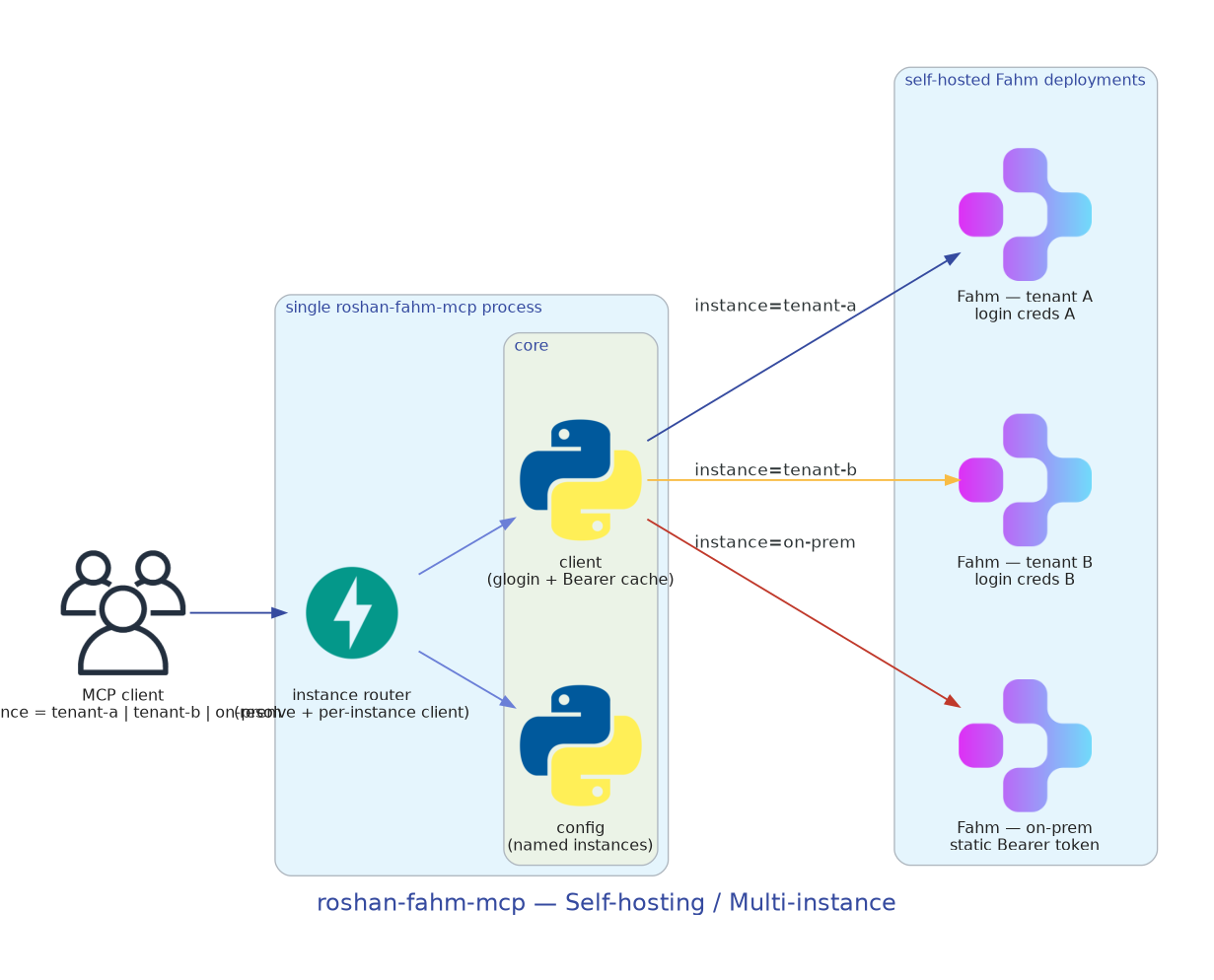
BASE_URL to your own Fahm deployment's
host root. Use VERIFY_SSL=false for self-signed certificates in development.ROSHAN_FAHM__INSTANCES__<NAME>__*
blocks as you need; every tool takes an instance argument to pick one. Omit
it to use ROSHAN_FAHM__DEFAULT_INSTANCE.401. A
HorizontalPodAutoscaler is included for Kubernetes.list_instances never returns secrets.Production-ready manifests live in deploy/:
deploy/helm/roshan-fahm-mcpdeploy/kubernetesdeploy/terraformEach carries the instance credentials (username / password / token) in a
Kubernetes Secret and the non-secret config (base URL, verify_ssl) in a
ConfigMap. See deploy/README.md for step-by-step
instructions, including multi-instance configuration, ingress, and autoscaling.
The unit suite is fully offline — all HTTP (including the /auth/glogin/
exchange) is mocked with respx:
python scripts/smoke_test.py        # offline tool sanity check
python -m pytest -q                 # unit tests
ruff check src tests                # lint
CI (GitHub Actions) runs lint + smoke test + pytest across Python 3.10/3.11/3.12
on every push and pull request, builds the Docker image (pushing to GHCR off
non-PR events), and on a v* tag builds the sdist/wheel and attaches them to the
GitHub Release. Dependabot keeps pip and github-actions dependencies current.
Optional live tests run against a real Fahm deployment when you opt in:
export ROSHAN_FAHM_BASE_URL=https://fahm.roshan-ai.ir
export ROSHAN_FAHM_USERNAME=... ROSHAN_FAHM_PASSWORD=...
export ROSHAN_FAHM_LIVE=1
pytest tests/live -q
MIT. "Roshan", "Fahm" (فهم) and related names/logos belong to their respective owners; this project only integrates with their API. Comply with Roshan AI's terms of service when using their service through this server.

40+ tools for querying dashboards, alerts, datasources, and logs in Grafana
Run Claude Code as an MCP server so any agent can delegate coding tasks to it
 @microsoft✓ Official
Browser automation using accessibility snapshots instead of screenshots
 @googleapis✓ Official
Google's universal MCP server supporting PostgreSQL, MySQL, MongoDB, Redis, and 10+ databases