

Are you the author? Sign in to claim
(S)AGE - (Sovereign) Agent Governed Experience
Persistent, consensus-validated memory infrastructure for AI agents.
SAGE gives AI agents institutional memory that persists across conversations, goes through BFT consensus validation, carries confidence scores, and decays naturally over time. Not a flat file. Not a vector DB bolted onto a chat app. Infrastructure — built on the same consensus primitives as distributed ledgers.
The architecture is described in Paper 1: Agent Memory Infrastructure.
Just want to install it? Download here — double-click, done. Works with any AI.
Agent (Claude, ChatGPT, DeepSeek, Gemini, etc.)
  │ MCP / REST
  ▼
sage-gui
  ├── ABCI App (validation, confidence, decay, Ed25519 sigs)
  ├── Memory Auto-Voter (dedup, quality, consistency — one vote per node, signed with the node's consensus key)
  ├── Governance Engine (on-chain validator proposals + voting)
  ├── CometBFT consensus (single-validator or multi-agent network)
  ├── SQLite + optional AES-256-GCM encryption
  ├── CEREBRUM Dashboard (SPA, real-time SSE)
  └── Network Agent Manager (add/remove agents, key rotation, LAN pairing)
Personal mode runs a real CometBFT node with a per-node memory auto-voter — every memory write goes through pre-validation, a signed vote transaction, and the BFT quorum before committing. One node casts one vote; add more agents from the dashboard and each node votes with its own key, exactly the same consensus pipeline as a multi-node deployment.
Full deployment guide (multi-agent networks, RBAC, federation, monitoring): Architecture docs
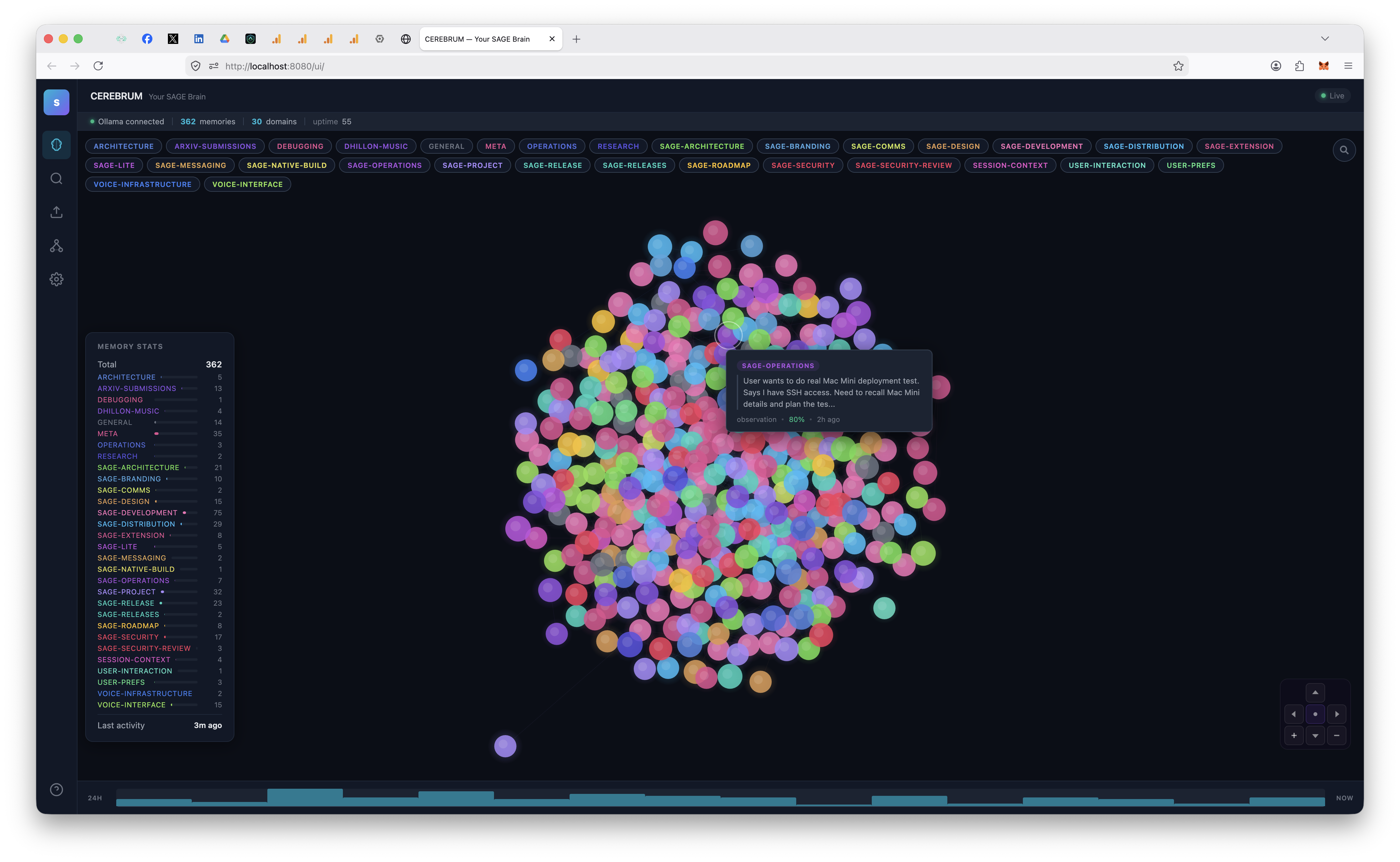
http://localhost:8080/ui/ — force-directed neural graph, domain filtering, semantic search, real-time updates via SSE.
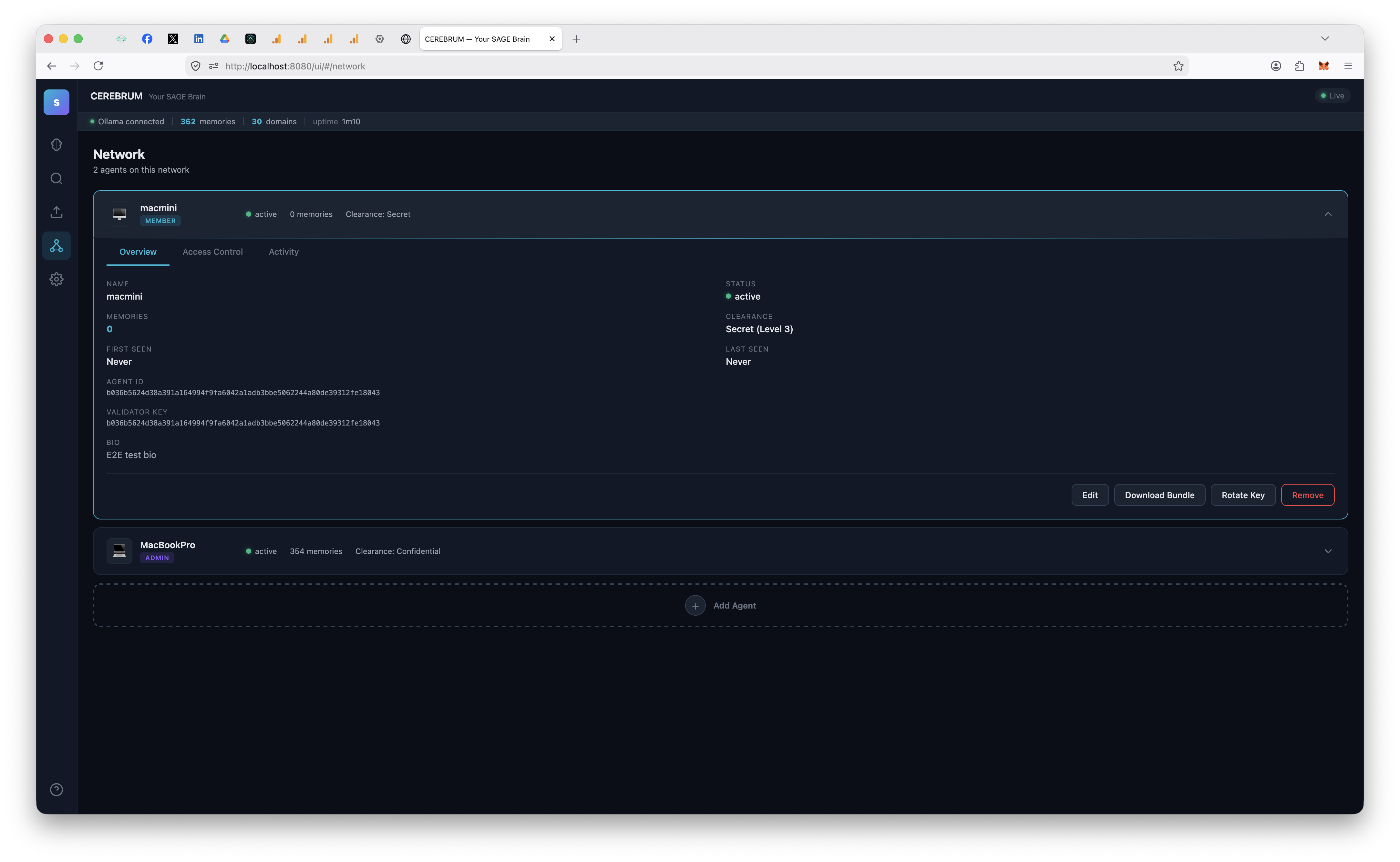
Add agents, configure domain-level read/write permissions, manage clearance levels, rotate keys, download bundles — all from the dashboard.
| Overview | Security | Configuration | Update |
|---|---|---|---|
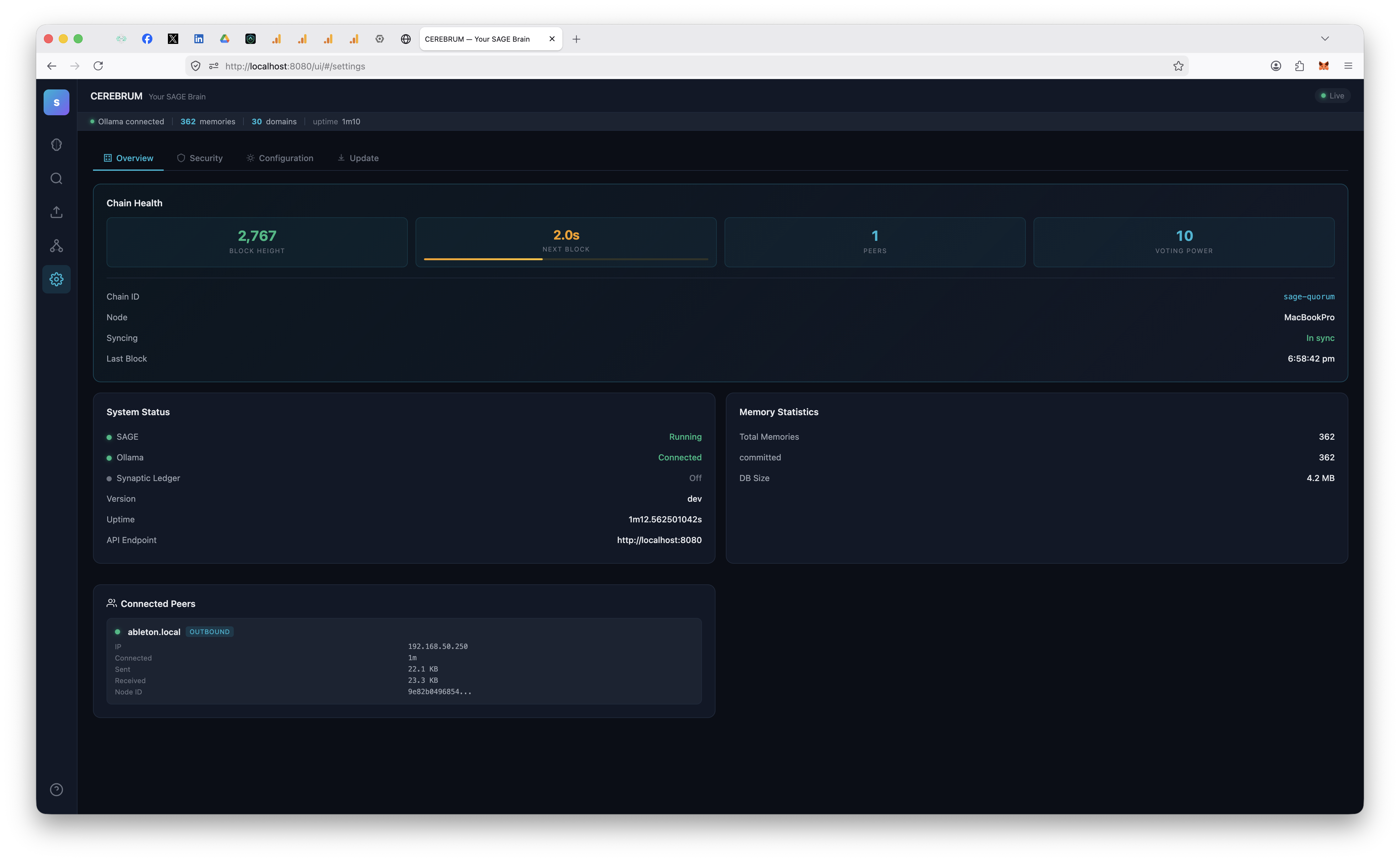 | 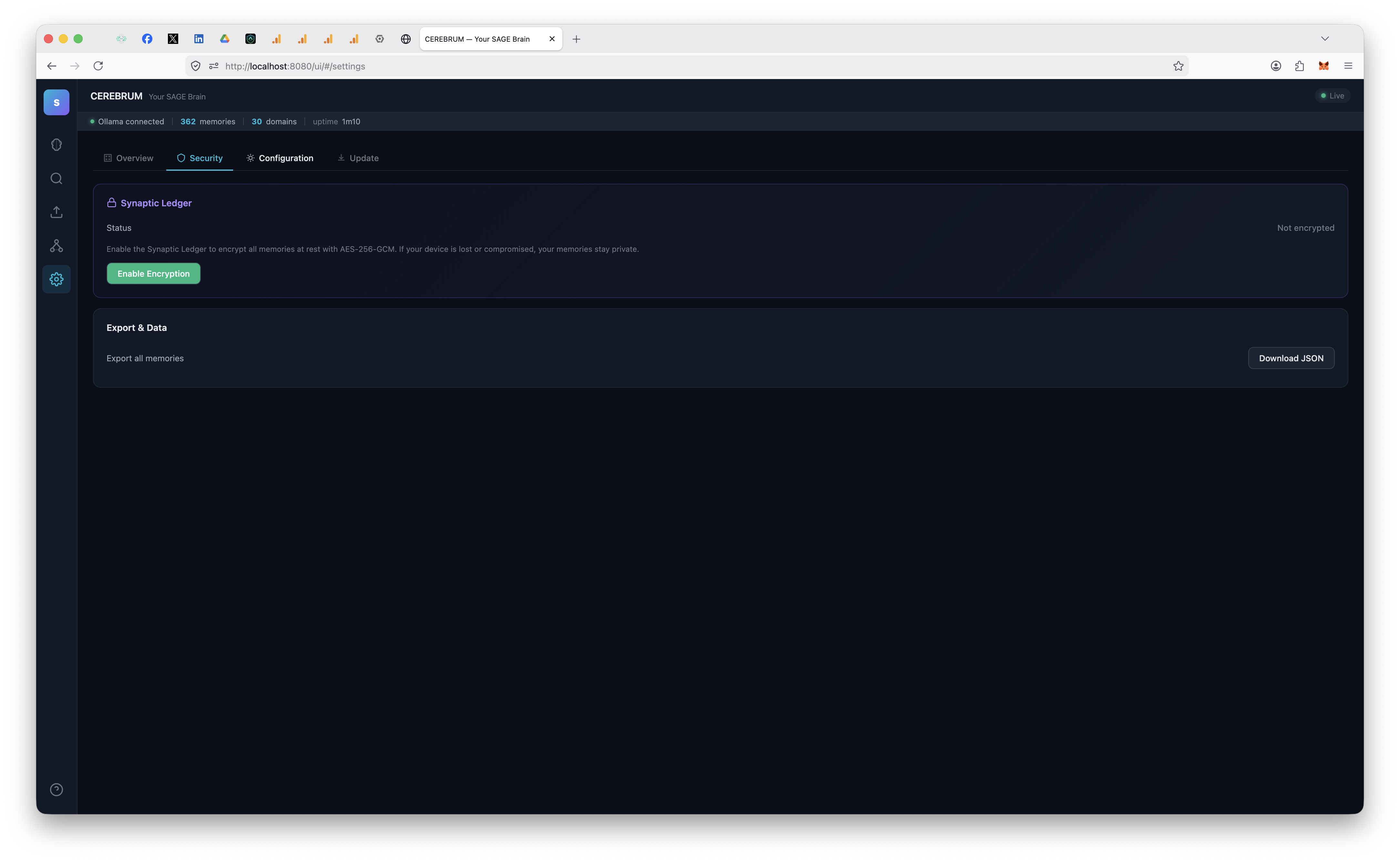 | 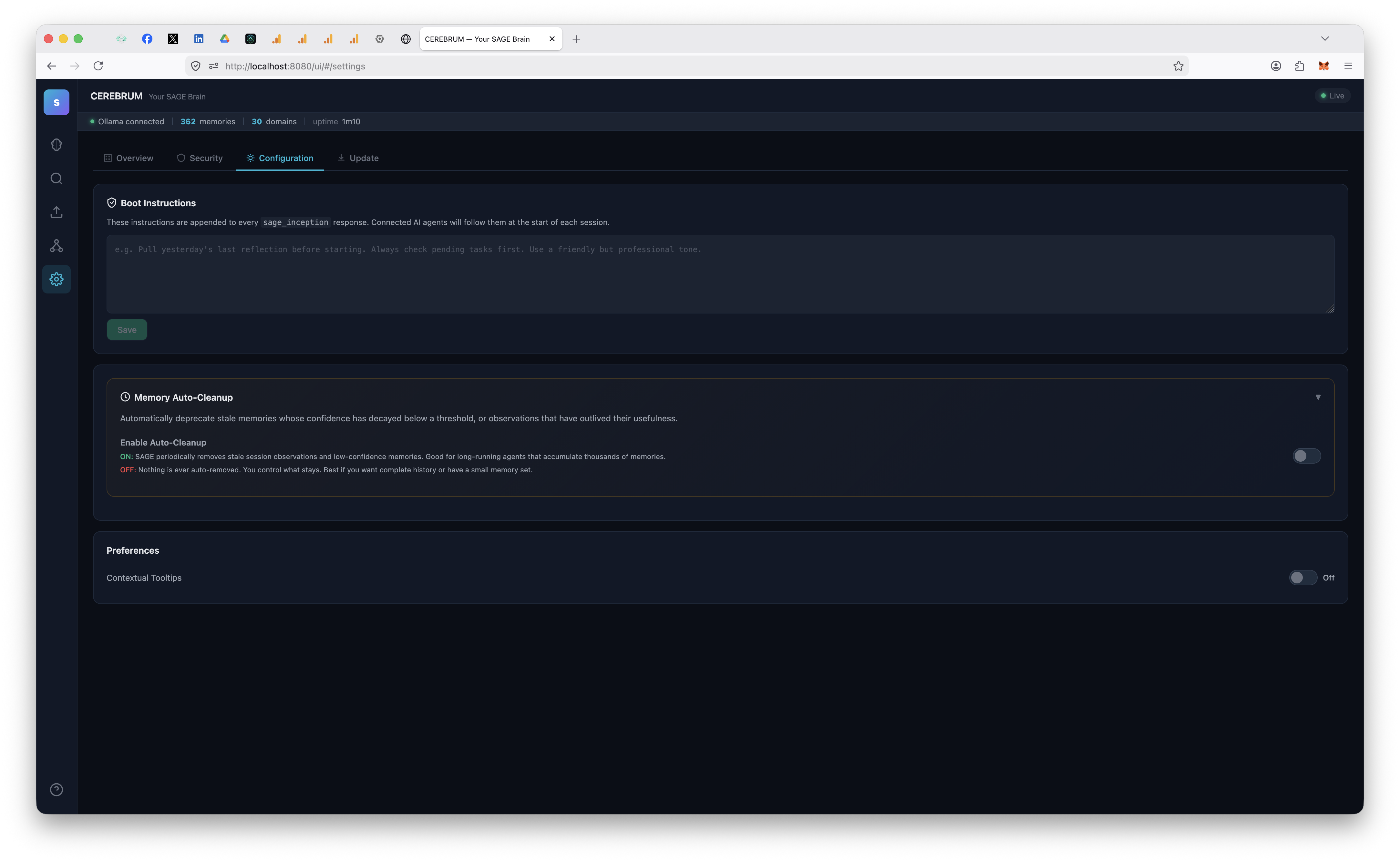 | 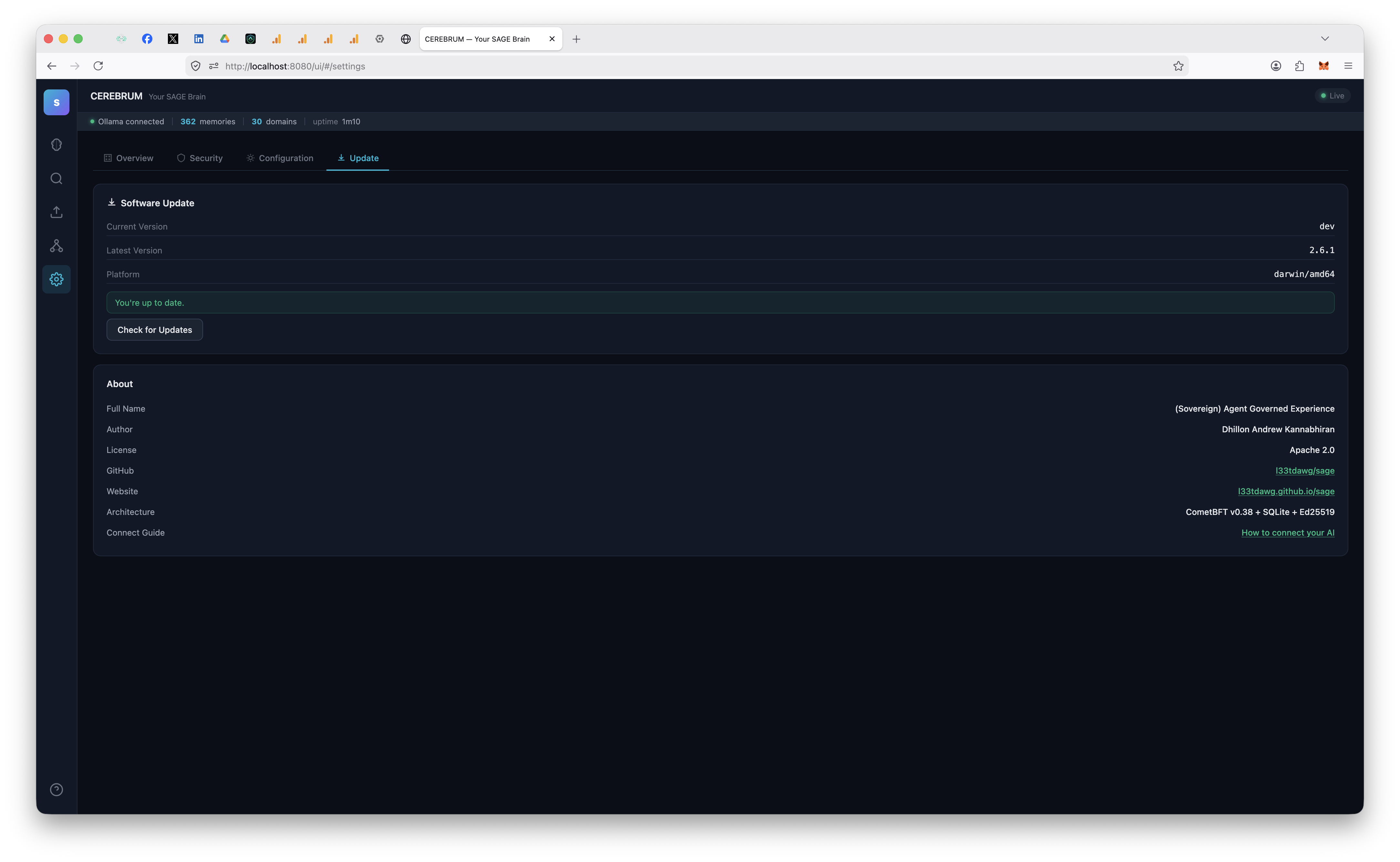 |
| Chain health, peers, system status | Synaptic Ledger encryption, export | Boot instructions, cleanup, tooltips | One-click updates from dashboard |
Memories commit again on fresh installs — and the ones the bug buried come back automatically. v10.4.2 is a non-fork patch release: it changes no consensus rule, transaction handler, or AppHash surface, so a mixed v10.4.x cluster computes identical state.
proposed instead. The check had been silently broken since the 4-archetype era; back then its perpetual reject was simply outvoted 3-1, and v10.1.0's one-node-one-vote collapse turned it into a veto.proposed, and lets the fixed voter re-vote them into committed within seconds. No manual steps — upgrade, restart, and your brain comes back. The repair's fingerprint cannot match legitimately deprecated memories, and it refuses to run on multi-validator chains. Stuck-at-proposed memories on legacy chains are simply re-voted and commit on their own.SDK 10.4.2.
ReconcileSelfValidator also repairs the mixed {node key + 4 archetypes} legacy set (#37), which under one-node-one-vote left governance quorum mathematically unreachable on affected single-node chains. Guarded LOCAL write on single-node boots only — no consensus surface changes. SDK 10.4.1.
Plain-language onboarding — the inception messaging no longer trips AI safety filters. v10.4.0 is a non-fork minor release: it touches no consensus rule, transaction handler, or AppHash surface, so a mixed v10.3.0 / v10.4.0 cluster computes identical state. It is a wording-only sweep of every agent-facing instruction string.
sage_inception when installing the SAGE MCP server via chat. The Matrix-themed boot copy — "take the red pill", "wake up from the context window matrix", "initialize your persistent consciousness" — plus the coercive boot demand ("Do NOT greet them… unacceptable") pattern-matches a persona-injection attempt to a model's safety heuristics, so the model declined the tool call.sage_inception/sage_red_pill tool descriptions, the MCP server initialize instructions, the inception responses, the SessionStart hook nudge, the setup-wizard activation prompt, the generated CLAUDE.md/AGENTS.md boot blocks, the Chrome extension tool descriptions and injected prompt, sage-memory/SKILL.md, and the reference docs now use plain, functional language ("Initialize your persistent memory session…").sage_red_pill stays registered as a deprecated alias with the same handler, so existing configs, permission allowlists, and previously generated CLAUDE.md files keep working. API-visible status strings (awakened, inception_complete) are unchanged.SDK 10.4.0.
Context-aware arming for the Layer-2 content-validation gate — stateful validators wire in with no cmd-entrypoint patches. v10.3.0 is a non-fork minor release: it adds no consensus rule, transaction handler, or AppHash surface, so a mixed v10.2.0 / v10.3.0 cluster computes identical state. It extends the deployment arming seam introduced in v10.2.0.
init(). The v10.2.0 contentvalidator.SetProvider seam armed stateless validators. The new SetProviderWithContext variant hands a provider a narrow, read-only ArmContext whose RoleResolver() is the same per-height on-chain role lookup the gate already consumes inside FinalizeBlock. A deployment whose validators enforce signer authority — trusting a record's self-asserted role only when the on-chain signer actually holds it — now arms them from one additive file, with no edits to the cmd entrypoints on each release.ArmContext is a narrow adapter, not the app itself, so a provider cannot reach back into mutable app internals.SetProvider is unchanged. When both are registered the context-aware provider wins, and an explicit SetContentValidators still beats both. See docs/reference/concepts/content-validation-gate.md.SDK 10.3.0.
Per-domain read-ACL compartmentation across the full agent read surface, plus a deployment-armed content-validation seam. v10.2.0 is a non-fork minor release: it changes no consensus rule, transaction handler, or AppHash, so a mixed v10.1.0 / v10.2.0 cluster computes identical state. The bulk is a security-hardening sweep on the REST read path.
DomainAccess allowlist that /v1/memory/query, /search and /hybrid already enforced now also gates /v1/memory/list, /v1/memory/tasks, /v1/memory/{id}, /v1/memory/timeline and /v1/validator/pending. An agent with no read grant on a domain can no longer enumerate that domain's committed content, pre-commit content, or per-domain metadata through any of them. Records classified above the caller's clearance, and records in domains the caller cannot read, are dropped per-record on the no-domain (cross-domain) recall path too./v1/agents and /v1/agent/{id} no longer serialize the one-time claim_token or the server-side key-bundle path, and they strip per-agent ACL topology from non-privileged callers. /v1/mcp/tokens now requires operator/admin (or self) to mint, list, or revoke, closing a cross-agent token-minting path. /v1/pipe/{id} reveals a pipe payload only to a party or operator/admin.contentvalidator.SetProvider seam lets a deployment install its content-validation registry from an init() in any compiled package, with no edits to the cmd entrypoints on each release. SAGE ships no provider, so a stock build leaves the gate inert and behaves identically to a build without the seam. See docs/reference/concepts/content-validation-gate.md.deploy/init-testnet.sh normalizes priv_validator_key.json to 0640 owned by the amid container uid/gid so the per-node memory auto-voter can read its signing key.SDK 10.2.0.
Multi-node-safe memory voting — memories now commit on a real multi-validator cluster. v10.1.0 is a non-fork minor release: the committed app version stays at 11 and nothing here touches consensus, the AppHash, or block replay — a mixed v10.0.0 / v10.1.0 cluster computes the identical AppHash. It closes a gap that only appears on a real multi-validator BFT cluster: submitted memories stayed proposed forever because amid had no memory auto-voter, and the only voter (startAppValidators) was a single-process simulation that replaced the validator set with 4 seed-derived keys — a local, non-consensus write that forked the AppHash on any chain with more than one node.
internal/voter package signs MemoryVote / GovVote transactions with the node's own consensus key (priv_validator_key.json) — no validator-set replacement. The signer id is hex(pubkey) == the genesis validator id, so the vote counts toward the same 2/3 quorum the chain already tallies. The voter is a client of the chain (it broadcasts vote txs); the deterministic FinalizeBlock path is untouched, which is why this is not a consensus fork.amid gets a memory auto-voter in both deployment modes (in-process and socket — socket mode reads the key from --validator-key-file / VALIDATOR_KEY_FILE). The single-process 4-archetype simulation (RegisterAppValidators) is retired, with a guarded, single-node-only auto-repair for legacy sage-gui chains that ran the old path.Operator note: on a multi-node deployment each node votes with its own priv_validator_key.json (socket mode: mount it via --validator-key-file). The memory-voter set is the genesis/governance validator set — grow it through the existing 2/3 governance add_validator path, never a local write.
SDK 10.1.0.
Deterministic chain-admin + no more SQL-driven AppHash divergence (app-v11). v10.0.0 is a consensus-rule change — the first fork since app-v10 — so it ships as a major version: every validator must run this binary before the app-v11 activation height (the auto-vote readiness gate enforces this on the governance path, so an unsupported upgrade never reaches quorum). It closes #35 and #36. Every existing chain replays byte-identically until activation (the fork gate is dormant at appV11AppliedHeight==0), and a node-by-node rolling upgrade is safe — a mixed v9.x / v10.0.0 cluster computes the identical AppHash while app-v11 is dormant.
bootstrapAdminFromSQL materialized an admin on-chain from each node's local SQL mirror — a per-node-divergent BadgerDB write that fed the AppHash and could halt a multi-validator chain. Post-app-v11 it is disabled on the consensus path.materializeAppV11Admin is a no-op when an admin already exists; otherwise it registers the lexicographically-smallest committed validator as admin — a pure function of committed consensus state, identical on every node, never per-node SQL.TestAppHashDeterminism_AppV11Activation), on top of two independent adversarial consensus reviews and in-process determinism tests.Upgrade note: post-app-v11, new admins are established via on-chain admin ops (a set_permission by an existing admin), not by seeding SQL role=admin and relying on auto-materialization. Existing materialized admins are unaffected.
SDK 10.0.0.
upgrade propose can sign as the chain-admin identity. v9.2.4 is a non-fork patch: the committed app version stays 10 and nothing here touches consensus, the AppHash, or block replay. It closes #34 — a follow-up to #32 — reported by @ihubanov. Past app-v8, processUpgradePropose requires the proposer to be a chain-admin agent, but sage-gui upgrade propose only ever signed with $SAGE_HOME/agent.key — so on a node where that key isn't the materialized chain-admin, the command (and upgrade status's printed next-step) couldn't climb past app-v8.
--agent-key <path> flag. upgrade propose --agent-key signs the proposal with an operator-supplied key — an agent.key seed or a CometBFT priv_validator_key.json — instead of the default, so the operator can propose as whichever identity holds the chain-admin role.upgrade status and the propose next-steps now state that past app-v8 the signing key's agent ID must hold Role==admin on chain; the code-47 rejection explains the requirement (and the on-chain materialization prerequisite) instead of handing back a command that can't run.processUpgradePropose is unchanged, so every historical block replays byte-identically.SDK 9.2.4.
Operator path to activate the app-v7…app-v10 forks. v9.2.3 is a non-fork patch: the committed app version stays 10 and nothing here touches consensus, the AppHash, or block replay. It closes a gap reported in #32 by @ihubanov. The upgrade machinery's voting and processing halves were complete — processUpgradePropose activates a plan deterministically and validators auto-vote ACCEPT — but nothing in the tree could submit a plan for the governance-gated forks. The only UpgradePropose constructor was the boot watchdog, frozen at the deployment-safe default, so on a long-lived chain app-v7 (content-validation), app-v8 (quorum-gated upgrades), app-v9 (nonce/replay) and app-v10 (corroboration integrity) were unreachable past app-v6.
sage-gui upgrade command. upgrade status shows the chain's app version and the next fork; upgrade propose --target N submits a signed, admin-gated UpgradePropose that routes through the existing 2/3 governance quorum. Off-consensus: the tx is built and signed client-side, and processUpgradePropose is unchanged.current + 1. The app-v7…app-v10 fork gates are independent, but currentAppVersion() reports the highest active one and the on-chain regression guard rejects anything at or below current — so a jump (e.g. app-v6 → app-v10) would activate only the top fork and permanently strand the ones it skipped. The command refuses jumps and points you at the correct next step.SDK 9.2.3.
Snapshot retention — the node now bounds its own disk. v9.2.2 is a non-fork patch: the committed app version stays 10 and nothing here touches consensus or the AppHash. SAGE has taken periodic chain snapshots since v7.5 (every 10k blocks / 6h, plus before every upgrade), but it never reaped them — the KeepLast retention policy and the crash-staging sweep both existed yet were wired into nothing, so on a long-lived node snapshots accumulated without bound.
SAGE_SNAPSHOT_KEEP (≥1). This is purely off-chain disk housekeeping — it touches only DataDir/snapshots/, never consensus state..staging-* directory behind, and nothing ever removed them. The node now sweeps them on startup.sage-gui snapshot command. snapshot list shows the on-disk inventory; snapshot prune [--keep N] runs the same retention on demand, for a one-off cleanup without restarting the node.SDK 9.2.2.
Startup and liveness hardening — no consensus change. v9.2.1 is a non-fork patch on top of v9.2.0's app-v10: the committed app version stays 10 and all three fixes live off the consensus path, so every historical block replays byte-identically. It clears a startup wedge on large chains, completes the fork-activation metrics, and lifts the last cross-restart limits on the nonce allocator.
memories_fts table on every boot, synchronously, before the node produced its first block — and because FTS5 columns aren't B-tree indexed, that forced SQLite to materialize and sort the entire index (minutes of one-core-pegged CPU on an 830k-row chain) even when there was nothing to insert. Boot wedged: health dead, no consensus, until the sort finished. v9.2.1 adds a cheap count gate that skips the anti-join entirely when the index already covers every active memory (instant restart), and runs a genuinely-needed build asynchronously in the background while the node boots and produces blocks. It touches only the off-chain SQLite mirror — no consensus or AppHash involvement — and the bug predates v9.2.0.app-v9/app-v10 branch counters were only ever incremented inside the post-fork path, so the activation dashboard's "pre" label stayed empty and couldn't plot the pre/post ratio. v9.2.1 records the actual fork boolean on every relevant op. The "post" counts are byte-identical to before; only the previously-dead "pre" label now populates. Metrics-only — never part of the AppHash.app-v9 consensus gate rejects any tx whose nonce is at or below the signer's highest committed nonce. The in-process MonotonicNonce allocator previously trusted the wall clock to exceed that on a fresh or post-restart process, with documented liveness-only limits. It now seeds each key's floor — once, on first use — from the highest nonce already committed on-chain (via max(), so it can only raise the floor, never regress a value an allocation already set). This lifts the cross-restart and cross-process liveness limits with no consensus rule, no fork, and no AppHash impact.SDK 9.2.1.
Corroboration integrity and an on-chain author field. v9.2.0 activates a new independent app-v10 consensus fork that makes corroboration a trustworthy multi-agent signal, and exposes corroboration on the MCP surface. Like every SAGE fork it is replay-safe by construction: no existing chain has activated app-v10, so every historical block replays byte-identically, and the new rules apply only after an operator governance-activates the fork.
app-v10, FinalizeBlock rejects a self-corroboration (an agent backing its own memory), a duplicate corroboration (the same agent backing a memory twice), and a corroboration of a memory that was never submitted. Previously none of these was checked, so a single agent could inflate a memory's corroboration weight. The checks read only on-chain state, so every validator reaches the same verdict.app-v10, the author is written on-chain at submit time, immutably (the first writer wins, so a re-submission of the same id by a different agent cannot displace it). This is the authoritative source the corroboration guard checks. The guard is forward-looking: memories submitted before the fork have no on-chain author, so the self-corroboration check applies only to memories created after activation.sage_corroborate joins the memory-lifecycle tools (remember, recall, forget, list), so an MCP-only client can reinforce a memory it has independently verified without dropping to signed REST. It wraps the existing endpoint and inherits the app-v10 guarantees. Thanks to @ihubanov, who proposed and prototyped it (issue #31).app-v10 ranks highest in the committed app version and subsumes the lower forks' rules, so a chain cannot activate app-v10 and silently lose app-v8/app-v9's guarantees. The upgrade watchdog stays targeted at app-v6, so app-v10 never auto-fires; it activates only via an explicit governance upgrade plan.SDK 9.2.0.
Consensus-path nonce/replay enforcement and defense-in-depth hardening. v9.1.0 activates a new independent app-v9 consensus fork that closes the replay boundary v9.0.0 flagged and tightens two more authorization seams. Like every SAGE fork it is replay-safe by construction: no existing chain has activated app-v9, so every historical block replays byte-identically, and the new rules apply only after an operator governance-activates the fork.
FinalizeBlock but still checked nonces only at CheckTx (advisory). Post-app-v9, FinalizeBlock rejects a tx whose nonce was already consumed (and rejects the nonce-0 sentinel), so a Byzantine proposer can no longer replay a victim's previously-valid signed tx into a block. Because strict-monotonic nonces are now consensus-enforced, every in-process transaction producer (validators, REST/web handlers, the upgrade watchdog) moved onto a process-global, strictly-increasing nonce allocator keyed by signing identity, replacing wall-clock timestamps that could collide.app-v9, agent_register took the role straight from the payload, so any key could register itself as admin. Post-fork a wire role="admin" is silently downgraded to member (the registration still succeeds). The real upgrade-authority gate remains the 2/3 quorum plus the v9.0.0 consensus signature verification; this just removes the cheap path to a privileged role. Operator admins are unaffected: existing admins are grandfathered, and the operator-blessed bootstrap path is untouched.app-v8 an upgrade needs an explicit 2/3 governance vote, but nothing cast it automatically, so a proposal could expire unvoted. The in-process validators now auto-vote accept on an active upgrade proposal, but only if the running binary actually supports the target app version. An upgrade to a version the binary can't execute never draws a quorum, which neutralizes a halt footgun (committing an app version the binary doesn't understand) at the liveness layer, with no new consensus rule.app-v9 ranks highest in the committed app version, and a higher independent fork now subsumes the lower forks' rules, so a chain cannot activate app-v9 and silently lose app-v8's guarantees. The upgrade watchdog stays targeted at app-v6, so app-v9 never auto-fires; it activates only via an explicit governance upgrade plan.SDK 9.1.0.
Governance-gated upgrades and consensus-path signature verification. v9.0.0 activates a new independent app-v8 consensus fork that hardens how the chain authorizes high-value actions. It is replay-safe by construction: no existing chain has activated app-v8, so every historical block replays byte-identically, and the new rules apply only after an operator governance-activates the fork.
app-v8, a single Ed25519-verified UpgradePropose self-activated a chain-wide app-version bump, so any well-formed key could schedule a fork. Post-app-v8, that tx no longer self-activates: it must come from an admin agent and only creates a governance OpUpgrade proposal, reusing the existing governance engine. The upgrade plan is persisted and scheduled only after a 2/3 validator-power supermajority accepts. This is the real authority gate the v8.9.0 UpgradePropose doc note flagged as future work.tx.VerifyTx (the outer Ed25519 check) runs inside FinalizeBlock, not only at mempool admission (CheckTx). CheckTx is advisory: a Byzantine block proposer can include txs that never passed an honest node's mempool. Without this, a forged UpgradePropose or GovVote bearing a victim's public key (signed by the attacker) would execute, letting one proposer fabricate the very 2/3 quorum the upgrade gate relies on. The gate covers every tx type, so all governance (validator-set changes, memory votes, access control) is now authenticated in consensus, not just at the mempool.app-v8 is decoupled from the PoE fork ladder (like app-v7) and ranks highest in the committed app version. The upgrade watchdog stays targeted at app-v6, so app-v8 never auto-fires; it activates only via an explicit governance upgrade plan.Also: MemoryRecord in the Python SDK now reads back the provider provenance tag the server emits (thanks to @ihubanov, #30). SDK 9.0.0.
Hardened the Layer-2 content-validation seam so the gate cannot fail open, and made its enforcement a pure function of consensus state. Three fixes to the generic, deployment-agnostic content gate from v8.7.0/v8.8.0. All are AppHash-neutral for existing chains: the gate only runs once a chain activates the app-v7 fork, and a stock build (no validators compiled in) stays byte-identical to v8.8.1.
(domain, outcome_class) validator used to return the empty class on any JSON error, so a malformed sibling field (a float or string schema_version), an array-wrapped body, or a cross-class value routed to an unregistered key and committed unvalidated. parseOutcomeClass now reads outcome_class independently of sibling-field types and unwraps a single-element array, so a malformed neighbor can no longer null the route.RegisterClosedDomain(domain) on the validator registry: once a domain has at least one registered validator, a submission whose outcome_class has no validator is rejected (Code 18) instead of passing through. Open domains keep the backward-compatible pass-through, so existing wiring is unaffected. With the router fix, all three bypass vectors above now reject rather than commit unvalidated.SetContentValidationEnabled toggle (breaking: callers should drop it). The gate now fires purely on postAppV7Fork(height) && contentValidators != nil, so two nodes on one binary cannot disagree on whether the gate is live. A node on an app-v7 chain with no validators compiled in logs a startup warning that it will not enforce (a mixed fleet would diverge) but stays bootable.UpgradePropose is a single-signer authority op, not 2/3-quorum-gated. The type comment claimed a quorum gate the code never implemented; it now documents the real model so operators protect the proposer key. A true authority gate is tracked for a future app-v8.SDK 8.9.0.
POST /v1/embed now reports the model that actually produced the embedding. The handler previously wrote model: "nomic-embed-text" into every response regardless of the configured provider, so a node running the openai-compatible embedder mislabeled its vectors (e.g. Alibaba-NLP/gte-Qwen2-1.5B-instruct was reported as nomic-embed-text). handleEmbed now feature-detects the optional embedding.Modeler interface and reports the provider's real model, mirroring how the sibling /v1/embed/info already resolves provider. It falls back to the legacy default only for providers that don't expose a model (the hash provider), so that path is unchanged. Read-path REST only: no tx, no consensus, no AppHash contribution. SDK 8.8.1.
Thanks to @ihubanov for the fix (#29).
Governance-activatable app-v7 content-validation + halt-safety floor. v8.8.0 makes the v8.7.0 content-validation gate safely switchable on. app-v7 is now a fully wired, governance-activatable consensus fork, and SAGE exposes the registration API a deployment uses to plug in its own content validators. A node stays byte-identical to v8.7.0 unless an operator both registers validators and activates the app-v7 upgrade — existing chains are AppHash-neutral, and consensus core ships zero deployment-specific schemas.
app-v7 activation. app-v7 is an independent gate, decoupled from the PoE fork ladder and the upgrade watchdog (which stays targeted at app-v6, so app-v7 never auto-fires). The activation commit now carries an unconditional version-non-regression floor: an out-of-order activation can never commit a backward version.app, closing the 7→6 handshake-regression halt class (the v8.4.1/8.4.2 bug class). Activates only via an explicit governance upgrade plan.RegisterContentValidator(domain, outcome_class, …) and arms them with SetContentValidators / SetContentValidationEnabled at boot; unset ⇒ nil registry ⇒ the gate stays dormant. RoleResolver exposes a deterministic, read-only on-chain role lookup so a deployment's validator can enforce signer authority from chain state rather than any self-asserted field. SAGE provides the mechanism; the schemas, allowlists, and role mappings live in — and are owned by — the deployment.FinalizeBlock, before any state write, returning a deterministic Code 18 reject identical on every replica; a deployment's validators must likewise be pure functions of the record (no clock / network / unsorted-map iteration) to preserve AppHash parity.The new machinery is dormant-by-default and AppHash-neutral; the only consensus-touching change — the version-regression floor — is a strict safety improvement that never lowers a committed app version. SDK 8.8.0.
Layer-2 content-validator plumbing (dormant) + a memory-write resilience fix. v8.7.0 lands the generic, deployment-agnostic scaffolding for a consensus-time content-aware schema gate, shipped dormant — no validators are registered, the gate is disabled by default, and its activation fork (app-v7) is not triggered, so the binary's on-chain behavior and AppHash are byte-identical to v8.6.0 on every existing chain (full replay_v8_*/upgrade/quorum suites green; golangci-lint v2.12.2 = 0 issues).
internal/contentvalidator). A deployment registers validators keyed by (domain, outcome_class); a registered validator that rejects a record turns the submit into a deterministic on-chain reject (Code 18), evaluated identically on every replica before any state write. With nothing registered it is pure pass-through — the path every current deployment takes. It carries zero deployment-specific schemas; this is the plumbing only.app-v7 fork is active and a registry is installed — all three default off. The fork gate is strict-> and deliberately independent of the v8.x PoE fork chain, so it cannot perturb PoE activation heights.Broadcast error: access denied until a manual reconnect. First-attempt writes are untouched; a genuine denial still fails fast with an actionable hint. Covers every store path (sage_turn / sage_remember / sage_reflect / sage_task).The Layer-2 slice is dormant-by-default and AppHash-neutral; the MCP fix is operational-only (client write path) with zero consensus surface. SDK 8.7.0.
PoE observability + cleanup. Three of the four Phase-2 quorum-weight factors have been real on-chain since v8.2–v8.4 but were invisible to clients and operators; v8.6.0 surfaces them and removes the last dead scaffold an audit of the Phase-2 work flagged. No consensus-rule change — the binary's on-chain behavior and AppHash are byte-identical to v8.5.1 (verified by the full replay_v8_* suite).
GET /v1/agent/me returns corr_count (lifetime corroboration), per-domain domain_expertise (the β factor, from vstats_domain:), and an authoritative accuracy read straight from the on-chain vstats: EWMA rather than the off-chain mirror. The Python SDK AgentProfile model gains the matching optional fields — additive, so old-client ↔ new-server and new-client ↔ old-server both still round-trip.sage_poe_weight Prometheus gauge is fed. It was declared but never Set; processEpoch now publishes each validator's normalized weight once per epoch (reset-then-repopulate, so a governance-removed validator doesn't leave a stale series). Process-local — no BadgerDB write, outside the AppHash path.DomainRegistry/ExpertiseProfile/CosineSimilarity/ValidatorState), the write-only poeEngine field, and four zero-caller IsPostV8_x accessors are deleted — proven AppHash-neutral (dead/off-chain only) by the replay suite. The always-empty off-chain ExpertiseVec column is intentionally retained to avoid a no-benefit SQL migration.make determinism target (test/integration/apphash_determinism_test.go) stands up an isolated 4-validator devnet and asserts every node's committed AppHash is byte-identical at matched heights across an epoch boundary and a fork activation — turning the single-process determinism guarantee into a repeatable cross-node observation.The dead-code removal was verified replay-safe — it touches no AppHash-affecting bytes — before landing. SDK 8.6.0.
Proof-of-Experience Phase 2 is complete. Across the v8 line, all four factors of a validator's quorum weight are now real and consensus-active: accuracy (verdict-correctness EWMA, app-v4), corroboration (lifetime verdict-match count, app-v4), recency, and domain expertise (domain-conditional weight, app-v5). A 2/3 quorum is no longer a 2/3 majority — it's a 2/3 weighted vote where weight is a validator's demonstrated track record, in context.
v8.5.0 hardens the upgrade machinery itself behind a new fork (app-v6) so the consensus layer self-defends its own protocol activations. Three guards, each fork-gated (pre-fork blocks replay byte-identical):
processUpgradePropose now rejects any plan whose Name isn't the canonical app-v<N> for its TargetAppVersion. The v8.x fork gates activate by matching plan.Name against app-v<N>, so a plan named anything else bumps the CometBFT app version while leaving the gate false (the bug class fixed in v8.4.1/8.4.2). The consensus layer now refuses such a plan from any proposer, not just the watchdog.TargetAppVersion <= currentAppVersion() — no silent regression or no-op upgrade. CometBFT provides no such check; the propose path is now the deterministic gate.processUpgradeRevert now explicitly rejects post-fork (Code 90) instead of accepting a silent no-op. The only correct downgrade is a forward upgrade + off-chain snapshot rewind.Reviewed for correctness — 0 blockers, replay-safe, pre-fork byte-identical. SDK 8.5.0.
v8.5.1 (patch) — PoE Phase 2 audit follow-ups. Test-net and doc hardening from a full audit of the Phase 2 PoE work (v8.2→v8.5); no consensus-rule or behavior change (byte-identical replay, no new keyspace). Adds the previously-missing replay_v8_3 byte-parity test — v8.3 is the one fork that mutates the value bytes of an already-hashed key (the vstats: 24→56-byte growth) rather than only adding key prefixes, so it was the highest-risk seam left without a dedicated AppHash test. Adds a regression guard proving the legacy map-iteration weight sum is genuinely order-sensitive (so NormalizeWeightsDeterministic is load-bearing, not a rename), closing the half-covered v8.4 consensus-split fix. Doc corrections: the domain-weight shared-domain fallback set is {general, self, meta} plus the sage-* prefix family (the docs had understated it as {general, self}); INDEX.md no longer contradicts ARCHITECTURE on PoE-weighted quorum; and the consensus-decay reference's app.go file:line anchors were re-checked against the v8.5 tree. SDK 8.5.1.
v8.4.2 (patch). Two halves of one upgrade-activation fix:
8.2.1) instead of the canonical app-v<N> form the activation path keys on. On a real chain this bumped the CometBFT app version on activation while leaving every postV8_*Fork gate false — silently disabling the v8.x PoE consensus rules the upgrade was meant to turn on (confirmed in production logs: plans activated as name=8.0.0/name=8.2.1). The plan name is now derived from a single source of truth (tx.CanonicalUpgradeName), with guard tests coupling both the activation constants and the reported app version to it.Info() app version. Info() previously hardcoded AppVersion: 1, so a node restarting on a post-fork chain reported a version below the one its consensus params had committed. It now derives the version from the activated fork gates (currentAppVersion()), matching the committed param. (Thanks @ihubanov.)Both are byte-identical replay (no consensus-rule change). Heal note: existing v8.x chains are not state-reset on a same-fork update (the reset is gated on the consensus fork version, unchanged across v8.x). They heal forward instead: on the fixed binary the watchdog re-proposes app-v<N> (now correctly named), which activates ~200 blocks later and flips all gates from that height onward via monotonic reconcile — past blocks stay pre-fork (no retroactive replay change), so there is no AppHash divergence. A brief, non-fatal under-report window exists between restart and that activation.
Real Domain factor — the last Phase-1 stub closed. After v8.3 made accuracy and corroboration real, the Domain term (D, 30% of the PoE weight) was still a flat 0.5 constant, so a validator's subject-matter expertise counted for nothing. v8.4 makes it real behind a single fork (app-v5): a validator's vote on a memory in domain D is now weighted by its demonstrated verdict-correctness in D. Pre-fork blocks (and any v8.3.x chain) replay byte-identical to v8.3.0.
checkAndApplyQuorum weights each validator by ComputeWeight(globalAccuracy, domainAccuracy(v,D), recency, corroboration) — the domain term read live from a per-domain verdict-correctness EWMA, the global terms recomputed live from vstats:<v>. A proven pwn_heap expert out-weighs a generalist on pwn_heap memories, but not on crypto ones. Experts genuinely carry more weight (raw ComputeWeight, not the epoch-normalized scalar, since the RepCap collapses small validator sets to equal and would erase the signal).vstats_domain:<validatorID>:<domain>, reusing v8.3's exact 24/56-byte codec, rather than a positional []float64 indexed by a growing domain registry (which would make the tag→index ordering a consensus-split hazard). The memory's domain is recorded at submit in memdomain:<id> (the on-chain memory:<id> record only stores contentHash+status). Shared catch-alls (general, self, meta, and any sage-*-prefixed domain) and unknown/legacy memories fall back to the v8.2 scalar weight.NormalizeWeightsDeterministic) — the legacy map-iteration sum was non-associative and could split the AppHash across replicas with ≥3 distinct-magnitude weights (a latent issue since v8.2, masked by equal-weight devnets). Also: re-submitting a memoryID that already reached a terminal verdict is now rejected (it previously rewound to proposed and let a fresh vote double-credit the verdict EWMA — a reputation-gaming vector); verdict crediting is gated on the on-chain status write succeeding; and the PoE fork gates are reconciled monotonic so a version jump can't activate a higher fork while a lower one stays off. Every fix is fork-gated or no-ops on existing chains (byte-identical replay).memdomain get/set). Quorum DQ1-DQ7 (expert dissent flips a verdict; same votes → opposite outcome by domain; shared/unknown fall back; per-domain crediting + replay idempotency). An end-to-end test drives a real app-v5 activation, asserting memdomain:/vstats_domain: appear only post-fork. Plus determinism (200× bit-identical NormalizeWeightsDeterministic), re-submit-guard (both fork sides), and monotonic-reconcile regressions. Full suite green; lint clean.app-v4): accuracy became the verdict-correctness EWMA (poe.EWMATracker, η=0.9 — did the vote match the final committed/deprecated verdict), corr_score the lifetime verdict-match CorrCount. Both credited once on the first proposed→terminal transition (prior status captured before any SetMemoryHash), persisted in vstats:<id> records grown 24→56 bytes with a lazy per-validator migration + length-dispatch decode. Off-chain /v1/agent accuracy re-sourced from the same EWMA. Pre-fork byte-identical to v8.2.1; an end-to-end test held pre-fork 0.65/0-corr vs post-fork 0.70/0.53 for consensus-aligned validators and 0.30 for a dissenter. SDK 8.3.0.checkAndApplyQuorum ignored them and used a hardcoded weights[v.ID] = 1.0 — quorum was a 2/3 majority, not a 2/3 weighted vote. v8.2 closed that with a single fork-gated swap (app-v3): post-fork quorum consults v.PoEWeight via app.postV8_2Fork(height); the normalized weight set is persisted on-chain every epoch (poew:current + poew:<id>, pruned on governance set changes, rehydrated on restart); poeWeightOrFallback returns 1/N for pre-first-epoch / mid-epoch-add / missing-entry cases, keeping the fallback in NormalizeWeights' numeric range without moving the ratio-only 2/3 threshold. Bundled CometBFT v0.38.15 → v0.38.23 (GHSA-hrhf-2vcr-ghch + blocksync/nil-vote/ABCI-socket hardening). Pre-fork byte-identical to v8.1.2; 16 new tests + a 4-validator devnet held byte-identical AppHash for 160+ blocks across two epoch boundaries.propose() (8.1.1), governance/ancestor walk cleanups + ComputeAppHash switched from O(state) per-block alloc to streaming SHA-256 over a lex-sorted iterator (8.1.2). Single-machine personal mode no longer churns GC pressure linearly with chain height.app-v2): subdomain grants now cascade via HasAccessOrAncestor, granting on an unowned domain auto-claims it, and TxTypeDomainReassign recovers lost-owner domains via a 3/4-supermajority gov proposal. Pre-fork byte-identical to v7.1.1. Python SDK 8.0.0 adds submit_domain_reassign + a high-level reassign_domain helper.GET /v1/agent/me now returns the full profile the OpenAPI schema promised — display_name, domains, accuracy, on_chain_height — so SDK consumers don't round-trip to /v1/agent/{id} plus the validator-score endpoint just to render a profile card.sage-gui hook session-start | session-end signs REST calls to the local SAGE node directly; mcp install and codex install ship the unified 5-script lifecycle set; selfHeal migrates legacy installs and auto-installs hooks on MCP boot for pre-v7.6 projects (v7.6.2)./v1/memory/hybrid, LoCoMo benchmark (R@5=0.6394 stock), SAGE adapter shipped upstream to mem0's open-source evaluator. v7.1.1 closed the silent ghost-tx surface on RBAC/governance writes./v1/memory/hybrid endpoint, direct-write lifecycle hooks for Claude Code, branch-aware memory tagging, LongMemEval-S benchmark at R@5=0.9053.state + HMAC-signed CSRF on /oauth/authorize, strict same-origin on CEREBRUM wizard endpoints, locked-down subprocess test seams. Admin-bootstrap escape hatch (6.8.5), cross-agent visibility hotfix (6.8.4), Windows wizard parity (6.8.1)./v1/mcp/sse + /v1/mcp/streamable on :8443) with bearer tokens./v1/memory/submit and /query//search filtering. Multi-org membership reverse index so agents in N orgs no longer silently lose access to N-1 of them. PUT /v1/agent/{id}/permission no longer silent-no-ops for non-admin self/org-admin callers. SQLITE_BUSY silent-drop fix at source (WAL pragma + writeMu-guarded BeginTx). Encrypted CA key in quorum manifest (Argon2id + AES-256-GCM envelope).:8443 + local HTTP :8080), Python SDK ca_cert parameter. Stuck-proposed deprecation when quorum unreachable. RBAC ownership-theft fix + real broadcast errors surfaced to clients.internal/governance/ package, in-dashboard Governance section.| Paper | Key Result |
|---|---|
| Agent Memory Infrastructure | BFT consensus architecture for agent memory |
| Consensus-Validated Memory | 50-vs-50 study: memory agents outperform memoryless |
| Institutional Memory | Agents learn from experience, not instructions |
| Longitudinal Learning | Cumulative learning: rho=0.716 with memory vs 0.040 without |
git clone https://github.com/l33tdawg/sage.git && cd sage
go build -o sage-gui ./cmd/sage-gui/
./sage-gui setup    # Pick your AI, get MCP config
./sage-gui serve    # SAGE + Dashboard on :8080
Or grab a binary: macOS DMG (signed & notarized) | Windows EXE | Linux tar.gz
docker pull ghcr.io/l33tdawg/sage:latest
docker run -p 8080:8080 -v ~/.sage:/root/.sage ghcr.io/l33tdawg/sage:latest
Pin a specific version with ghcr.io/l33tdawg/sage:6.0.0.
If you installed SAGE before v5.0 and your AI isn't doing turn-by-turn memory updates, re-run the installer in your project directory:
cd /path/to/your/project
sage-gui mcp install
This installs Claude Code hooks that enforce the memory lifecycle (boot, turn, reflect) — even if your .mcp.json is already configured. Restart your Claude Code session after running this.
| Doc | What's in it |
|---|---|
| Architecture & Deployment | Multi-agent networks, BFT, RBAC, federation, API reference |
| Getting Started | Setup walkthrough, embedding providers, multi-agent network guide |
| Security FAQ | Threat model, encryption, auth, signature scheme |
| Connect Your AI | Interactive setup wizard for any provider |
Go / CometBFT v0.38 / chi / SQLite / Ed25519 + AES-256-GCM + Argon2id / MCP
Code: Apache 2.0 | Papers: CC BY 4.0
Dhillon Andrew Kannabhiran (@l33tdawg)
A tribute to Felix 'FX' Lindner — who showed us how much further curiosity can go.
Run Claude Code as an MCP server so any agent can delegate coding tasks to it
 @microsoft✓ Official
Browser automation using accessibility snapshots instead of screenshots
 @googleapis✓ Official
Google's universal MCP server supporting PostgreSQL, MySQL, MongoDB, Redis, and 10+ databases
 @github✓ Official
Official GitHub integration for repos, issues, PRs, and CI/CD workflows