

Are you the author? Sign in to claim
A detective for your data. Zero-config data quality monitoring — works with dbt, Postgres, BigQuery, Snowflake. No YAML.





Your data broke in production. Again.
Scherlok makes sure it doesn't happen next time.

Zero config. Zero YAML. Zero rules to write.
Scherlok learns what "normal" looks like, then tells you when something changes.
Every data team has the same nightmare:
A source API silently changes from dollars to cents. Revenue dashboards show wrong numbers for 3 weeks before anyone notices.
A column starts returning NULLs. A table stops updating. Row counts drop 40% on a Tuesday. Nobody knows until the CEO asks why the report looks weird.
Current tools (Great Expectations, Soda, dbt tests) require you to define what "correct" looks like before you can detect what's wrong. Hundreds of rules. Dozens of YAML files. And you still miss things — because you can't write rules for problems you haven't imagined yet.
Scherlok takes the opposite approach: learn first, then detect.
scherlok connect postgres://user:pass@host/db   # connect once
scherlok investigate                              # learn your data
scherlok watch                                    # detect anomalies
Three commands. Five minutes. Done.
| Anomaly | What Happened | Severity |
|---|---|---|
| Volume drop | Row count dropped 40% overnight | CRITICAL |
| Volume spike | 3x more rows than normal | WARNING |
| Freshness alert | Table hasn't updated in 12h (normally every 2h) | CRITICAL |
| Schema drift | Column removed or type changed | CRITICAL |
| NULL surge | NULL rate jumped from 2% to 45% | WARNING |
| Distribution shift | Column mean shifted 5+ standard deviations | WARNING |
| Cardinality explosion | Status column went from 5 values to 500 | CRITICAL |
Every anomaly is auto-scored: INFO, WARNING, or CRITICAL. No thresholds to configure.
Already running dbt? Scherlok complements dbt test with automatic anomaly detection — no rules to write.
pip install scherlok[dbt]

# After `dbt run`, point Scherlok at your project
scherlok dbt --project-dir ./my_dbt_project
Scherlok reads target/manifest.json, discovers every materialized model (table, incremental, view), auto-resolves the connection from your profiles.yml, and profiles each model:
Investigating 4 dbt models in ./my_dbt_project (postgres)
  ✓ stg_customers                  (12,345 rows)
  ✓ stg_orders                     (98,765 rows)
  ✗ fct_orders                     CRITICAL: Row count dropped 42% (98,765 → 57,283)
  ✓ dim_customers_inc              (12,300 rows)

Summary: 4 profiled, 1 anomalies (1 critical, 0 warning)
Use it as a CI gate after dbt run:
- run: dbt run --target prod
- run: scherlok dbt --project-dir . --target prod --fail-on critical
Or collapse both steps into one with the wrapper:
- run: scherlok dbt-run-and-watch --project-dir . --target prod --fail-on critical
Supported adapters: postgres, bigquery, snowflake, mysql, duckdb. For others, pass --connection-string explicitly.
📖 Full docs: dbt integration guide →
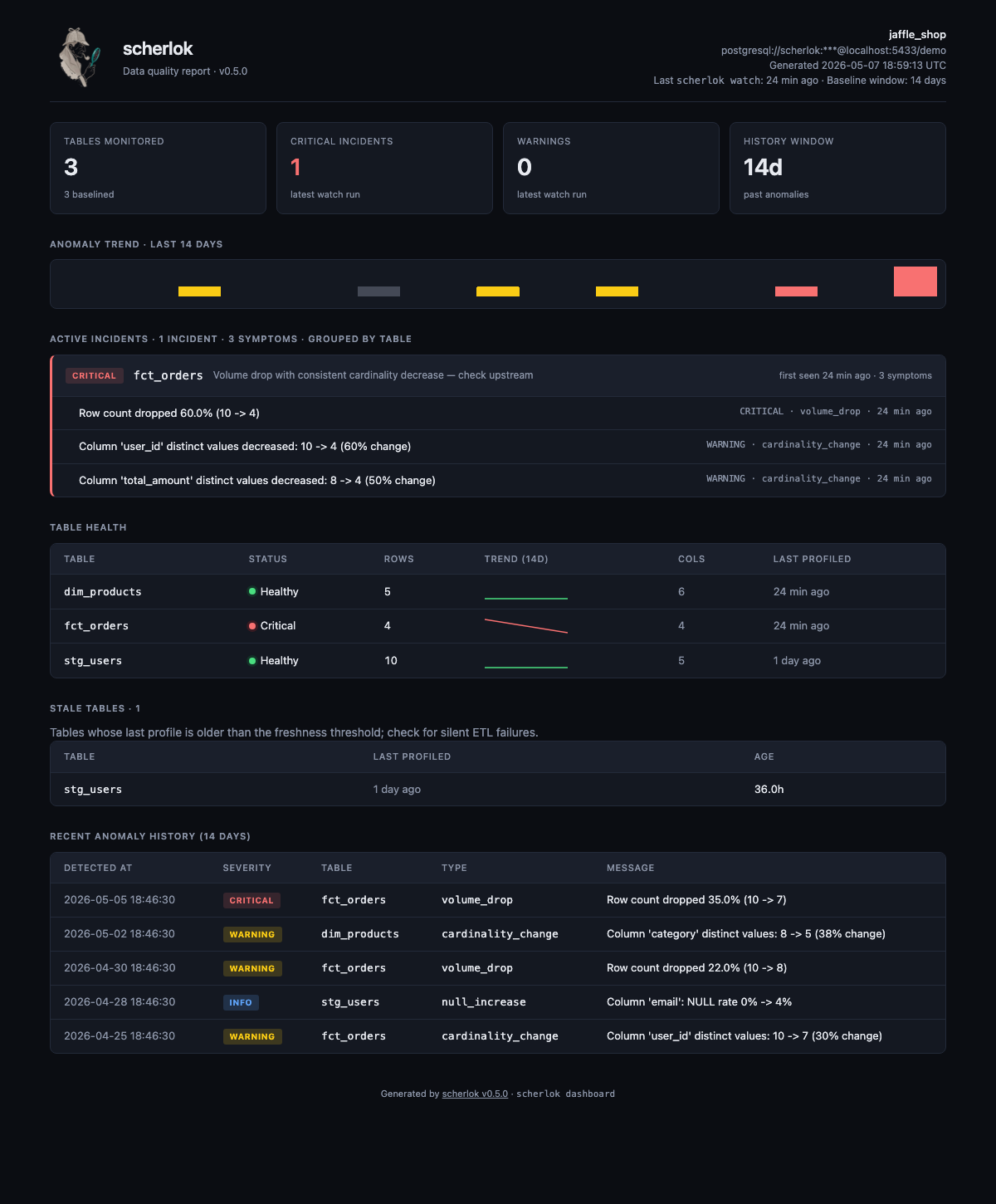
scherlok dashboard --out report.html
One self-contained HTML file (~28 KB): KPIs, per-table incidents grouped with first-seen timestamps, +/−/~ schema-drift diff, sparklines, and full anomaly history. Auto dark/light theme via prefers-color-scheme.
📖 Full docs: dashboard guide →
Let Claude Code / Claude Desktop run data-quality checks directly:
pip install scherlok # scherlok-mcp ships built-in since v0.7.0
{
  "mcpServers": {
    "scherlok": {
      "command": "scherlok-mcp",
      "env": { "SCHERLOK_CONNECTION": "postgresql://user:pass@host/db" }
    }
  }
}
The agent gets list_tables, investigate, watch, status, history, and check as tools. Credentials are resolved server-side (never passed by the model), every operation is read-only on the warehouse, and there's no arbitrary-SQL tool.
📖 Full docs: MCP server guide →
investigate — Learn the patterns$ scherlok investigate
Profiling 12 tables...
✓ users — 45,231 rows, 8 columns
✓ orders — 1,203,847 rows, 15 columns
✓ products — 892 rows, 12 columns
...
Done. Profiles saved.
Scherlok profiles every table: row counts, column types, NULL rates, value distributions, freshness cadence, cardinality. Stores everything locally in SQLite.
watch — Detect anomalies$ scherlok watch
Checking 12 tables against learned profiles...
🔴 CRITICAL orders volume_drop Row count dropped 52% (1,203,847 → 578,412)
🟡 WARNING users null_increase Column "email": NULL rate 2.1% → 18.7%
🔵 INFO products distribution Column "price": mean shifted 3.2σ
3 anomalies detected. Exit code: 1
# Slack
scherlok watch --webhook https://hooks.slack.com/services/...

# Discord
scherlok watch --webhook https://discord.com/api/webhooks/...

# Microsoft Teams
scherlok watch --webhook https://outlook.office.com/webhook/...

# Any endpoint (generic JSON payload)
scherlok watch --webhook https://my-api.com/alerts

# CI/CD gate (fails pipeline on CRITICAL)
scherlok watch --exit-code --fail-on critical
Auto-detects Slack, Discord, and Teams from the URL and formats the payload accordingly. Any other URL receives a generic JSON payload.
Use Scherlok as a data quality gate. The ci command does it in one line:
# GitHub Actions
- name: Data quality check
  run: |
    pip install scherlok
    scherlok config --store s3://my-bucket/scherlok/profiles.db
    scherlok ci ${{ secrets.DATABASE_URL }} \
      --webhook ${{ secrets.SLACK_WEBHOOK }} \
      --fail-on critical
If Scherlok detects a critical anomaly, the pipeline fails. Bad data never reaches production.
export SCHERLOK_SMTP_HOST=smtp.gmail.com
export SCHERLOK_SMTP_USER=alerts@company.com
export SCHERLOK_SMTP_PASSWORD=app-specific-password

scherlok watch --email team@company.com --email cto@company.com
# PostgreSQL
scherlok connect postgres://user:pass@host:5432/db

# BigQuery — see src/scherlok/connectors/bigquery.md for auth, billing, CI patterns
pip install scherlok[bigquery]
scherlok connect bigquery://project-id/dataset-name

# Snowflake
pip install scherlok[snowflake]
export SNOWFLAKE_USER=...
export SNOWFLAKE_PASSWORD=...
export SNOWFLAKE_WAREHOUSE=...
scherlok connect snowflake://account/database/schema

# MySQL
pip install scherlok[mysql]
scherlok connect mysql://user:pass@host:3306/dbname

# DuckDB
pip install scherlok[duckdb]
scherlok connect duckdb:///path/to/file.db
| Database | Status |
|---|---|
| PostgreSQL | Available |
| BigQuery | Available |
| Snowflake | Available |
| MySQL | Available |
| DuckDB | Available |
Share profiles across CI runs and team members:
# AWS S3
scherlok config --store s3://my-bucket/scherlok/profiles.db

# Google Cloud Storage
scherlok config --store gs://my-bucket/scherlok/profiles.db

# Azure Blob Storage
scherlok config --store az://my-container/scherlok/profiles.db
| Great Expectations | Soda | Monte Carlo | Scherlok | |
|---|---|---|---|---|
| Setup time | Hours | 30 min | Weeks | 5 minutes |
| Config required | Hundreds of rules | YAML checks | Dashboard setup | None |
| Anomaly detection | Manual thresholds | Paid feature | Yes | Yes, free |
| Self-hosted | Yes | Limited | No (SaaS) | Yes |
| CI/CD gate | Yes | Yes | No | Yes |
| Price | Free | Freemium | $50-200K/yr | Free, forever |
scherlok connect <url>          Connect to a database
scherlok investigate            Profile all tables (learn patterns)
scherlok watch [-w <url>] [-e <email>]  Detect anomalies and alert
scherlok ci <url> [opts]        All-in-one CI/CD command (connect + watch + exit code)
scherlok status                 Quick health dashboard
scherlok report                 Detailed profile summary
scherlok history [--days N]     Timeline of past anomalies
scherlok config --store <url>   Set remote storage
scherlok version                Show version
pip install scherlok

# With BigQuery support
pip install scherlok[bigquery]
Requires Python 3.10+.
A pre-built image with every warehouse extra (dbt, bigquery, snowflake) is published to GitHub Container Registry on every release tag:
docker run --rm ghcr.io/rbmuller/scherlok:latest version
Mount your project directory and inject connection details the same way your CI does it; the entrypoint is the scherlok CLI:
docker run --rm \
  -v "$PWD:/work" -w /work \
  -e SCHERLOK_CONNECTION=postgres://... \
  ghcr.io/rbmuller/scherlok:latest watch
The image is built from python:3.12-slim and runs unprivileged (USER scherlok).
Contributions welcome! See CONTRIBUTING.md.
We're especially looking for:
MIT — Developed by Robson Bayer Müller
Run Claude Code as an MCP server so any agent can delegate coding tasks to it
 @microsoft✓ Official
Browser automation using accessibility snapshots instead of screenshots
 @googleapis✓ Official
Google's universal MCP server supporting PostgreSQL, MySQL, MongoDB, Redis, and 10+ databases
 @github✓ Official
Official GitHub integration for repos, issues, PRs, and CI/CD workflows