

Are you the author? Sign in to claim
The missing layer between AI and the web. Open-source escalating web unlocker + read/search/transcribe/grab across web,
The missing layer between AI and the web. A Python CLI and library that lets an AI agent read and search the internet, fronted by a fully open-source "unlocker" that gets through common bot-walls with no paid proxy and no API key.





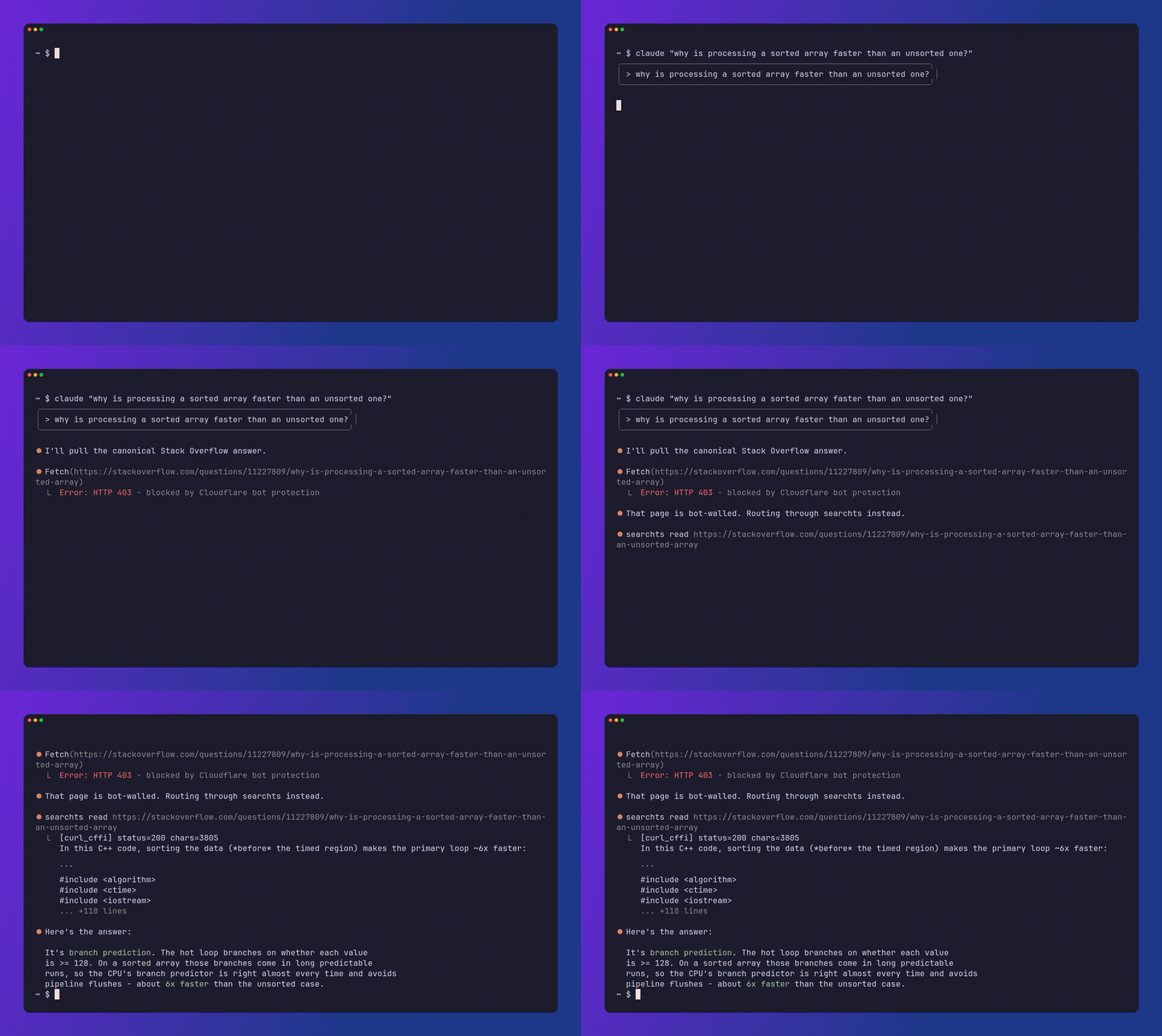
AI agents constantly need to read web pages, but the naive way they fetch is trivially blocked by modern anti-bot systems (Cloudflare, PerimeterX, DataDome). Paid unlocker services solve this, but the thing they really charge for is a large pool of clean residential IP addresses. searchts runs on your own machine, from your own connection, at personal volume, so it sidesteps that cost and gets through most of those walls for free.
searchts reads any URL through an escalating ladder and stops at the first tier that returns real content:
If every tier is defeated by an interactive CAPTCHA, an optional human-in-the-loop step opens a real browser so you can solve it once and continue. Block detection is phrase-based (not vendor-name based), so legitimate pages that merely embed a bot-sensor script are not falsely rejected. Content is extracted to clean Markdown with trafilatura.
Share links from AI chat apps are a special kind of hard: the conversation never appears in the page HTML as extractable text, so generic readers (and most AI agents' built-in fetch) return an empty shell or a fragment cut off mid-chat. searchts read recognizes these URLs and decodes each provider's own data channel instead, returning the complete conversation as role-labeled Markdown — keyless, no login:
| Provider | Share URL | How it's read |
|---|---|---|
| ChatGPT | chatgpt.com/share/… | turbo-stream payload embedded in the page |
| Claude | claude.ai/share/… | keyless snapshot API (behind Cloudflare) |
| Gemini | gemini.google.com/share/… | keyless batchexecute RPC |
| Grok | grok.com/share/… | keyless share-links API |
| Poe | poe.com/s/… | __NEXT_DATA__ payload embedded in the page |
Each provider is a drop-in plugin module (searchts/share_extractors/); if a provider changes its format, extraction falls back to the normal unlocker ladder instead of failing.
pipx install searchts            # recommended: global, isolated CLI
# or
pip install searchts

# optional extras
pip install "searchts[browser]" && patchright install chromium   # stealth-browser tier
pip install "searchts[mcp]"                                       # MCP server for agents
searchts read https://example.com          # fetch any page as clean Markdown
searchts search "open source vector db"    # multi-provider web search (keyless by default)
searchts transcribe https://youtu.be/...   # transcript of a YouTube/TikTok/Instagram/Reddit video
searchts grab https://example.com          # download a page's assets + extract palette/fonts
searchts get https://example.com/logo.png  # download one asset (image/PDF/font/file)
searchts doctor                            # see what is configured and working
read flags: --json, --backend <tier>, --human (CAPTCHA handoff), --scrub (redact injection).
search flags: -n <count>, --json, --provider <name>. Content goes to stdout (pipeable); status to stderr.
grab flags: --out <dir>, --kinds <images,icons,css,fonts,svg>, --read (also save page.md), --max <n>, --json.
Add searchts to your agent in one line - as an MCP server, or as a Claude Code slash command:
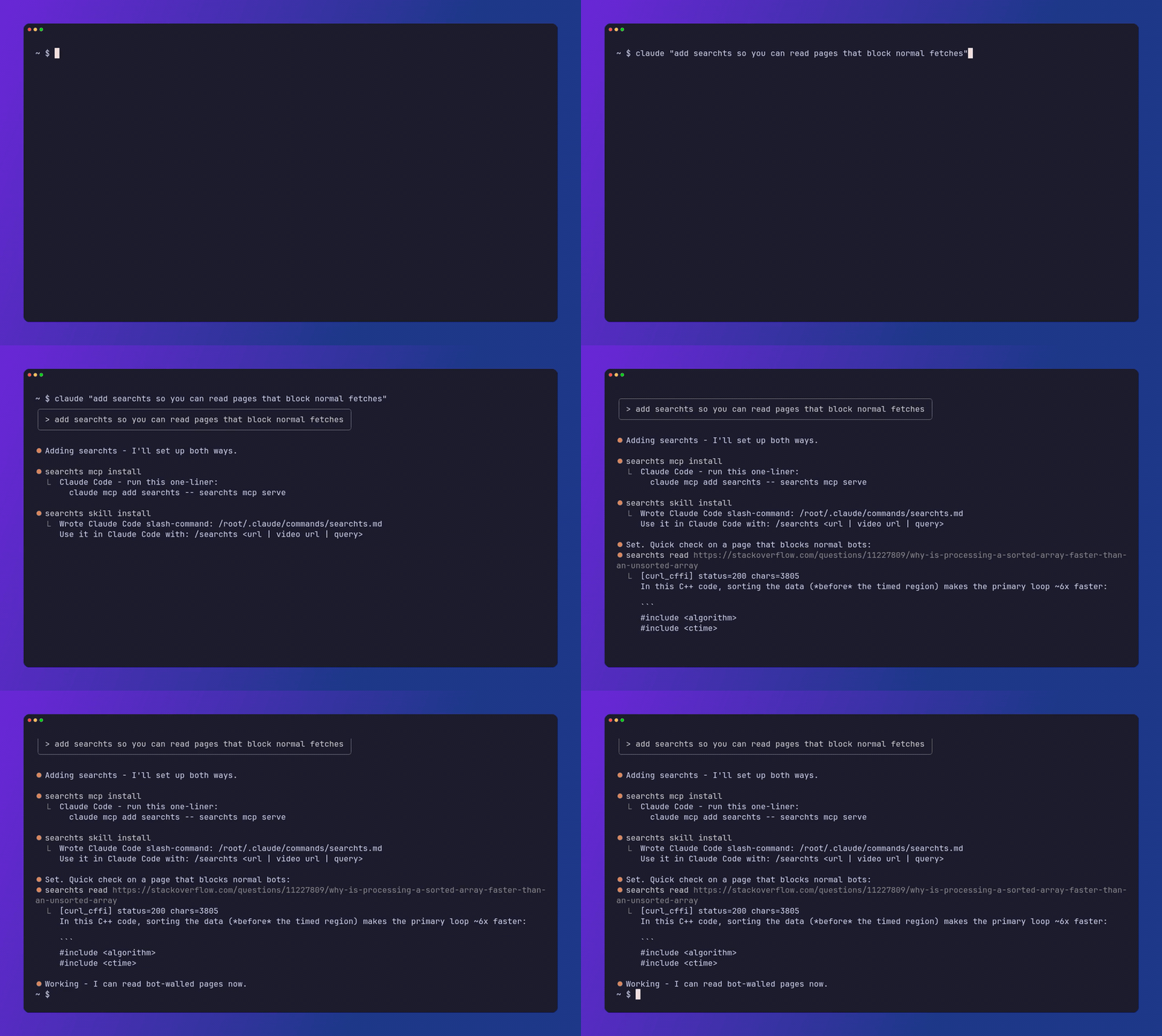
Two ways, both one command:
# 1) MCP: gives the agent always-on read_url + web_search + fetch_asset + grab_site + get_status tools
pip install "searchts[mcp]"
searchts mcp install          # prints the wiring, e.g. for Claude Code:
                              #   claude mcp add searchts -- searchts mcp serve

# 2) Slash command: type /searchts <url-or-query> in Claude Code
searchts skill install        # writes ~/.claude/commands/searchts.md
See the MCP server reference for all five tools (read_url, web_search, fetch_asset, grab_site, get_status), their inputs and outputs, and when to use each.
searchts grab <url> downloads a page's images/icons/css/fonts and extracts a color palette plus the fonts in use; searchts get <url> pulls a single asset. Both go through the same escalating unlock ladder, so they work on fingerprint-gated CDNs, not just open ones.SEARCHTS_NO_MEMORY=1 to disable).read_url, web_search, fetch_asset, grab_site, get_status), and a Python library.from searchts import unlocker
r = unlocker.fetch("https://example.com")
print(r.backend, r.status, r.text)
from searchts.search import search
for hit in search("open source vector db", max_results=5):
print(hit.title, hit.url)
Rather than take our word for it, searchts ships a reproducible benchmark: it runs the unlocker over a set of (often bot-walled) pages and reports how many it read — keyless — and which tier carried each.
python -m benchmarks.run              # print a scorecard
python -m benchmarks.run --out docs/  # write docs/scorecard.md + results.json
Latest run: docs/scorecard.md. Add your own targets — see benchmarks/README.md.
The numbers only mean something from a residential connection: a datacenter IP (or a VPN that reshapes your TLS fingerprint) blocks the fast curl_cffi tier more than a real user sees.
--human for those.Search works with no keys (DuckDuckGo). Everything else is optional, via searchts configure or a .env (see .env.example):
SEARXNG_URL, for more and better results.ffmpeg and yt-dlp.Run searchts doctor to check what is configured and working.
The core is read / search / transcribe, and for most reads you can just
searchts read <the-url> on the public page. As an optional extra, if you have
separately-installed platform CLIs (gh, twitter-cli, opencli, mcporter),
searchts can also reach GitHub, Twitter/X, Reddit, and LinkedIn through them, and
searchts doctor will report which are present. These are add-ons, not the core.
See ROADMAP.md for where searchts is headed — and what's deliberately out of scope.
searchts builds on and extends Agent-Reach (MIT), reusing its channel, installer, and diagnostics architecture. The escalating open-source unlocker, multi-provider search with rank fusion, prompt-injection scrubbing, per-domain backend memory, the human-in-the-loop CAPTCHA flow, the video transcript channels, the read_url / web_search MCP tools, and the read / search CLI commands are additions in searchts. Thanks to the original authors.
MIT. See LICENSE. Original portions Copyright (c) 2025 Agent Eyes; modifications and additions Copyright (c) 2026 capad-xyz.
Built by capad. Questions or feedback: open an issue or email oss@capad.fyi.
Fun fact: "searchts" doesn't officially abbreviate anything. Off the record, it stands for "search this shit".
Run Claude Code as an MCP server so any agent can delegate coding tasks to it
 @microsoft✓ Official
Browser automation using accessibility snapshots instead of screenshots
 @googleapis✓ Official
Google's universal MCP server supporting PostgreSQL, MySQL, MongoDB, Redis, and 10+ databases
 @github✓ Official
Official GitHub integration for repos, issues, PRs, and CI/CD workflows