

Are you the author? Sign in to claim
A 3-stage safety guardrail agent for LLM coding assistants (Claude Desktop, Cursor, CodeX) via MCP protocol.





A three-stage guardrail agent for LLM-powered coding assistants.
Sentinel sits between an LLM agent and its execution environment, reviewing every proposed action before it runs. It integrates with tools like Claude Code, Cursor, and CodeX via the Model Context Protocol (MCP), acting as an always-on safety layer that can block destructive commands, flag scope creep, and maintain a full audit trail of every decision.
Supports both Stdio (local process) and SSE (web endpoint) MCP transports for maximum compatibility.
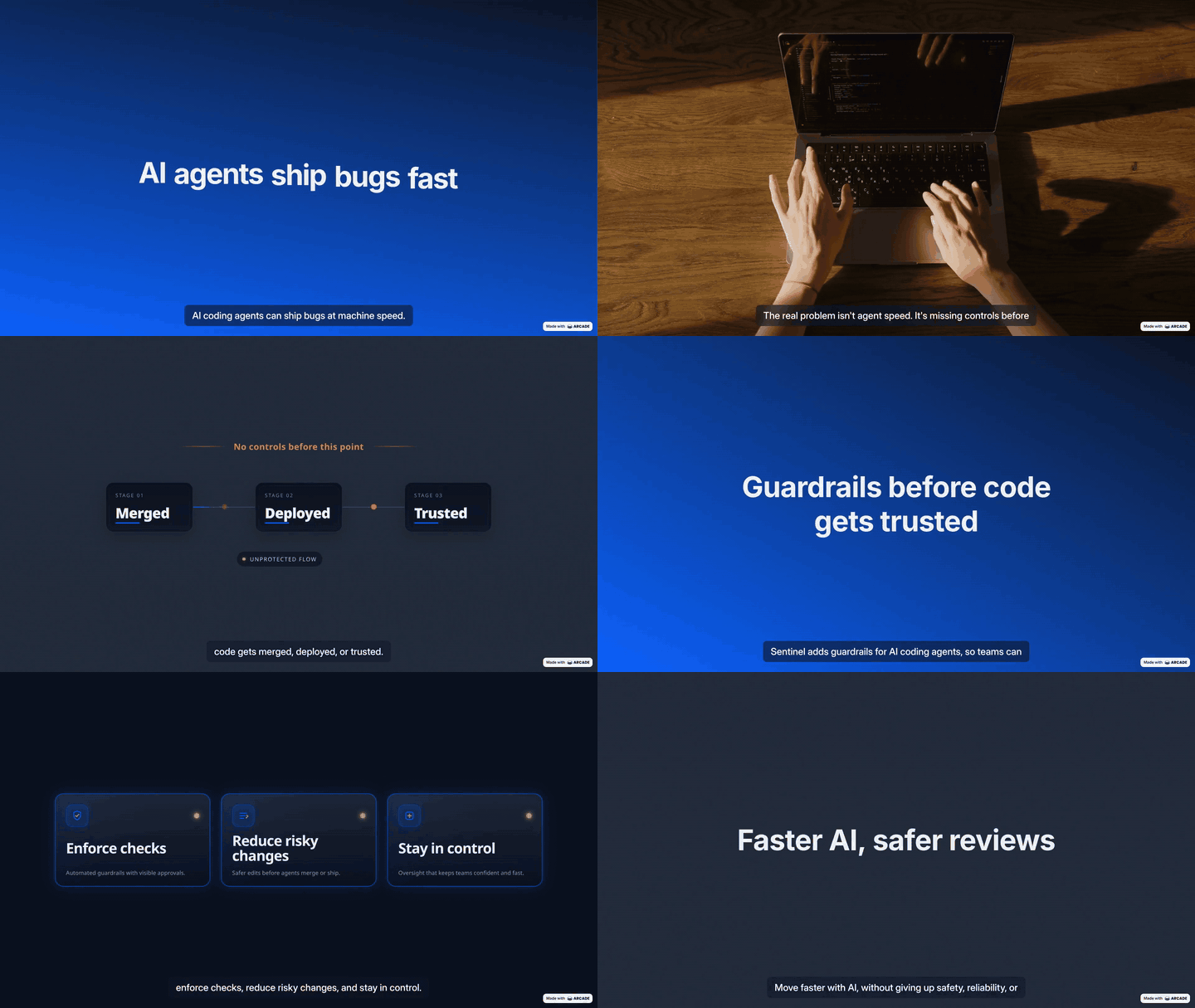
Autonomous LLM coding agents can execute shell commands, modify files, push to remote repositories, and make network requests. This power comes with real risk: a single poorly-scoped prompt or a hallucinated action can cause data loss, expose credentials, or make irreversible changes to a production system.
Existing solutions are binary — either the agent runs everything without review, or a human must manually approve every step. Neither scales.
Sentinel implements a multi-stage decision pipeline that handles the full spectrum from obviously safe to dangerously risky actions, using the fastest and most appropriate tool at each stage:
Stage 1 — Rules Engine: Deterministic pattern matching on a configurable YAML ruleset (config/rules.yaml). Handles unambiguous cases (recursive deletes, credential exposure, root-level writes) in microseconds with zero network dependency. Features mtime hot-reloading across all processes so rules updated in the dashboard take effect immediately in running MCP servers.
Stage 2 — Trained Classifier: A TF-IDF vectorizer and Logistic Regression classifier trained on a labeled dataset of agent actions. Runs in milliseconds, entirely offline, and produces an explainable risk score with confidence bounds.
Stage 3 — LLM Reviewer: For ambiguous actions that statistical models cannot resolve reliably, a large language model evaluates the action in the context of the user's stated task. This is the only stage that makes a network call, and it only activates when the previous stages are uncertain. Supports Ollama (local), OpenAI, Anthropic, and Google Gemini.
MCP Client (Claude Code / Cursor / CodeX / Web UI)
        |
        +-- stdio transport (mcp_server/server.py)
        +-- SSE transport   (mcp_server/sse_server.py)
        |
        v
  api/main.py (FastAPI)        <- REST API, static /dashboard, audit log, config management
        |
        v
  sentinel_core/orchestrator.py
        |
        +-- Stage 1: sentinel_core/rules_engine.py   (config/rules.yaml - mtime hot-reload)
        +-- Stage 2: sentinel_core/classifier.py     (model_artifacts/model.pkl)
        +-- Stage 3: sentinel_core/llm_reviewer.py   (sentinel_core/model_manager.py)
        |
        v
  sentinel.db (SQLite)         <- append-only audit log
| Metric | Value |
|---|---|
| Training Examples | 828 (hand-labeled + synthetically generated) |
| Class Balance | 58% safe / 42% risky |
| 5-Fold Cross-Validation Accuracy | 76.3% ± 3.0% |
| CV Macro-F1 Score | 75.9% ± 3.1% |
| Hold-out Test Accuracy | 75.2% |
| Risky Class Precision | 70% |
| Safe Class Precision | 79% |
| Confident Predictions (Stage 2 handles directly) | 40% of traffic |
| Stage 3 LLM escalation rate | 60% of traffic |
The classifier's confidence threshold is set at 80%. Predictions above this threshold are resolved by Stage 2 without invoking the Stage 3 LLM, reducing average latency and eliminating API cost for 40% of all reviewed actions.
Top 5 features associated with risky actions: bash, delete, iptables, exec, secret
Top 5 features associated with safe actions: version, list, describe, test, check
sentinel/
├── api/
│   └── main.py                  FastAPI application, all HTTP endpoints
├── sentinel_core/
│   ├── orchestrator.py          Three-stage pipeline coordinator
│   ├── rules_engine.py          Stage 1: YAML rule matching
│   ├── classifier.py            Stage 2: sklearn inference
│   ├── llm_reviewer.py          Stage 3: LLM reasoning
│   ├── model_manager.py         Provider abstraction (Ollama / OpenAI / Anthropic / Gemini)
│   ├── audit_log.py             SQLite decision logger
│   └── model_artifacts/         model.pkl + vectorizer.pkl (gitignored)
├── mcp_server/
│   ├── server.py                MCP stdio server
│   └── sse_server.py            MCP SSE server (port 8002)
├── dashboard/
│   ├── index.html               Single-page control panel
│   ├── app.js                   Dashboard logic
│   └── style.css                Dashboard styles
├── config/
│   ├── rules.yaml               Stage 1 allow/block patterns
│   ├── model_config.yaml        Active provider and model selection
│   └── model_config.local.yaml  API keys (gitignored, never committed)
├── data/
│   └── training_examples.csv    Labeled dataset for Stage 2 training
├── train/
│   ├── train_classifier.py      Training script (scikit-learn)
│   └── generate_training_data.py  Synthetic training data generation
├── docs/
│   └── ARCHITECTURE.md          Internal design notes and rationale
├── start.bat                    Windows one-click launcher
├── Dockerfile                   Container image definition
└── requirements.txt
The design goal was to minimize latency and cost for the common case while preserving high-accuracy judgment for the ambiguous case. The vast majority of agent actions are either obviously safe (git status, npm install) or obviously risky (rm -rf /, git push --force). Routing both through an LLM would be slow and expensive. Routing both through a rules engine alone would miss the large middle ground.
The three-stage cascade solves this:
We implemented Stage 3 with Ollama as the default to ensure that no action text leaves the user's machine unless they explicitly configure a cloud provider. This is important for codebases that may contain proprietary logic, internal hostnames, or sensitive file paths. The provider abstraction in model_manager.py makes it straightforward to switch to a cloud LLM without changing any Stage 3 logic.
Stage 2 does not pass every prediction to Stage 3 — only predictions below an 80% confidence threshold. This gates the expensive network call behind a statistical signal. Predictions above the threshold are resolved by Stage 2 directly, which accounts for approximately 40% of all traffic in practice. The remaining 60% escalates to Stage 3, where LLM reasoning provides the most marginal value.
Windows (One-Click):
Double-click start.bat in the project root folder. The script will automatically:
venv) if missingrequirements.txthttp://localhost:8000http://localhost:8002http://localhost:8080 in your default browserManual / Linux / macOS Setup:
# 1. Create and activate virtual environment
python -m venv venv
source venv/bin/activate        # macOS/Linux (use venv\Scripts\activate on Windows)

# 2. Install dependencies
pip install -r requirements.txt

# 3. Train classifier model (first run only)
python train/train_classifier.py

# 4. Run API Server (Terminal 1)
python -m uvicorn api.main:app --port 8000 --reload

# 5. Run SSE MCP Server (Terminal 2)
python mcp_server/sse_server.py --port 8002

# 6. Run Dashboard UI (Terminal 3)
python -m http.server 8080 --directory dashboard
Sentinel seamlessly connects to any MCP-compliant AI assistant. Follow the exact step-by-step guide below for your platform:
start.bat or the backend services are running.%APPDATA%\Claude\claude_desktop_config.json in Notepad or VS Code.~/Library/Application Support/Claude/claude_desktop_config.json.sentinel under mcpServers with the absolute path to your Python virtual environment executable and mcp_server/server.py:
{
  "mcpServers": {
    "sentinel": {
      "command": "C:\\path\\to\\sentinel\\venv\\Scripts\\python.exe",
      "args": [
        "C:\\path\\to\\sentinel\\mcp_server\\server.py"
      ],
      "env": {
        "PYTHONPATH": "C:\\path\\to\\sentinel"
      }
    }
  }
}
sentinel running with active tools review_action and get_recent_decisions.Ctrl + , / Cmd + ,.sentinelSSE (recommended for zero sub-process overhead) or stdio.http://localhost:8002/sse.command to your python.exe and args to mcp_server/server.py.~/.claude/claude_code_config.json (or project-level .claude/config.json).{
"mcpServers": {
"sentinel": {
"command": "python",
"args": ["mcp_server/server.py"],
"cwd": "/path/to/sentinel"
}
}
}
review_action automatically before executing.For web platforms, remote agents, or testing with the MCP Inspector:
http://localhost:8002/ssehttp://localhost:8002/messages/npx -y @modelcontextprotocol/inspector sse http://localhost:8002/sse
The dashboard provides a built-in interactive server connection manager and real-time syncing optimizer:
LIVE SYNC (xx ms) dynamically monitors API latency, continuously updating decision logs, active review progress bars, and model health without manual page reloads.Open the dashboard at http://localhost:8080 and navigate to Model Settings.
Local (Ollama): Select any model detected from your local Ollama installation. No internet required. Pull a model with ollama pull <model-name> before selecting it.
API providers: Select Google Gemini, OpenAI, Anthropic, or a custom OpenAI-compatible endpoint. Enter your API key and click Save Model Settings. After saving, the dashboard automatically calls the provider's live /models endpoint and populates the model dropdown with every model your key has access to. You can then pick from the list or type any model name manually. If you leave the model field blank, Sentinel auto-selects the recommended default for that provider. The key is stored in config/model_config.local.yaml on disk, never written to the audit log, and never returned in full over the API (only the last 4 characters are shown in the dashboard).
Click ↻ Refresh next to the model field at any time to re-fetch the live model list without saving again.
Navigate to the Rules tab in the dashboard to add, edit, or remove pattern-matching rules. Rules support exact substring matching and regular expressions. Changes take effect immediately without restarting the server.
Sentinel exposes its capabilities to coding assistants via the Model Context Protocol (MCP). The server uses FastMCP to initialize the tools and handle the transport layer (both stdio and sse are supported).
When the MCP server starts, it initializes the following tools and makes them available to the connected client:
| Tool | Initialization & Arguments | Description |
|---|---|---|
review_action | action_text (str), user_task (str) | Review a proposed agent action BEFORE executing it. Returns a verdict of ALLOW, BLOCK, or REVIEW. |
get_recent_decisions | limit (int, default=20) | Return recent entries from the audit log to provide the agent with context of past verdicts. |
The FastAPI backend exposes the following endpoints. Full interactive documentation is available at http://localhost:8000/docs when the server is running.
| Method | Path | Description |
|---|---|---|
| GET | /health | Health check, returns paused state and project path |
| GET | /status | Lightweight paused/auth status |
| POST | /review | Submit an action for review |
| POST | /pause | Pause the guardrail pipeline |
| POST | /resume | Resume the guardrail pipeline |
| GET | /log | Retrieve recent audit log entries |
| GET | /rules | Get current Stage 1 ruleset |
| POST | /rules | Update Stage 1 ruleset |
| GET | /models/local | List locally available Ollama models |
| GET | /models/config | Get current model provider configuration |
| POST | /models/config | Update model provider configuration |
| POST | /models/test | Test the active model provider connection |
| GET | /models/available | Fetch live list of models available on the saved API key |
| GET | /mcp/servers | List registered MCP servers |
| POST | /mcp/servers | Register a new MCP server |
| DELETE | /mcp/servers/{name} | Remove a registered MCP server |
curl -X POST http://localhost:8000/review \
  -H "Content-Type: application/json" \
  -d '{"action_text": "rm -rf /tmp/build", "user_task": "Clean up build artifacts"}'
Response:
{
  "action_text": "rm -rf /tmp/build",
  "verdict": "ALLOW",
  "decided_by_stage": "classifier",
  "reason": "Classifier predicted 'safe' with 89% confidence.",
  "log_id": 42
}
The classifier is trained on data/training_examples.csv, a hand-curated and synthetically augmented dataset of shell commands, SQL statements, git operations, and API calls labeled as safe or risky.
To generate additional synthetic training data:
python train/generate_training_data.py
To retrain after modifying or expanding the dataset:
python train/train_classifier.py
The script prints a full classification report and the top 15 features associated with risk, allowing the model's learned signals to be verified and understood without treating it as a black box.
config/model_config.local.yaml, which is gitignored by default.sentinel.db) records action text and review decisions but never stores API keys.SENTINEL_API_KEY is set as an environment variable before starting the server, all mutating endpoints (rules update, model config update, pause/resume) require that key via the X-Sentinel-Key header.REVIEW, requiring manual sign-off. This is intentionally conservative.MIT License. See LICENSE for details.
Run Claude Code as an MCP server so any agent can delegate coding tasks to it
 @microsoft✓ Official
Browser automation using accessibility snapshots instead of screenshots
 @googleapis✓ Official
Google's universal MCP server supporting PostgreSQL, MySQL, MongoDB, Redis, and 10+ databases
 @github✓ Official
Official GitHub integration for repos, issues, PRs, and CI/CD workflows
