

Are you the author? Sign in to claim
Zero-dependency CLI to scan, recommend, deduplicate, audit, and visualize Claude Code / Codex skills and MCP servers.
English | 简体中文




A zero-dependency CLI to scan, recommend, deduplicate, audit, and visualize Claude Code / Codex skills and MCP servers.
When you keep adding skills to Claude Code or Codex, the local setup can become hard to reason about: duplicated skills, shared symlinks, unused tools, unclear names, and MCP servers that keep consuming context. skm turns that local toolbox into something you can inspect, search, compare, and clean up safely.
git clone https://github.com/GrubbyLee/skill-manager.git
cd skill-manager
node scripts/install.mjs

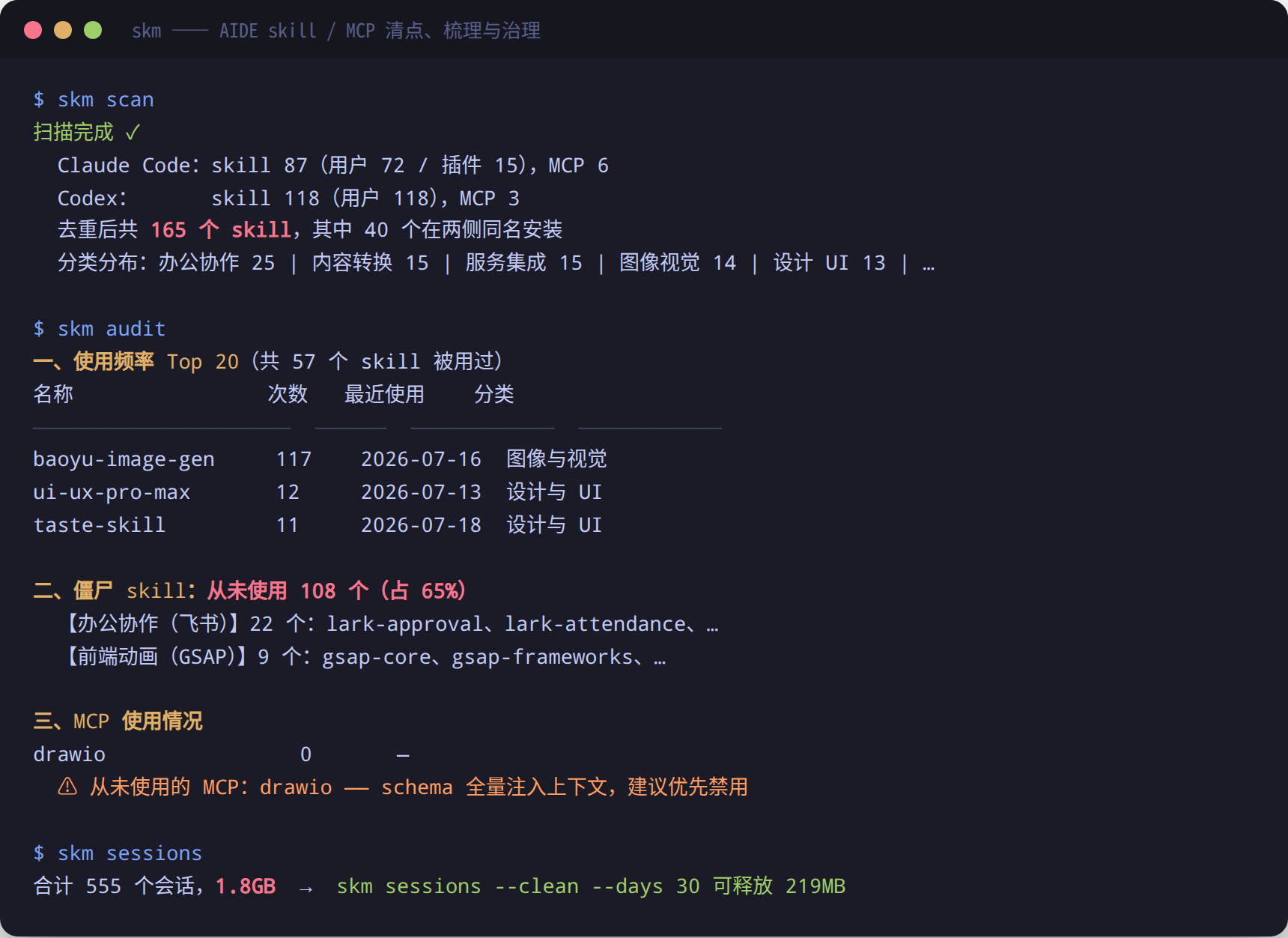
skm scan
skm
skm ask "convert a web page to Markdown"
skm report --format html --output skm-report.html
skm graph --format html --output skill-graph.html
No npm package install is advertised yet. The package name aide-skill-manager is reserved, but the current recommended installation path is git clone.
CLI output supports language selection:
skm scan --lang en
SKM_LANG=zh-CN skm doctor
| Question | Command | What you get |
|---|---|---|
| How many skills and MCP servers are installed? | skm scan | Counts, categories, install sources, context estimate |
| Is my local AIDE setup healthy? | skm | Health score, zombie skills, duplicate installs, idle MCP, session size |
| Which skill should I use for this task? | skm ask "task" | Best match, reasons, alternatives |
| Which skills are duplicated? | skm dupes | Same name, same content, same category, text similarity |
| Which skills were never really used? | skm audit | Real usage frequency from Claude Code / Codex sessions |
| How are skills related? | skm graph --format html | Filterable, draggable, single-file knowledge graph |
| What are the risky items? | skm risks | Prioritized risk list and conservative suggestions |
| Can I share one local overview? | skm report --format html | Single-file overview with health, risks, usage, sessions, graph summary |
| Where did my session logs grow? | skm sessions | Workspace-level session log size and dry-run cleanup plan |
| Command | Purpose |
|---|---|
skm / skm status | One-screen health overview |
skm doctor | Read-only environment diagnostics |
skm risks | Risk report without changing AIDE data |
skm report | One-page overview report |
skm scan | Scan skills and MCP servers, rebuild catalog |
skm list / skm list --mcp | List skills or MCP servers |
skm search <keyword> | Search by name, category, and description |
skm recommend <task> | Ranked skill recommendations |
skm ask <task> | Q&A-style skill recommendation |
skm graph | Export the skill knowledge graph |
skm dupes | Detect duplicates and similar skills |
skm audit | Audit real usage frequency |
skm sessions | Inspect session log distribution |
skm sessions --clean | Clean session logs with confirmation |
skm disable / skm enable | Soft-disable or restore skills / MCP servers |
Detailed command manual: docs/usage.en.md.
If you know what you want to do but do not remember which skill fits:
skm ask "convert a web page to Markdown"
skm recommend "create image cards for Xiaohongshu" --top 5
skm recommend "markdown to html" --why
By default, recommendations run locally. No external model is called, and no directory information is uploaded. The ranking combines skill name, category, description, task intent, conversion direction, usage history, recency, and whether the skill is available in both Claude Code and Codex.
You can explicitly ask a local AIDE CLI to help judge the short candidate list:
skm recommend "create a knowledge graph" --advisor codex --why
skm recommend "summarize meeting notes" --advisor claude
Advisor mode sends only a compact candidate list. It does not send real skill paths, config paths, MCP env values, API keys, passwords, private keys, or session log bodies.
skm graph --format html --output skill-graph.html
The HTML graph is a zero-dependency single file. Open it in a browser and filter relationships from the left panel; the graph only shows nodes involved in the selected relationships. Nodes are draggable, which helps when you have many installed skills.
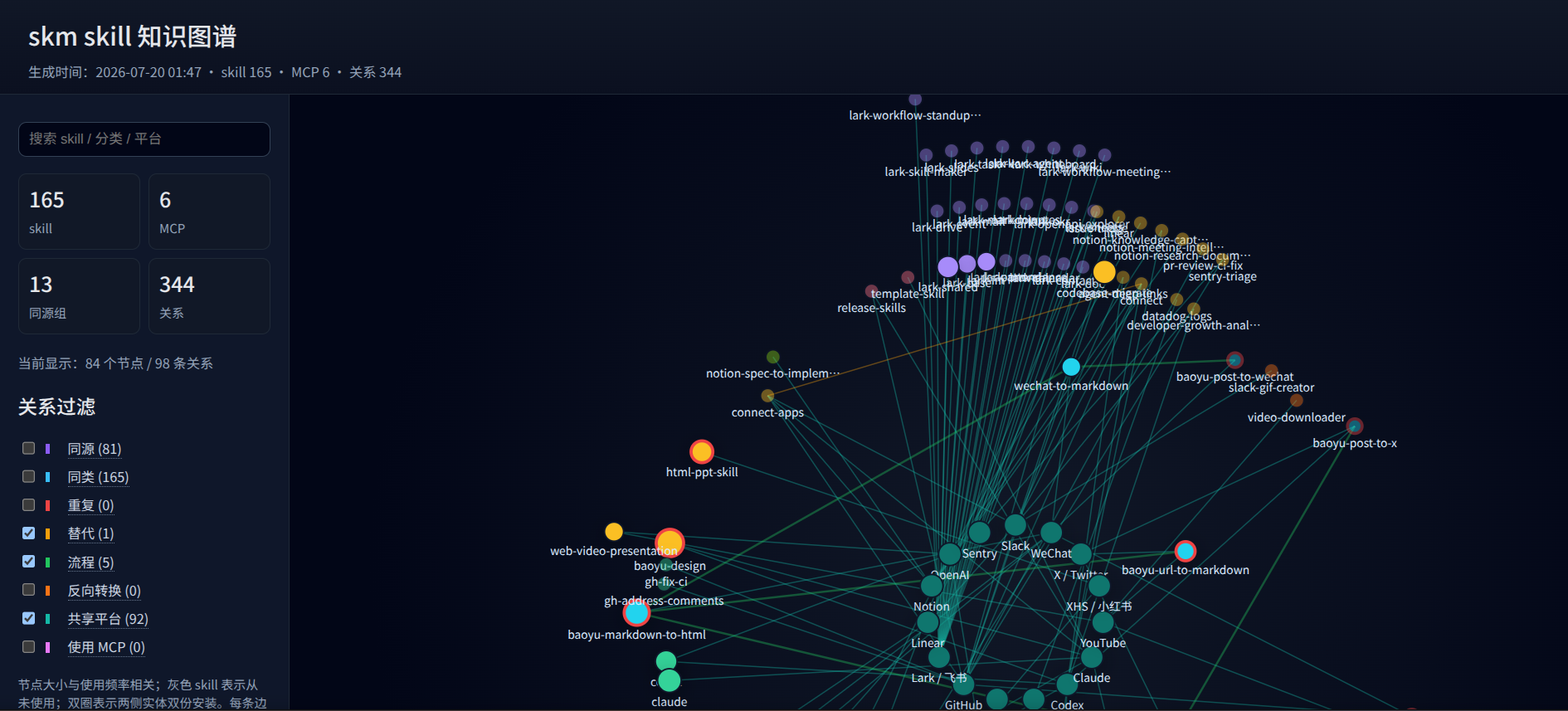
Current relationship types include same family, same category, duplicate, alternative, workflow, reverse conversion, shared platform, and uses MCP. Details are in docs/graph.md.
skm report --format html --output skm-report.html
The report puts health score, risks, usage, context cost, session logs, graph summary, and next commands on one local HTML page. Details are in docs/report.en.md.
skm doctor
skm scan
skm
skm risks
skm report --format html --output skm-report.html
skm dupes
skm audit
skm list --mcp
skm sessions
skm sessions --clean --days 30 --keep 3 --dry-run
Start with read-only commands. Refresh facts first, then inspect health, risks, duplicates, usage, MCP servers, and session logs. Use dry-run before any cleanup.
Most commands are read-only for Claude Code and Codex data. Some commands may update skm's own cache under ~/.skill-manager, but they do not modify your Claude/Codex configs, skills, MCP servers, or session logs.
Only three actions can modify files:
| Action | What changes | Safeguards |
|---|---|---|
sessions --clean | Deletes session log files | Requires retention policy; prints plan first; interactive confirmation or --yes; never deletes sessions active within 24 hours; aggregates usage stats before deletion |
disable/enable <skill> | Renames skill directories | Reversible, no deletion; plugin skills are refused |
disable/enable --mcp | Edits ~/.claude.json / config.toml | Automatic backups; confirmation required; restore never overwrites manually recreated config |
More details: docs/safety.md.
Install the thin navigator skill into Claude Code or Codex, then ask your coding assistant which skill to use for a task:
cp -r integrations/skill-navigator ~/.claude/skills/
cp -r integrations/skill-navigator ~/.codex/skills/
| Too many tools | Scan and label |
|---|---|
 |  |
| Knowledge graph | Safe cleanup |
|---|---|
 |  |
| Document | Content |
|---|---|
| README.zh-CN.md | Chinese README |
| docs/usage.en.md / docs/usage.md | Full command manual |
| docs/recommend.en.md / docs/recommend.md | Recommendation logic and advisor mode |
| docs/graph.en.md / docs/graph.md | Knowledge graph relationships and HTML interactions |
| docs/report.en.md / docs/report.md | HTML overview report |
| docs/safety.en.md / docs/safety.md | Safety boundaries and data notes |
| docs/roadmap.en.md / docs/roadmap.md | Roadmap |
| docs/community.en.md / docs/community.md | Community post templates |
| CONTRIBUTING.en.md / CONTRIBUTING.md | Contribution guide |
GitHub Actions validates macOS and Windows. Linux is validated locally by the maintainer with the same read-only build/test commands.
npm run check
npm test
npm pack --dry-run --registry=https://registry.npmmirror.com
CI entry: GitHub Actions / macOS / Windows CI.
skm help, argument validation, doctor, scan, status, risks, report, list, search, recommend, ask, graph, dupes, audit, sessions, disable, enable, and the local install script support English and Simplified Chinese output.
Use --lang en, --lang zh-CN, or SKM_LANG=en. JSON field names stay stable.
skm scan / skm recommend samplesFull roadmap: docs/roadmap.en.md.
If skm helped you understand your local skill setup, a GitHub Star helps more users find it. You can also:
skm scan result: https://github.com/GrubbyLee/skill-manager/discussions/9Run Claude Code as an MCP server so any agent can delegate coding tasks to it
 @microsoft✓ Official
Browser automation using accessibility snapshots instead of screenshots
 @googleapis✓ Official
Google's universal MCP server supporting PostgreSQL, MySQL, MongoDB, Redis, and 10+ databases
 @github✓ Official
Official GitHub integration for repos, issues, PRs, and CI/CD workflows