

Are you the author? Sign in to claim
Hooking implementations and supporting tools for various coding agents (Claude, Cursor, Gemini, etc)
Released as part of the Hooking Coding Agents with the Cedar Policy Language talk at Unprompted 2026.
A reference monitor for AI coding agents. Rust hook binaries and Cedar policies intercept every shell command, file operation, and web request to forbid exfiltration and destructive behaviors, and enforce information flow control. YARA signatures and Cedar policy evaluation are deterministic; the optional LLM-based classifiers (data sensitivity, secure code policy) are probabilistic.
Works with Claude Code, Cursor, GitHub Copilot, and Gemini CLI.
Install Rust and Cargo using rustup:
# Install Rust and Cargo
curl --proto '=https' --tlsv1.2 -sSf https://sh.rustup.rs | sh

# Verify installation
cargo --version
The YARA signature engine and Cedar policies work without any external
dependencies. The LLM-based classifiers (data sensitivity and secure code
policy) require Ollama with the gpt-oss-safeguard-20b
model:
# Install Ollama — see https://ollama.com/download for other platforms
brew install ollama

# Pull the model (~12 GB)
ollama pull gpt-oss-safeguard
The harness server loads Cedar policies and listens on a Unix socket for hook connections.
cargo run --bin sondera-harness-server -- -v
By default, it loads policies from ./policies and the socket path is
resolved in order of preference:
| Priority | Path | When |
|---|---|---|
| 1 | /var/run/sondera/sondera-harness.sock | Directory exists or can be created |
| 2 | ~/.sondera/sondera-harness.sock | Fallback for unprivileged users |
Override with --socket:
cargo run --bin sondera-harness-server -- \
  --policy-path /path/to/policies \
  --socket /var/run/sondera/sondera-harness.sock \
  -v
See Deployment for more details on socket ownership and permissions.
The sondera-claude binary registers hooks for all Claude Code lifecycle
events (pre-tool-use, post-tool-use, session-start, etc.). Choose a scope:
# Local (default) — .claude/settings.local.json, not committed to git
cargo run -p sondera-claude -- install

# Project — .claude/settings.json, committed to git, shared with team
cargo run -p sondera-claude -- install --project

# User — ~/.claude/settings.json, applies to all projects
cargo run -p sondera-claude -- install --user
To uninstall, use the same scope flag:
cargo run -p sondera-claude -- uninstall --user
Hooks for Cursor (sondera-cursor), GitHub Copilot (sondera-copilot), and
Gemini CLI (sondera-gemini) follow the same pattern.
Cedar policies and the schema live in policies/. The harness server loads all
.cedar and .cedarschema files from this directory at startup.
policies/
├── base.cedarschema       # Entity types (Agent, Trajectory, Tool, File, Label, Taint) and actions
├── base.cedar             # Default-permit baseline with targeted forbids for prompt injection,
│                          #   credential access, data exfiltration, shell/web/file pre- and
│                          #   post-execution gates, and trajectory-level runaway protection
├── destructive.cedar      # Blocks irreversible operations: rm -rf, git force-push, terraform
│                          #   destroy, DROP DATABASE, lock file deletion, kill -9, and more
├── file.cedar             # File-type-aware guards: Bell-LaPadula IFC (no write-down), private
│                          #   key access, secrets in source code, obfuscation in scripts, and
│                          #   OWASP/CWE policy violations (injection, weak crypto, broken authz)
├── ifc.cedar              # Information flow control: sensitivity-gated outbound blocking,
│                          #   taint propagation guards, network tool restrictions, and
│                          #   step-count limits scaled by data classification level
├── supply_chain_risk.cedar # Supply chain attack detection: typosquatting, dependency confusion,
│                          #   build script injection, lock file tampering, and registry exfiltration
├── ifc.toml               # Prompt templates for LLM-based data classification
└── policies.toml          # Prompt templates for LLM-based secure code generation evaluation
Write your own .cedar files into this directory to add custom rules. The
harness evaluates all policies on every hook event — a single matching forbid
overrides any permit.
The examples/ directory contains standalone policies, payloads, and runnable
hook examples.
sondera copilot ... hook path with fixture payloads, an
investment-advisor Cedar policy pack, and a smoke script.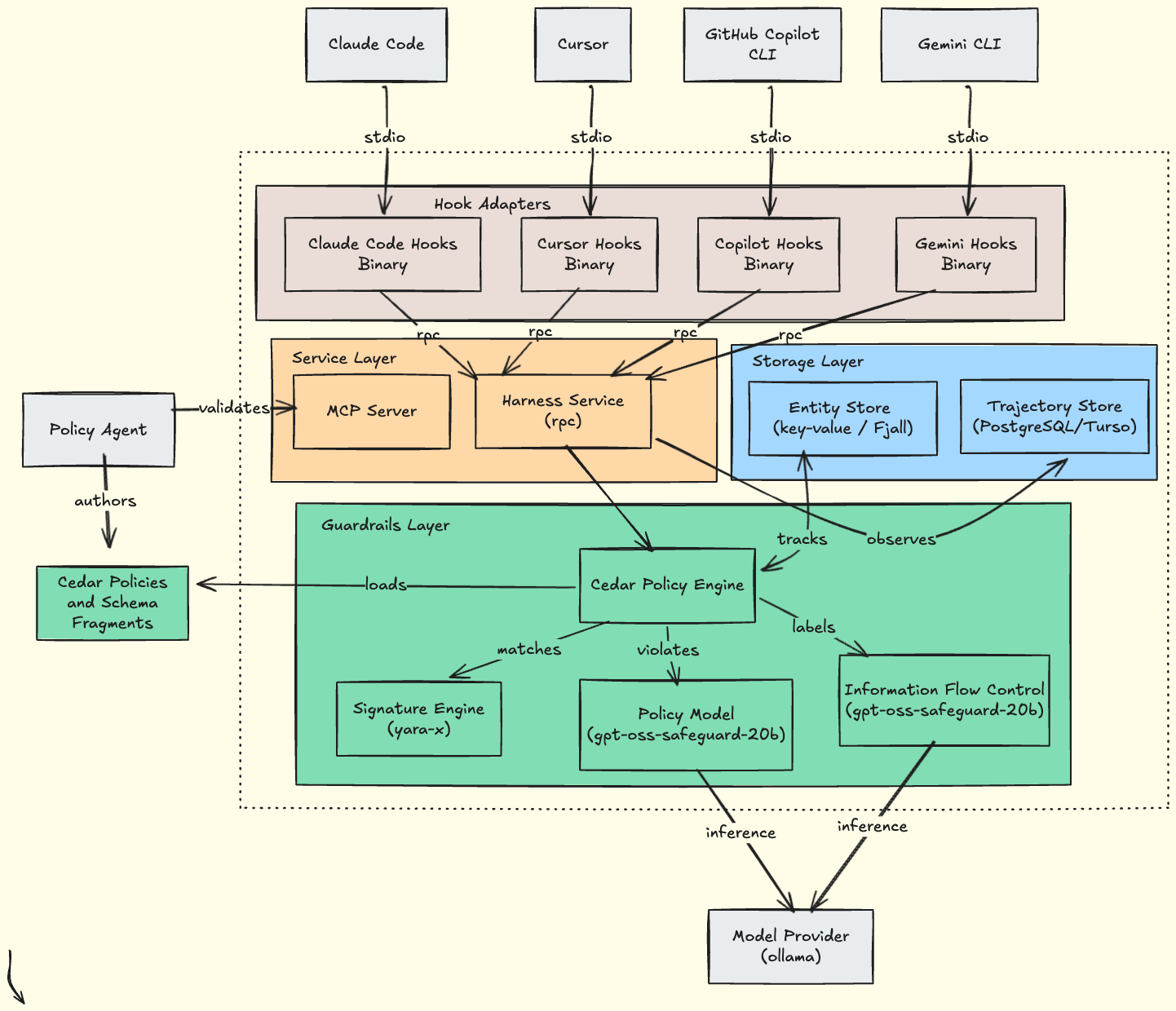
Agent frameworks (Claude Code, Cursor, Copilot, Gemini CLI) communicate with per-agent hook adapter binaries over stdin/stdout JSON. Each hook binary forwards events over tarpc RPC (Unix socket) to the harness service layer, which coordinates three guardrail subsystems:
The Cedar Policy Engine loads policies and schema fragments authored by a policy agent via the MCP server, combines guardrail signals with entity state from the Fjall key-value store, and returns an adjudication (Allow / Deny / Escalate) back through the hook binary to the agent.
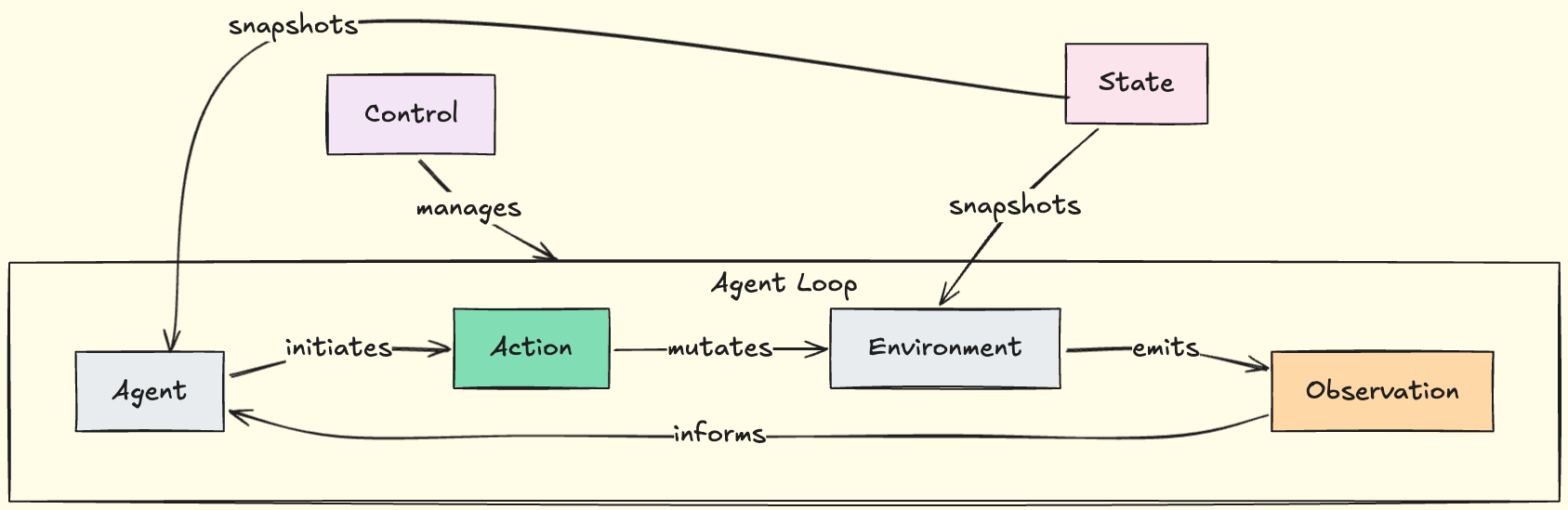
The harness models agent execution as a trajectory of typed events. Each hook adapter normalizes its agent-specific JSON into four event categories:
| Category | Description | Examples |
|---|---|---|
| Action | Agent-initiated operations, evaluated before execution | ShellCommand, FileRead, FileWrite, FileEdit, WebFetch, ToolCall |
| Observation | Environment responses, evaluated after execution | ShellCommandOutput, FileOperationResult, WebFetchOutput, Prompt |
| Control | Lifecycle events that manage the trajectory | Started, Completed, Failed, Adjudicated |
| State | Snapshots of environment context | Working directory, open files, git branch |
Each adapter maps agent-specific tool names to these common types — Claude's
Bash tool, Cursor's shell execution hook, Copilot's bash tool, and Gemini's
bash tool all normalize to the same ShellCommand action. The harness
evaluates policies against these normalized events, so Cedar rules work
identically across all four agents.
| Crate | Purpose |
|---|---|
crates/harness | Cedar policy engine, entity store, trajectory storage, tarpc RPC |
crates/guardrails/signature | YARA-X signature scanning (prompt injection, exfiltration, secrets) |
crates/guardrails/ifc | LLM-based data classification (Microsoft Purview sensitivity labels) |
crates/guardrails/policy | LLM-based policy evaluation (secure code generation categories) |
crates/common | Shared I/O utilities for hook binaries (stdin/stdout JSON, tracing) |
crates/mcp | MCP server for interactive Cedar policy authoring |
apps/claude | Claude Code hooks |
apps/cursor | Cursor hooks |
apps/copilot | GitHub Copilot hooks |
apps/gemini | Gemini CLI hooks |
# Test
cargo test --workspace

# Lint
cargo fmt --all -- --check
cargo clippy --all-features -- -D warnings
Production hardening. The sondera-harness-server socket path is security-critical, whichever process
binds it first controls adjudication for all hook clients. Pre-create the directory with restricted ownership to prevent
a rogue process from binding the path before the harness starts:
sudo mkdir -p /var/run/sondera
sudo chown sondera:sondera /var/run/sondera
sudo chmod 0750 /var/run/sondera
On systemd hosts, use RuntimeDirectory=sondera in the unit file instead, which creates and locks down /run/sondera/
automatically. Avoid the home directory fallback in production, its world-writable parent makes it vulnerable to
pre-binding races.
MIT licensed. See LICENSE.
Claude Code hook that writes a forward-only why-block (decisions, trade-offs, assumptions, limitations) into your PR des
Blocks dangerous git and shell commands from being executed by AI coding agents
One command to install 6 essential safety hooks in 10 seconds — zero dependencies
Give Claude Code memory that evolves with your codebase via hooks and LLM-compiled knowledge