

Are you the author? Sign in to claim
sonilo-mcp
An MCP (Model Context Protocol) server that exposes Sonilo's licensed music and sound-effects API to MCP-compatible clients (Claude Code, Claude Desktop, Codex).
The flagship tool is video_to_music: hand it your finished video and it composes an original soundtrack matched to the cut — the music follows the pacing, emotion, and edits because the model saw them. Length matches the video automatically. Every track is licensed and safe for commercial use (terms apply). text_to_music is also available for fixed-length tracks with no video to match.
For sound design, video_to_sfx watches your video and generates matching sound effects, returned as a standalone audio file. text_to_sfx generates a standalone effect from a description.
▶ Example result — an AI-generated trailer with its soundtrack composed by video_to_music from the assembled cut. For recipes covering any AI-video pipeline (stitch → grade → add music → mux), see the Sonilo video-to-music cookbook.
claude mcp add sonilo --env SONILO_API_KEY=sks_... -- uvx sonilo-mcp
Get your API key from the Sonilo dashboard, then start a session and ask, e.g. "Make background music that matches this video: ~/Desktop/promo.mp4."
segments let you script effects to specific time ranges ([{start, end, prompt}]).wav, mp3, aac, or flac.dubbing, no card required: 2 each on text-to-music, text-to-sfx and audio-ducking, and 1 each on video-to-music, video-to-sfx, video-to-video-music, video-to-video-sfx, video-to-sound and video-to-video-sound. After that, calls bill at the normal rate. dubbing has zero free runs and is billed from the first call — it charges video duration × number of languages, so a free run on it would be worth far more than on any other endpoint.The play_audio tool requires PortAudio at runtime (for sounddevice). On macOS/Linux, install via:
brew install portaudiosudo apt-get install libportaudio2uvx sonilo-mcp and pip install will pull the Python bindings, but the system PortAudio library must be installed separately. The other tools (text_to_music, video_to_music, text_to_sfx, video_to_sfx, audio_ducking, get_sfx_task, get_account_services, get_usage) work without PortAudio.
Get your API key from the Sonilo dashboard.
Install the uv package manager (provides uvx):
curl -LsSf https://astral.sh/uv/install.sh | sh
See the uv repo for other install methods.
Go to Claude > Settings > Developer > Edit Config > claude_desktop_config.json to include the following:
{
  "mcpServers": {
    "sonilo": {
      "command": "uvx",
      "args": ["sonilo-mcp"],
      "env": {
        "SONILO_API_KEY": "sks_...",
        "SONILO_API_URL": "https://api.sonilo.com",
        "TIME_OUT_SECONDS": "600"
      }
    }
  }
}
Restart Claude Desktop. You should see the Sonilo tools available in the tool menu.
Get your API key from the Sonilo dashboard.
Install the uv package manager (provides uvx):
curl -LsSf https://astral.sh/uv/install.sh | sh
**Go to Codex > Settings > MCP servers to fill out the following:
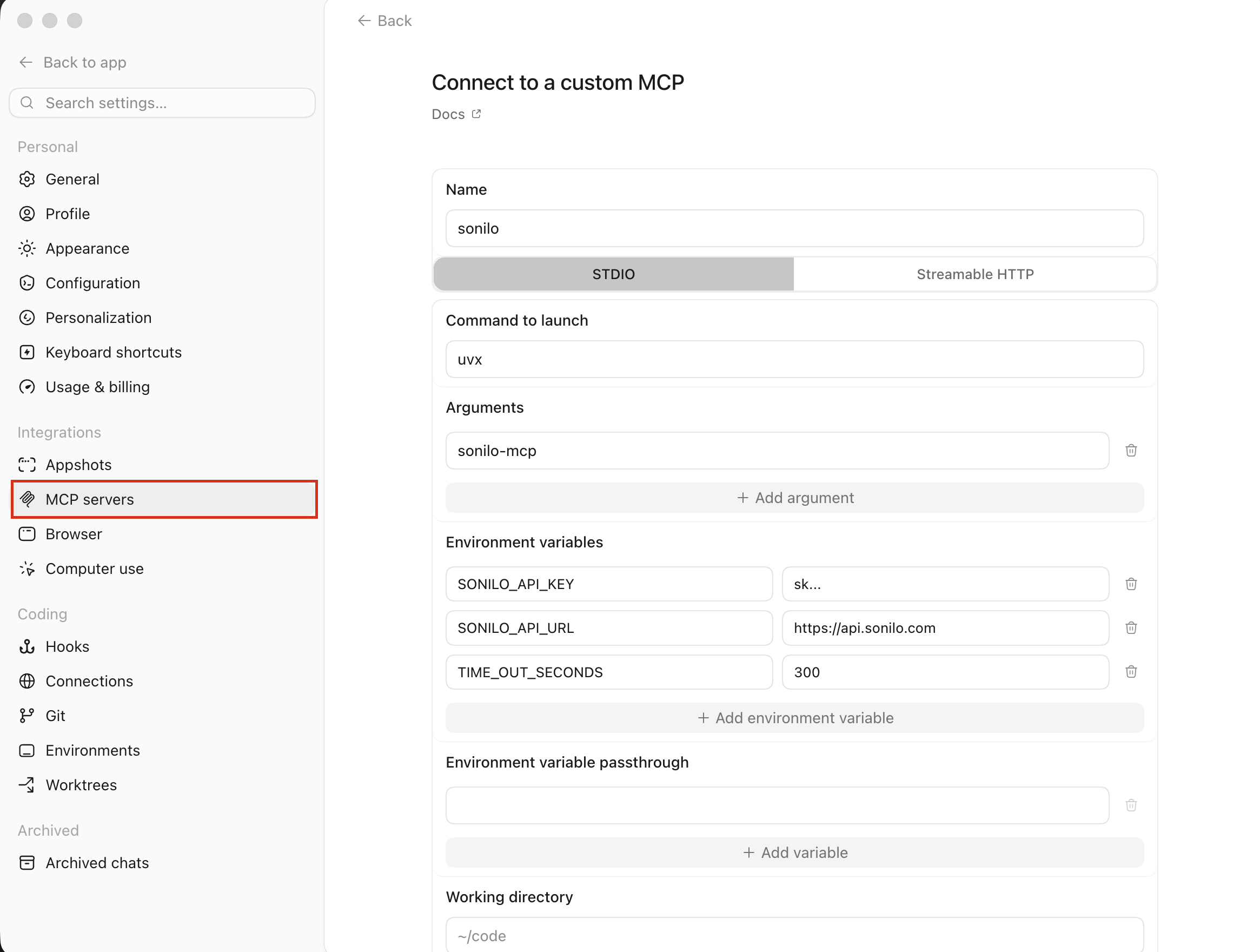
Or you can add the server** to ~/.codex/config.toml:
[mcp_servers.sonilo]
command = "uvx"
args = ["sonilo-mcp"]

[mcp_servers.sonilo.env]
SONILO_API_KEY = "sk_..."
SONILO_API_URL = "https://api.sonilo.com"
TIME_OUT_SECONDS = "600"
/mcp to confirm sonilo is connected and its tools are listed.Once the server is connected, just ask your assistant in natural language. For example:
~/Desktop/promo.mp4."https://example.com/clip.mp4 with a calm, ambient style."~/Desktop/trailer.mp4 — add a soundtrack that matches the cut."The assistant will call the matching tool (text_to_music, video_to_music, text_to_sfx, video_to_sfx, audio_ducking, get_sfx_task, get_account_services, get_usage, or play_audio) and save generated audio to your configured output directory.
| Variable | Default | Description |
|---|---|---|
SONILO_API_KEY | (required) | Bearer token. |
SONILO_API_URL | https://api.sonilo.com | Public API base URL. |
SONILO_MCP_BASE_PATH | ~/Desktop | Default output directory and base for relative input paths. Also the confinement boundary (see below). |
SONILO_MCP_ALLOW_ANY_PATH | false | Set to true to let tools read/write files outside SONILO_MCP_BASE_PATH. |
TIME_OUT_SECONDS | 600 | Generation timeout, in seconds. Aligned with the backend's read timeout. |
By default, the file tools (video_to_music input, play_audio, and any
output_directory) are confined to SONILO_MCP_BASE_PATH. Paths that
resolve outside it (after symlink resolution) are rejected. This limits the
blast radius if a client is tricked into reading or exfiltrating arbitrary
files. To opt out — e.g. to read a video from elsewhere on disk — set
SONILO_MCP_ALLOW_ANY_PATH=true.
| Tool | Description | Cost |
|---|---|---|
text_to_music(prompt, duration, output_directory?) | Generate music from a text prompt. | ✅ |
video_to_music(video_path? | video_url?, prompt?, preserve_speech?, output_directory?) | Generate music matched to a video. Max duration 360s (6 min); subject to the account's upload-size cap (typically 300 MB). preserve_speech (default false) keeps the source speech in the result — you also get a vocals speech stem and a ready-to-use mux; when set, the call runs the backend's async generation mode internally instead of streaming. | ✅ |
text_to_sfx(prompt, duration, audio_format?, output_directory?) | Generate a sound effect from text. Duration 1–180s; formats wav/mp3/aac/flac (default aac). | ✅ |
video_to_sfx(video_path? | video_url?, prompt?, segments?, audio_format?, output_directory?) | Generate SFX for a video; saves the generated SFX audio. Max video duration 180s (3 min). | ✅ |
video_to_video_music(video_path? | video_url?, prompt?, preserve_speech?, output_directory?) | Generate music for a video and return a new .mp4 with it muxed in. Max video duration 360s (6 min). | ✅ |
video_to_video_sfx(video_path? | video_url?, prompt?, segments?, output_directory?) | Generate SFX for a video and return a new .mp4 with them muxed in. Max video duration 180s (3 min). | ✅ |
video_to_sound(video_path? | video_url?, music_prompt?, sfx_prompt?, segments?, preserve_speech?, ducking?, output_directory?) | Generate music and SFX for a video in one call and save the mixed audio track. One charge instead of two, with the two layers balanced by the backend. ducking (default true) dips the music under the source speech. Max video duration 180s (3 min). | ✅ |
video_to_video_sound(video_path? | video_url?, music_prompt?, sfx_prompt?, segments?, preserve_speech?, ducking?, output_directory?) | Same as video_to_sound, but returns a new .mp4 with the mixed soundtrack muxed in. Max video duration 180s (3 min). | ✅ |
dubbing(video_path? | video_url?, languages?, output_directory?) | Dub a video into other languages and save one dubbed .mp4 per language. languages is a list of codes (en, zh_cn, ja, ko, pt, es, de, fr, it, ru); omit it for the default ["zh_cn", "es", "fr"]. video_url must be https — the dubbing pipeline fetches the source itself. Max video duration 180s (3 min). Billed per language, with no free trial. | ✅ |
audio_ducking(voice_path? | voice_url?, music_path? | music_url?, output_directory?) | Duck a music bed under a voice track. The voice input may be a video — the ducked mix is muxed back into a new .mp4. Each input max 360s (6 min); subject to the account's upload-size cap. | ✅ |
get_sfx_task(task_id, output_directory?) | Check an SFX, audio-ducking, video-to-video, video-to-sound, dubbing, or async video-to-music task and download its result — recovery for timed-out text_to_sfx, video_to_sfx, audio_ducking, video_to_video_music, video_to_video_sfx, video_to_sound, video_to_video_sound, dubbing, and video_to_music(preserve_speech=true) calls. | ❌ |
get_account_services() | List available services, limits, and the free-trial allowance left per service. | ❌ |
get_usage(days=30) | Show usage summary + per-day breakdown. | ❌ |
play_audio(input_file_path) | Play a local audio file. | ❌ |
Tools marked ✅ make API calls that incur charges on your Sonilo account.
Free trial: self-serve accounts start with a few free runs per service — no card required.
get_account_services()reports what is left astrial[service] = {granted, used, remaining}; check it before calling a ✅ tool so you can warn the user instead of failing on them. When a service'sremaininghits0, calls to it fail withtrial_exhausteduntil a payment method is added. Dubbing has no free runs and bills from the first call. Accounts without a free-trial allowance simply have notrialkey.
Optional: if
ffprobe(part of FFmpeg) is installed,video_to_musicchecks a video's duration locally and rejects anything over 360s before uploading.video_to_sfxperforms the same local check with its 180s cap.audio_duckingdoes the same for both of its inputs against its 360s cap. Without it, the same limits are still enforced by the backend.
The music tools stream their result and finish in one call — with one exception: video_to_music(preserve_speech=true) submits a task and polls it internally instead, because keeping the source speech is only available in the backend's async mode. You still get the saved file paths back from a single call; you just don't see the task, and — like the SFX tools — it uses the same get_sfx_task recovery path if the call times out. The SFX tools submit a task, then poll it until it completes — text_to_sfx and video_to_sfx do this for you and return the saved file paths, so you normally never see the task. audio_ducking uses the same submit-then-poll flow and the same get_sfx_task recovery path.
If a call times out, the generation keeps running (and is already charged). The error message carries the task id, and get_sfx_task("<id>") retrieves the result once it's ready. The task id is also printed to stderr the moment a task is submitted, so it survives even a cancelled call. get_sfx_task is safe to call repeatedly: if the file is already on disk it reports that instead of downloading a second copy.
Music is saved as .m4a (AAC in MP4 container). File names use the title returned by the backend (slugified), or a sonilo-<timestamp>.m4a fallback. When multiple parallel streams are returned, a -<index> suffix is appended.
video_to_music(preserve_speech=true) saves up to three kinds of file, each labeled in the returned text: the generated music audio (same naming as above, based on prompt or falling back to music-<first 8 chars of the task id>), the preserved speech stem as <base>-vocals.<ext>, and the mux — speech and music already mixed together, the ready-to-use combined result — as <base>-mux.<ext> (or <base>-mux-<index>.<ext> for multiple streams). The speech stem and mux extensions come from the backend's reported content_type (typically .m4a).
Sound effects are saved in the requested audio_format — wav, mp3, flac, or aac (the default, written as .m4a); video_to_sfx saves audio only, not the source video.
Combined sound (video_to_sound / video_to_video_sound) is saved as a single file: a .wav for video_to_sound, a .mp4 for video_to_video_sound. The name comes from music_prompt, falling back to sfx_prompt and then to sound-<first 8 chars of the task id> / v2v-sound-<first 8 chars of the task id>. The separate music and SFX stems stay on the backend — only the mixed result is downloaded.
Dubbing (dubbing) is saved as one .mp4 per requested language, named dubbing-<first 8 chars of the task id>.<language>.mp4 — there is no prompt to name the files after. Asking for four languages writes four files and costs four times as much as one. Dubbing polls for at least two hours regardless of TIME_OUT_SECONDS, matching the backend's own ceiling for the job.
File names come from the prompt (slugified, truncated to 80 characters). When there is no prompt to name a file after — video_to_sfx without one, or an SFX/ducking file recovered via get_sfx_task — the name is sfx-<first 8 chars of the task id> instead. A video_to_music(preserve_speech=true) task recovered via get_sfx_task is named music-<first 8 chars of the task id> instead (get_sfx_task detects the music envelope shape and saves audio/vocals/mux the same way as a direct video_to_music call). Existing files are never overwritten: a -1, -2, … suffix is added instead.
Ducking results are saved as a single file: a .wav, or a .mp4 when the voice input was a video (the ducked mix is muxed back into it). The file name is the voice input's name plus -ducked (e.g. interview.mp4 → interview-ducked.mp4), falling back to ducked-<first 8 chars of the task id> when there is no usable name. A ducking result recovered via get_sfx_task is named sfx-<first 8 chars of the task id> instead, since that tool has no voice file name to work from.
| Message | What to do |
|---|---|
Invalid SONILO_API_KEY | Verify the key at https://platform.sonilo.com/dashboard/api-keys. |
Insufficient minutes / Credit limit exceeded | Top up at https://platform.sonilo.com/dashboard/billing. |
You've used your N free trial calls for <service> | That service's free trial is spent. Add a payment method at https://platform.sonilo.com/dashboard/billing — retrying can't help. get_account_services shows what is left on the other services. |
Rate limit exceeded | Check get_account_services for your rpm/concurrency limits. |
Generation timed out (music, text_to_music/video_to_music without preserve_speech) | Raise TIME_OUT_SECONDS. Check get_usage to confirm whether the backend completed and charged. |
Timed out … waiting for task <id> (SFX, ducking, or video_to_music(preserve_speech=true)) | The generation is still running. Call get_sfx_task("<id>") to retrieve the result — nothing is lost, including for a timed-out preserve_speech music task (get_sfx_task recognizes its result shape and saves audio/vocals/mux the same way video_to_music itself would). |
Task not found | The task id doesn't exist, or belongs to a purely streaming generation (text_to_music, or video_to_music without preserve_speech), which isn't pollable. Check the id. |
Run Claude Code as an MCP server so any agent can delegate coding tasks to it
 @microsoft✓ Official
Browser automation using accessibility snapshots instead of screenshots
 @googleapis✓ Official
Google's universal MCP server supporting PostgreSQL, MySQL, MongoDB, Redis, and 10+ databases
 @github✓ Official
Official GitHub integration for repos, issues, PRs, and CI/CD workflows