

Are you the author? Sign in to claim
TapeAgents is a framework that facilitates all stages of the LLM Agent development lifecycle





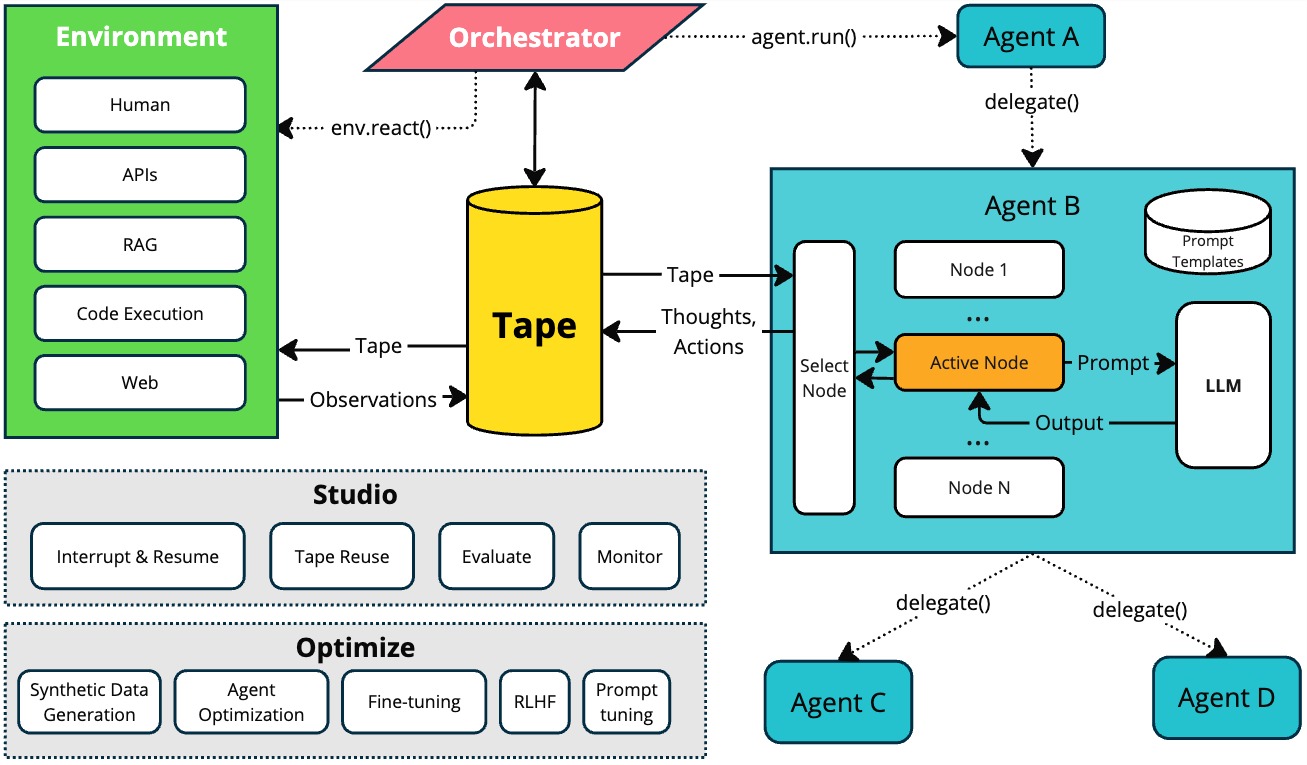
TapeAgents is a framework that leverages a structured, replayable log (Tape) of the agent session to facilitate all stages of the LLM Agent development lifecycle. In TapeAgents, the agent reasons by processing the tape and the LLM output to produce new thoughts, actions, control flow steps and append them to the tape. The environment then reacts to the agent’s actions by likewise appending observation steps to the tape.
Key features:
The Tape-centric design of TapeAgents will help you at all stages of your project:
Start with the introductory Jupyter notebook to quickly learn the core concepts of the framework.
The simplest agent just to show the basic structure of the agent:
from tapeagents.agent import Agent, Node
from tapeagents.core import Prompt
from tapeagents.dialog_tape import AssistantStep, UserStep, DialogTape
from tapeagents.llms import LLMStream, LiteLLM
from tapeagents.prompting import tape_to_messages

llm = LiteLLM(model_name="gpt-4o-mini")


class MainNode(Node):
    def make_prompt(self, agent: Agent, tape: DialogTape) -> Prompt:
        # Render the whole tape into the prompt, each step is converted to message
        return Prompt(messages=tape_to_messages(tape))

    def generate_steps(self, agent: Agent, tape: DialogTape, llm_stream: LLMStream):
        # Generate single tape step from the LLM output messages stream.
        yield AssistantStep(content=llm_stream.get_text())


agent = Agent[DialogTape].create(llm, nodes=[MainNode()])
start_tape = DialogTape(steps=[UserStep(content="Tell me about Montreal in 3 sentences")])
final_tape = agent.run(start_tape).get_final_tape()  # agent will start executing the first node
print(f"Final tape: {final_tape.model_dump_json(indent=2)}")
The examples/ directory contains examples of how to use the TapeAgents framework for building, debugging, serving and improving agents. Each example is a self-contained Python script (or module) that demonstrates how to use the framework to build an agent for a specific task:
Other notable examples that demonstrate the main aspects of the framework:
To run these examples, simply use:
uv run -m examples.<MODULE> <ARGS>
Install the latest release with its minimal dependencies:
pip install tapeagents
You can also install converters and finetune optional dependencies
pip install 'tapeagents[converters,finetune]'
Official documentation here
git clone https://github.com/ServiceNow/TapeAgents.git
cd TapeAgents
venv environment and install dependencies:make setup
# equivalent to `uv sync --all-extras`
See our full TapeAgents documentation.
For an in-depth understanding of the design principles, architecture, and research behind TapeAgents, see our technical report.
Feel free to reach out to the team:
We acknowledge the inspiration we took from prior frameworks, in particular LangGraph, AutoGen, AIWaves Agents and DSPy.
Manage multiple Claude Code agents from TUI or Web with tmux and git worktrees
Kanban-based orchestration for 10+ coding agents with isolated git worktrees per agent
Coding agent session manager supporting Claude Code, Gemini CLI, Codex, and more
191 agents, 155 skills, and 82 plugins cross-compatible with Claude Code, Cursor, and Codex