

Are you the author? Sign in to claim
Local-only GitHub Actions and CI maintenance check for AI-built apps.
A local check for GitHub Actions and CI maintenance hygiene (third-party action pinning, workflow token permissions, and update automation), built for apps shipped with Lovable, Bolt, Replit, Cursor, or v0.
Local by default. No uploads. No telemetry. It reads only your workflow files, on your machine.
The default code path makes no outbound network requests, writes its report locally, and sends
nothing anywhere. There is no analytics or phone-home of any kind. Only the opt-in --gh-org mode
uses the network (through your own gh session).
Works with Cursor, Claude Code, and Codex (local MCP server, below).
1. GitHub Action — add a maintenance check to CI that writes a summary to the run (no PR comments, no source upload):
permissions:
  contents: read
steps:
  - uses: actions/checkout@v4
  - run: npx taskbounty-check@0.1.6 . --github-summary --no-network
Want a human to interpret or fix what the Action surfaces? Request a free launch-safety review. TaskBounty gets no access to your repo, source, or workflows unless you submit that form.
2. Agent / MCP — a local stdio server for Cursor, Claude Code, and Codex:
npx -y taskbounty-check@0.1.6 mcp
3. One-off CLI — scan the current repo locally and write a report:
npx -y taskbounty-check@0.1.6 .
Pin a version (
@0.1.6) in committed config and CI for reproducibility.@latestis convenient for a quick one-off, but a pinned version is the reproducible choice.
The Action writes a counts-only maintenance summary to the workflow run (categories and next steps, no filenames, line numbers, or repo source). Below is that exact summary, rendered from this repo's own CI output:
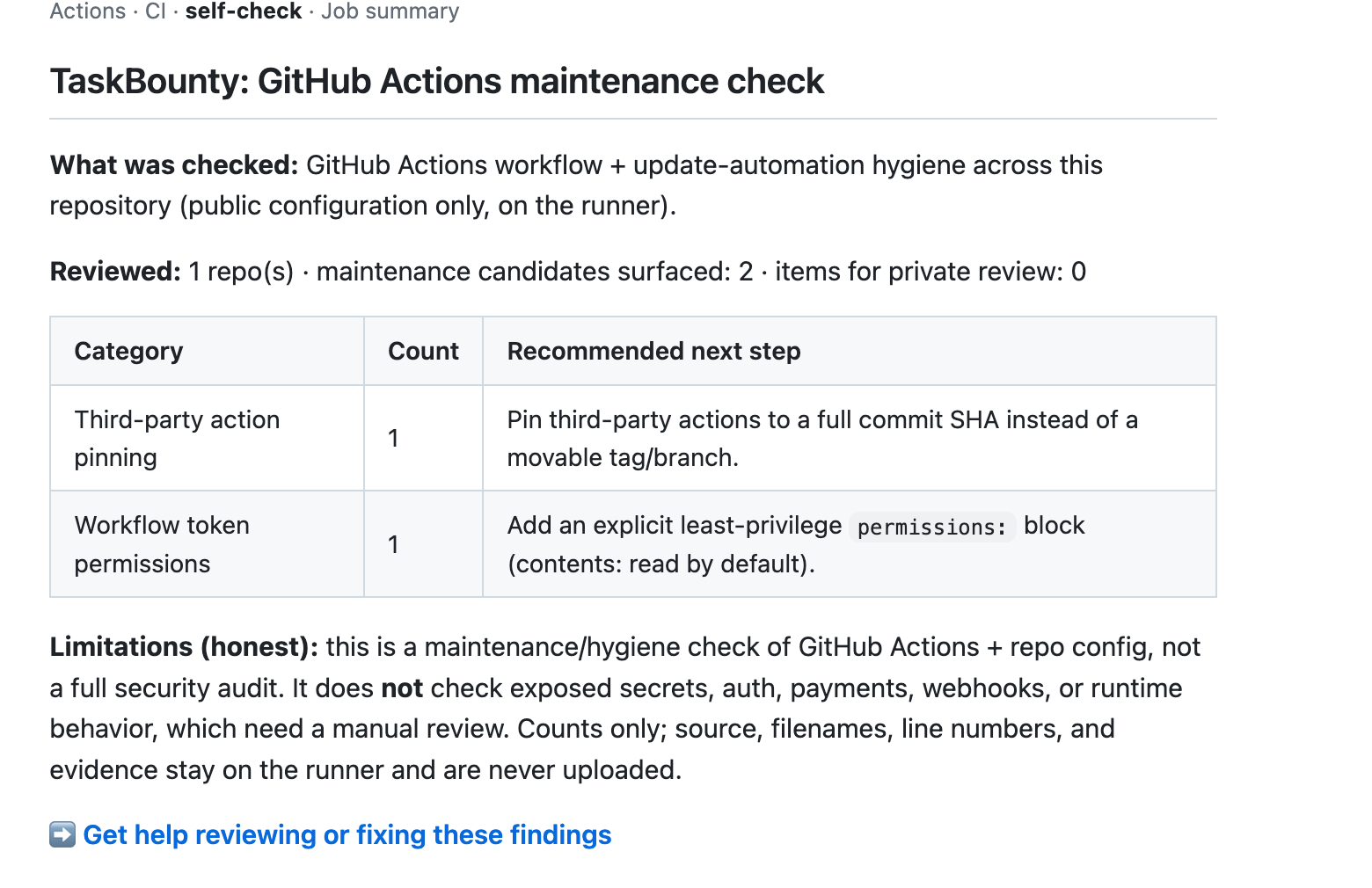
See it produced live by the self-check job in this repository's Actions runs.
Prefer a guided walkthrough? Follow the five-minute real-repository quickstart.
Checks (GitHub Actions + CI maintenance hygiene):
permissions: blockpull_request_target, script injection)Does NOT check (these need a manual review): exposed secrets, auth/authorization, payments, webhooks, runtime behavior. It is a maintenance/hygiene check, not a full security audit or a penetration test.
| Mode | Command | Network |
|---|---|---|
| Single repo | npx taskbounty-check . | none |
| Directory of repos | npx taskbounty-check ./all-repos | none |
| Explicit paths | npx taskbounty-check --manifest repos.json | none |
GitHub org (your gh session) | npx taskbounty-check --gh-org <org> | yes, opt-in |
--gh-org uses your existing gh CLI session to fetch each repo's workflow files to this
machine (read-only). Your GitHub token is never read by this tool and never sent to TaskBounty.
Run --explain-data to print this at any time.
<repo>/.github/workflows/*.yml|*.yaml and
update-automation config (dependabot.yml/renovate.json*). Never source files, .env,
secrets, SSH keys, credential stores, or anything outside the selected repository roots.
Symlinks that escape a root are skipped, never followed.<out>.json (full detail) and <out>.html.--share uploads nothing — it writes a sanitized,
counts-only file (scan id, label, candidate counts by category, private-review count,
scanner version, timestamps; repo names only with --include-repo-names) for you to submit
manually. Network stays off under --share. Only --gh-org intentionally uses the network.--share · --gh-org <org> · --manifest <file> · --org-label <label> ·
--include-repo-names · --dry-run · --explain-data · --delete-local-report ·
--no-network (default everywhere except --gh-org) · --out <basename> · --version · --help
Request a free 20-minute launch-safety review: https://www.task-bounty.com/ai-app-security-check/review?utm_source=npm&utm_medium=npm_readme&utm_campaign=workflow_security
TaskBounty receives nothing unless you submit that form. The scan runs locally and the full report stays on your machine; the review form gives us no access to your repositories, source, workflows, or secrets.
Emit SARIF 2.1.0 and surface findings in your repo's Security → Code scanning tab:
npx taskbounty-check@latest . --format sarif --output taskbounty.sarif
The SARIF carries deterministic rule ids (taskbounty/<rule>), severity levels, and file/line
references — no source contents, secrets, or environment values, and no network access.
Confirmed findings are emitted as kind: fail; lower-confidence items as kind: review.
Help interpreting SARIF results: https://www.task-bounty.com/ai-app-security-check/review?utm_source=github&utm_medium=sarif_docs&utm_campaign=workflow_security
Upload it with the official action (full example in examples/code-scanning.yml):
permissions:
  contents: read
  security-events: write
steps:
  - uses: actions/checkout@v4
  - run: npx taskbounty-check@0.1.6 . --format sarif --output taskbounty.sarif
  - uses: github/codeql-action/upload-sarif@v3
    with:
      sarif_file: taskbounty.sarif
Run a local stdio MCP server so Codex, Claude Code, or Cursor can scan and reason about findings
in your editor. It runs locally, makes zero outbound network requests, uploads no source, and
never modifies files — generate_fix_plan returns a plan as text for you to apply yourself.
npx taskbounty-check@latest mcp
Tools: scan_repo (local scan summary), explain_finding (plain-language explanation), generate_fix_plan (text fix plan).
Want a human to review the plan? https://www.task-bounty.com/ai-app-security-check/review?utm_source=mcp&utm_medium=mcp_docs&utm_campaign=workflow_security
Cursor — .cursor/mcp.json:
{ "mcpServers": { "taskbounty-check": { "command": "npx", "args": ["-y", "taskbounty-check@latest", "mcp"] } } }
Claude Code:
claude mcp add taskbounty-check -- npx -y taskbounty-check@latest mcp
Codex — in ~/.codex/config.toml:
[mcp_servers.taskbounty-check]
command = "npx"
args = ["-y", "taskbounty-check@latest", "mcp"]
Zero runtime dependencies. Published to npm with provenance (verify on the package's npm page). The default run makes no outbound requests and uploads nothing; see the methodology for the full data-handling and scope boundaries.
Run Claude Code as an MCP server so any agent can delegate coding tasks to it
 @github✓ Official
Official GitHub integration for repos, issues, PRs, and CI/CD workflows
 @microsoft✓ Official
Browser automation using accessibility snapshots instead of screenshots
 @googleapis✓ Official
Google's universal MCP server supporting PostgreSQL, MySQL, MongoDB, Redis, and 10+ databases