

Are you the author? Sign in to claim
Agent-native UI/UX design validation via MCP — journey completeness, state coverage, WCAG checks before code exists
Your generator gave you 6 screens. UXLoom proves you're missing 9 states.
AI generators (v0, Lovable, Figma Make, Claude) produce happy-path screens. UXLoom is the critic layer: it models user journeys as state machines, treats screens as nodes with state contracts, and mechanically proves what's missing before a line of production code exists — unreachable screens, dead ends, missing error/empty/loading states, WCAG contrast failures, undersized touch targets, and labels that will overflow under localization.
Agent-native by design: the interface is an MCP server (works with Claude Code, Codex, and any MCP client), with Agent Skills included.
Deterministic by design: same input, byte-identical report — benchmarked
(packages/bench) at 1.000 precision/recall on a seeded
defect catalog, SHA-256-stable across processes, 1000 screens in under 5ms.
That's what lets design completeness gate CI, where an LLM opinion can't.
Website: uxloom.dev · npm: uxloom · MCP registry: io.github.uxloom-dev/uxloom · 

| Package | What it is |
|---|---|
@uxloom/journeygraph | The open design-as-data format: journeys as state machines, screens as nodes with required states |
@uxloom/critics | The validators: journey completeness, state coverage, WCAG contrast, touch targets, text expansion |
uxloom | The MCP server + Agent Skills — the interface agents use |
New here? Start with the Quickstart — prerequisites, the Claude Code walkthrough, what to say to your agent, and troubleshooting.

# Claude Code
claude mcp add uxloom -- npx -y uxloom

# Codex CLI
codex mcp add uxloom -- npx -y uxloom
The project file (uxloom.project.json) lives in your workspace and belongs
in git — the design is data, versioned next to the code it specifies.
npx uxloom init      # one-command setup: MCP config + agent skill + starter file
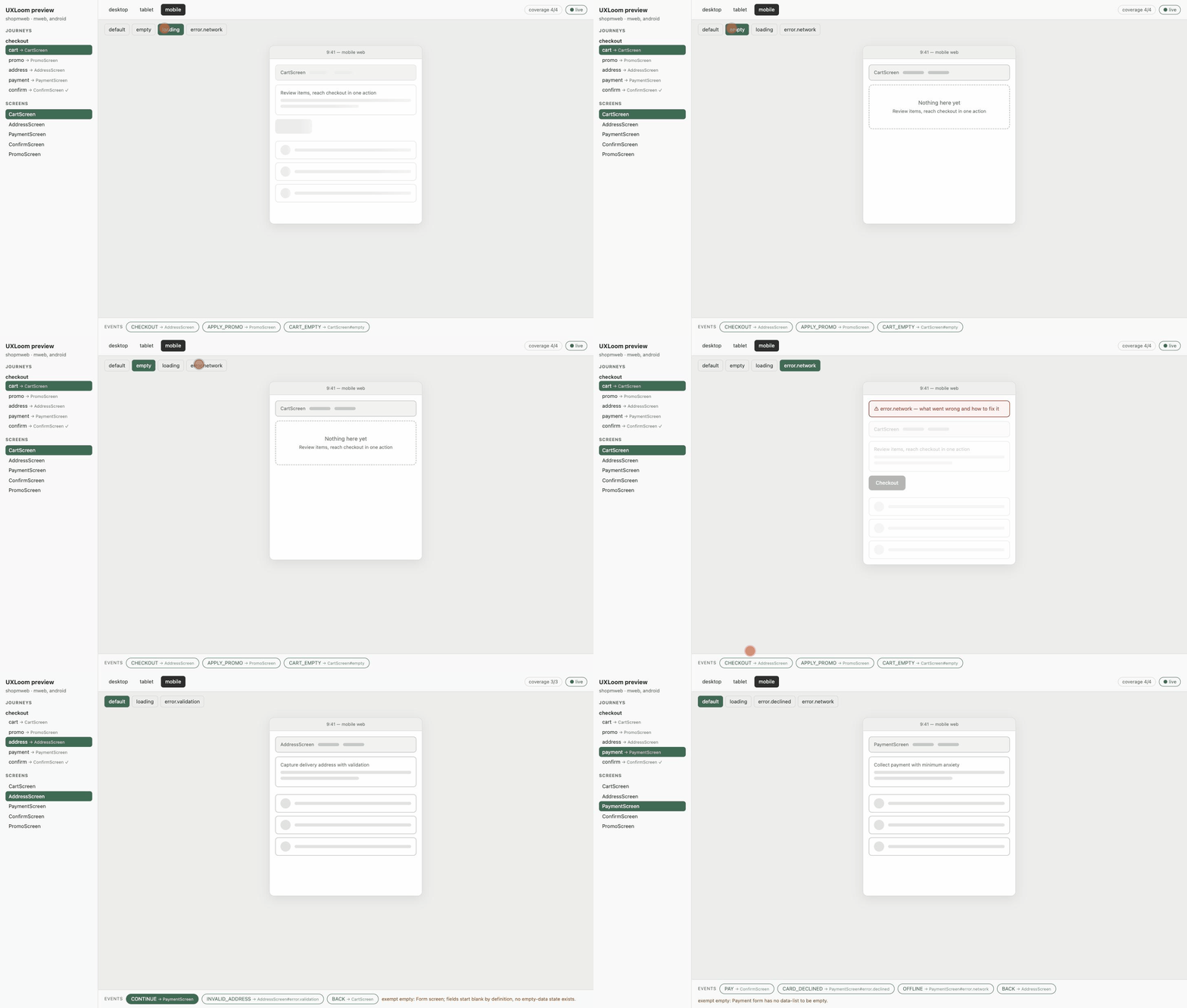
npx uxloom preview   # live wireframe mocks: every screen, every state, clickable journeys
npx uxloom check     # design completeness — exit 1 on errors, CI-ready
npx uxloom audit     # implementation drift vs the contract — exit 1 on drift
Add it to CI and a happy-path-only design can never merge:
- run: npx uxloom check design/uxloom.project.json
Workflow (also shipped as a skill in packages/mcp-server/skills/):
project_init → brief_start/brief_answer → journey_define →
screen_register → project_validate → fix → repeat until zero errors →
coverage_report.
tools/dogfood.mjs drives the real MCP server through three products, twice
each: screens as a happy-path generator hands them over, then repaired using
the validation report. Artifacts in examples/.
| Product | Generated (happy-path) | Repaired |
|---|---|---|
shopmweb — e-commerce checkout (mWeb + Android) | 9 errors, 6 warnings | 0 / 0 |
taskflow — SaaS signup/onboarding (web) | 1 error, 6 warnings | 0 / 0 |
ridenow — ride booking (iOS + Android, offline-heavy) | 3 errors, 7 warnings | 0 / 0 |
Caught: an unreachable promo screen, dead-end verification states, five
undesigned payment/error states, a 2.4:1 contrast button, a 40px touch target
on Android, a checkout label that breaks in German, and three products' worth
of missing offline states. Zero errors and zero warnings is reachable
honestly — screens declare documented exemptions where a baseline state
genuinely cannot apply, and contradictory exemptions are flagged.
npm install
npm run typecheck
npm test
Released and maintained: on npm and
the official MCP registry, with the benchmark scorecard published in every
GitHub release. The
JourneyGraph format (formatVersion: "0.1") may evolve until 1.0; releases
follow RELEASING.md — every surface is drift-checked in CI.
MIT
 @microsoft✓ Official
Browser automation using accessibility snapshots instead of screenshots
Run Claude Code as an MCP server so any agent can delegate coding tasks to it
 @googleapis✓ Official
Google's universal MCP server supporting PostgreSQL, MySQL, MongoDB, Redis, and 10+ databases
 @github✓ Official
Official GitHub integration for repos, issues, PRs, and CI/CD workflows