

VeritasGraph — open-source Knowledge Graph & GraphRAG framework on GitHub. Build multi-hop reasoning, ontology-aware ret
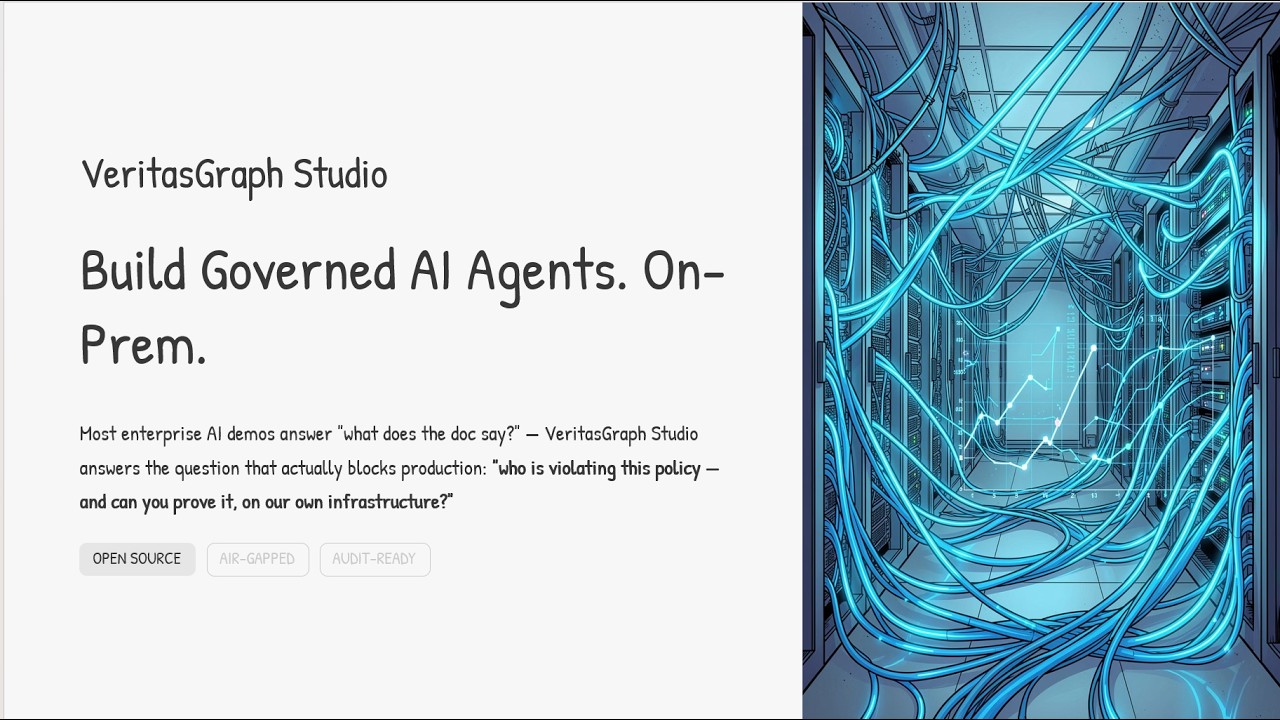
Stop chunking blindly. Combine Tree-Search structure with Knowledge-Graph reasoning — and wire it into governed AI agents. Runs 100% locally or in the cloud.




🎯 Traditional RAG guesses based on similarity. VeritasGraph reasons based on structure. Don't just find the document — understand the connection, then act on it with governed agents.
⭐ Star · 🍴 Fork · 💬 Discuss · 🐛 Report a bug
A complete walkthrough of designing, wiring, and shipping governed AI agents entirely on your own infrastructure.
📄 Read the guide: Build Governed AI Agents On-Prem (PDF)
pip install veritasgraph
veritasgraph demo --mode=lite
That's it — an interactive demo using cloud APIs (OpenAI/Anthropic), no local models required.
| Mode | Best For | Requirements |
|---|---|---|
--mode=lite | Quick demo, no GPU | OpenAI/Anthropic API key |
--mode=local | Privacy, offline use | Ollama + 8GB RAM |
--mode=full | Production, all features | Docker + Neo4j |
export OPENAI_API_KEY="sk-..."        # Lite: cloud APIs, zero setup
veritasgraph demo --mode=lite

veritasgraph demo --mode=local --model=llama3.2   # 100% offline with Ollama
veritasgraph start --mode=full                    # full GraphRAG pipeline



Useful links: ⚡ Live docs · 🎮 Live demo · 📖 Article · 📄 Research paper
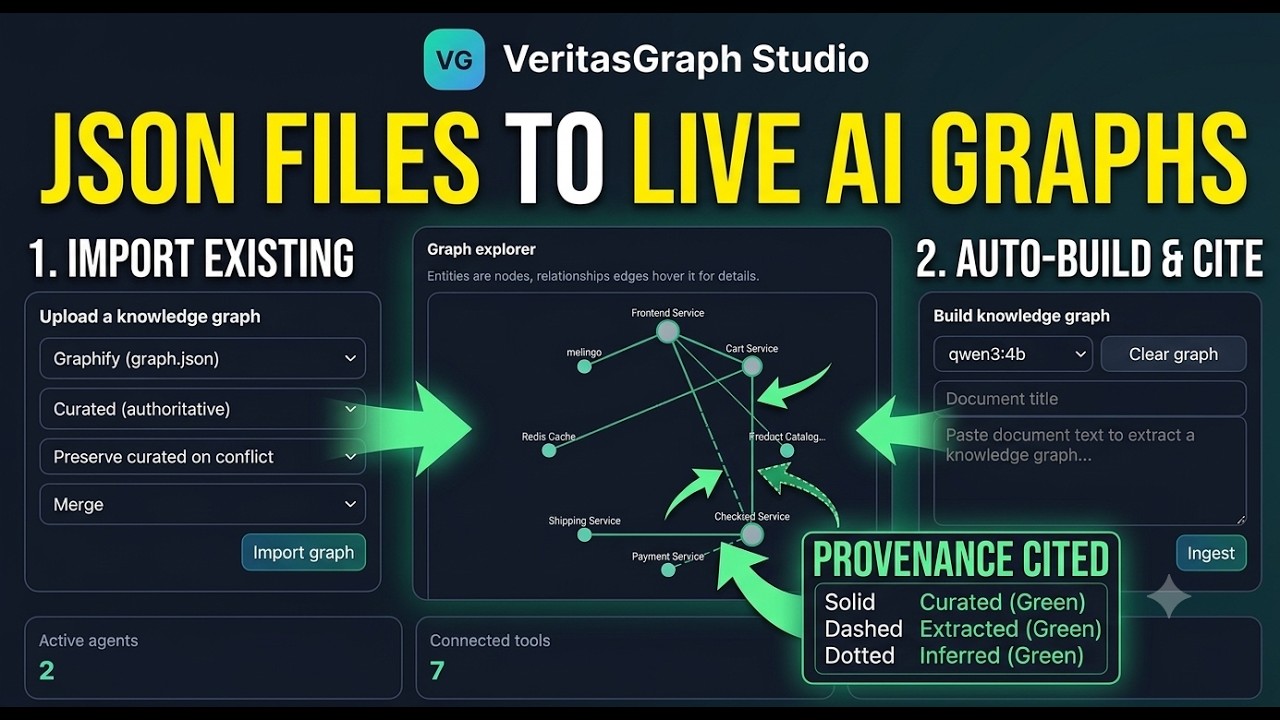
Studio is a local Agent Build Workspace (FastAPI + single-page UI) that lets you build a knowledge graph from your own documents and wire it into agents alongside tools, memory, data logging, guardrails, and headroom-style context budgeting — then chat with those agents live and watch every stage of the orchestration pipeline. Everything runs 100% locally against Ollama.
🎮 Try the Studio Live — stable URL that always redirects to the current running studio tunnel.
Run it:
pip install -r requirements.txt
ollama serve & ollama pull qwen3:latest          # any local chat model
STUDIO_DATA_DIR="$PWD/studio_api/data" \
  uvicorn studio_api.main:app --host 127.0.0.1 --port 8200 --log-level warning
# Studio UI → http://localhost:8200/studio   ·   API docs → /docs
One-command end-to-end demo (builds a graph + drives a fully-wired agent through graph reasoning, memory recall, PII redaction, and a guardrail block):
python3 demos/agent-studio/sample_pipeline.py --model qwen3:latest
[doc#chunk] source attribution.See studio_api/README.md for API and architecture, and docs/STUDIO_ENTERPRISE_TEST.md for enterprise test scenarios.
Why choose? VeritasGraph includes the hierarchical "Table of Contents" navigation of PageIndex PLUS the semantic reasoning of a Knowledge Graph.
Document Root
├── [1] Introduction
│   ├── [1.1] Background ←── Tree Navigation
│   └── [1.2] Objectives
├── [2] Methodology ←───────── Graph Links
│   └── relates_to ──────────→ [3.1] Findings
└── [3] Results
| Feature | Vector RAG | PageIndex | VeritasGraph |
|---|---|---|---|
| Retrieval type | Similarity | Tree search | 🏆 Tree + Graph reasoning |
| Attribution | ❌ Low | ⚠️ Medium | ✅ 100% verifiable |
| Multi-hop reasoning | ❌ | ❌ | ✅ |
| Tree navigation (TOC) | ❌ | ✅ | ✅ |
| Semantic search | ✅ | ❌ | ✅ |
| Cross-section linking | ❌ | ❌ | ✅ |
| Visual graph explorer | ❌ | ❌ | ✅ Built-in UI |
| 100% local/private | ⚠️ Varies | ❌ Cloud | ✅ On-premise |
| Open source | ⚠️ Varies | ❌ Proprietary | ✅ MIT license |


💡 What you're seeing: a query triggers multi-hop reasoning across the knowledge graph. Nodes light up as connections are discovered, showing exactly how the answer was found — not just what was found.
VeritasGraph ships a dedicated Model Context Protocol server — the first zero-trust, air-gapped Enterprise GraphRAG server for MCP. Connect Claude Desktop, Cursor, VS Code, Windsurf, Cline, or Continue directly to the GraphRAG engine over JSON-RPC 2.0 stdio, with zero external data egress.
python -m veritasgraph_mcp # from repo root (needs local Ollama for ingest/query)
Tools: veritasgraph_ingest_document, veritasgraph_query (multi-hop answers with [doc#chunk] citations), veritasgraph_search_entities, veritasgraph_get_graph, veritasgraph_clear_graph. See veritasgraph_mcp/README.md for IDE registration snippets.
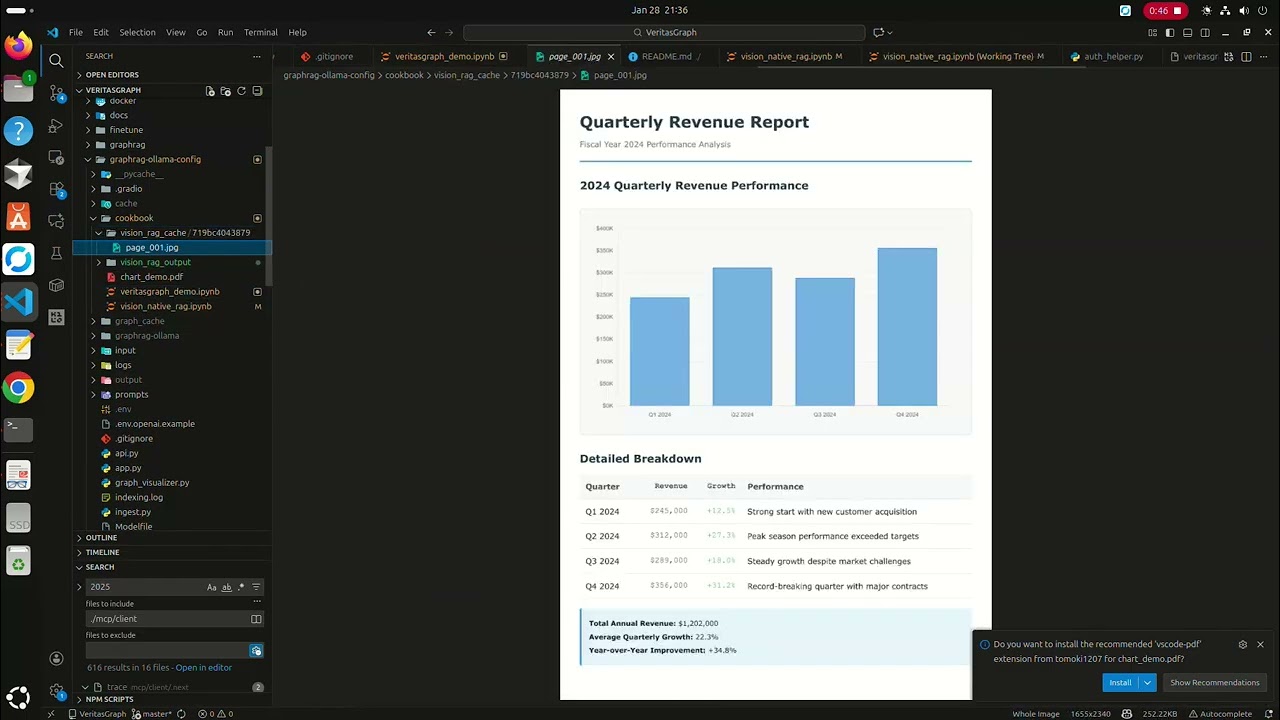
from veritasgraph import VisionRAGPipeline

pipeline = VisionRAGPipeline()                 # auto-detects available models
doc = pipeline.ingest_pdf("document.pdf")
result = pipeline.query("What are the key findings?")
print(result.answer)
from veritasgraph import VisionRAGPipeline

pipeline = VisionRAGPipeline()
doc = pipeline.ingest_pdf("report.pdf")

# View the document's hierarchical structure (like a Table of Contents)
print(pipeline.get_document_tree())
# Document Root
# ├── [1] Introduction (pp. 1-5)
# │   ├── [1.1] Background (pp. 1-2)
# │   └── [1.2] Objectives (pp. 3-5)
# └── [2] Methodology (pp. 6-15)

# Navigate to a specific section (tree-based retrieval)
section = pipeline.navigate_to_section("Methodology")
print(section['breadcrumb'])   # ['Document Root', 'Methodology']

# Or use graph-based semantic search
result = pipeline.query("What methodology was used?")
# → answer with section context: "📍 Location: Document > Methodology > Analysis Framework"
from veritasgraph import VisionRAGPipeline, VisionRAGConfig

config = VisionRAGConfig(ingest_mode="document-centric")  # tables stay intact!
pipeline = VisionRAGPipeline(config)
doc = pipeline.ingest_pdf("annual_report.pdf")
| Mode | Description | Best For |
|---|---|---|
document-centric | Whole pages/sections as nodes (default) | Most documents |
page | Each page = one node | Slide decks, reports |
section | Each section = one node | Structured documents |
chunk | Traditional 500-token chunks | Legacy compatibility |
veritasgraph --version                                    # show version
veritasgraph info                                         # check dependencies
veritasgraph init my_project                              # initialize a project
veritasgraph ingest document.pdf --ingest-mode=document-centric   # Don't Chunk. Graph.
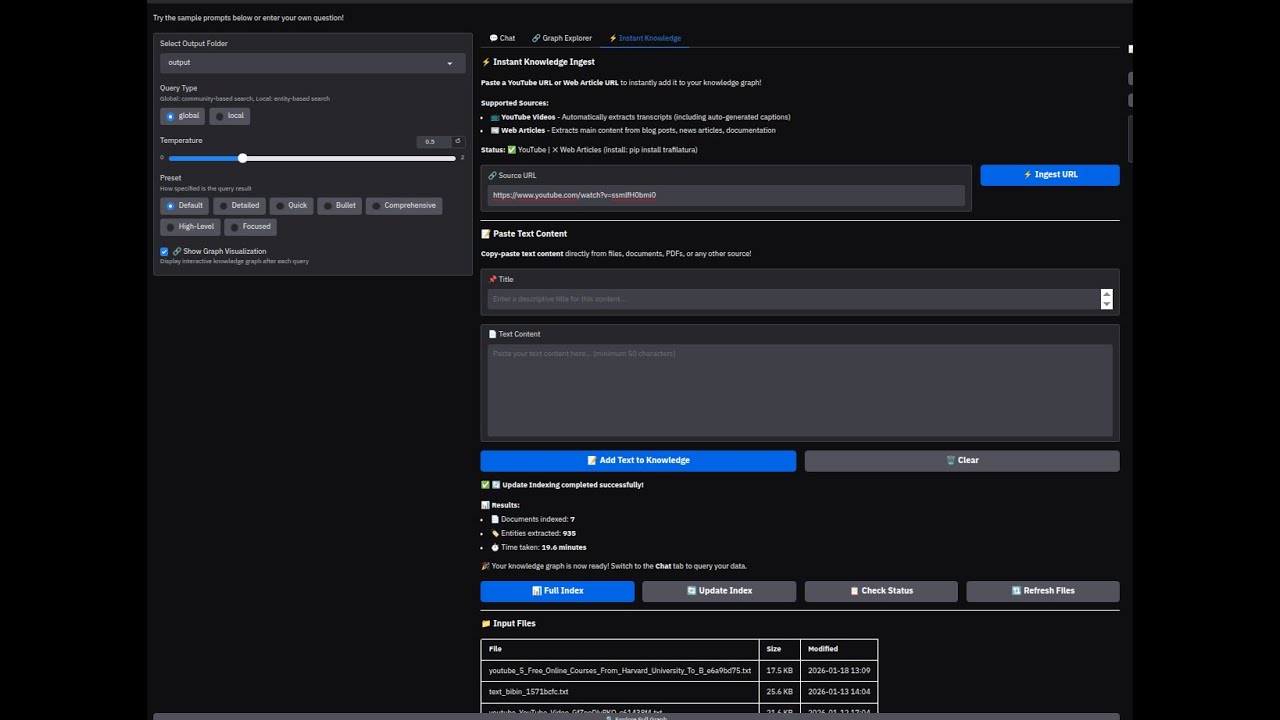
veritasgraph ingest https://youtube.com/watch?v=xxx       # auto-extract transcript
veritasgraph ingest https://example.com/article           # extract web article
pip install veritasgraph            # basic (includes lite mode)
pip install veritasgraph[web]       # Gradio UI + visualization
pip install veritasgraph[graphrag]  # Microsoft GraphRAG integration
pip install veritasgraph[ingest]    # YouTube & web-article ingestion
pip install veritasgraph[all]       # everything
GraphRAG is brilliant at describing what your documents say. But enterprise questions like "Which purchase orders violated our Segregation-of-Duties policy last quarter?" are rule-evaluation problems over structured records — not similarity search.
For those, VeritasGraph ships a sister module: VeritasReason — a deterministic reasoning engine (forward-chaining + Rete + SPARQL) that fires policy rules over a triplet store and returns auditable answers with W3C PROV-O provenance.
 Policy PDFs ─┐                        ┌─ ingest_structured.py (SQL → triples + text)
              ▼                        ▼
      VeritasGraph GraphRAG      VeritasReason (TripletStore + RuleSet
      (quotes policy text)       + ForwardChainer + PROV-O)
              └──────────┬───────────────┘
                         ▼
             Compliance answer + violators table + clause citations
python tests/test_policy_compliance_demo.py
Seeds a fake ERP into a tiny in-memory triple store, evaluates four SoD rules from rules/sod_policy.yaml, and prints violators with citations:
✓ Reasoner fired. Detected 4 violation(s):
  po:PO-2204 SOD-01   Approved & paid by emp:E118
  po:PO-2301 SOD-02   Requested & approved by emp:E091
  po:PO-2317 SOD-03   $48,750.00 approved by emp:E091 (role:Manager, not Director)
  po:PO-2402 SOD-04   Vendor vendor:V77 related to approver emp:E140
Or install and run the packaged demo:
pip install veritas-reason
veritasreason-policy-demo

The same pattern applies to leave-policy violations (HRIS attendance), expense-report fraud (ledger + receipts), clinical protocol breaches (EHR + guidelines), or KYC/AML (transactions + watchlists). Define the SQL → triple mapping in ingest_structured.py, write rules in rules/*.yaml, and ask in plain English. See veritas-reason/plan.md for a full walk-through.
VeritasGraph includes an interactive 2D knowledge-graph explorer (PyVis) that visualizes entities and relationships in real time.

| Feature | Description |
|---|---|
| Query-aware subgraph | Shows only entities related to your query |
| Community coloring | Nodes grouped by community membership |
| Red highlight | Query-related entities shown in red |
| Node sizing | Bigger nodes = more connections |
| Interactive | Drag, zoom, hover for entity details |
| Full graph explorer | View the entire knowledge graph |
VeritasGraph works with any OpenAI-compatible API — mix and match cloud and local:
| Provider | API Base | API Key | Example Model |
|---|---|---|---|
| Ollama (default) | http://localhost:11434/v1 | ollama | llama3.1-12k |
| OpenAI | https://api.openai.com/v1 | sk-proj-... | gpt-4-turbo-preview |
| Groq | https://api.groq.com/openai/v1 | gsk_... | llama-3.1-70b-versatile |
| Together AI | https://api.together.xyz/v1 | your-key | Meta-Llama-3.1-70B-Instruct-Turbo |
| LM Studio | http://localhost:1234/v1 | lm-studio | (model loaded in LM Studio) |
Also supported: Azure OpenAI, OpenRouter, Anyscale, LocalAI, vLLM.
cd graphrag-ollama-config
cp settings_openai.yaml settings.yaml
cp .env.openai.example .env       # edit with your provider settings
python -m graphrag.index --root . --config settings_openai.yaml
python app.py
⚠️ Embeddings must match your index. If you indexed with
nomic-embed-text(768 dims), you must query with the same model — switching embedding models requires re-indexing. Full details in OPENAI_COMPATIBLE_API.md.
Run a full stack (Ollama + Neo4j + Gradio) with one command:
cd docker/five-minute-magic-onboarding
# set your Neo4j password in .env, then:
docker compose up --build
Services: Gradio UI → http://127.0.0.1:7860 · Neo4j → http://localhost:7474 · Ollama → http://localhost:11434. See docker/five-minute-magic-onboarding/README.md.
| Method | Duration | Local Ollama | Setup | Best For |
|---|---|---|---|---|
python app.py --share | 72 hours | ✅ | 1 min | Quick demos |
| Ngrok tunnel | Unlimited* | ✅ | 5 min | Team evaluation |
| Cloudflare tunnel | Unlimited* | ✅ | 5 min | Team evaluation |
| Hugging Face Spaces | Permanent | ❌ (cloud LLM) | 15 min | Public showcase |
*Free tier has some limitations.
graph TD
    subgraph "Indexing Pipeline (one-time)"
        A[Source Documents] --> B{Document Chunking};
        B --> C{"LLM Extraction<br/>(Entities & Relationships)"};
        C --> D[Vector Index];
        C --> E[Knowledge Graph];
    end
    subgraph "Query Pipeline (real-time)"
        F[User Query] --> G{Hybrid Retrieval Engine};
        G -- "1. Vector search for entry points" --> D;
        G -- "2. Multi-hop graph traversal" --> E;
        G --> H{Pruning & Re-ranking};
        H -- "Rich context" --> I{LoRA-Tuned LLM Core};
        I -- "Answer + provenance" --> J{Attribution Layer};
        J --> K[Attributed Answer];
    end
    style A fill:#f2f2f2,stroke:#333,stroke-width:2px
    style F fill:#e6f7ff,stroke:#333,stroke-width:2px
    style K fill:#e6ffe6,stroke:#333,stroke-width:2px
The four stages:
TextUnits, extract (head, relation, tail) triplets, assemble nodes + edges in a graph DB (e.g. Neo4j).Hardware: 16+ CPU cores · 64GB+ RAM (128GB recommended) · NVIDIA GPU with 24GB+ VRAM (A100 / H100 / RTX 4090).
Software: Docker & Docker Compose · Python 3.10+ · NVIDIA Container Toolkit.
Copy .env.example → .env and populate with environment-specific values.
Who is it for? Engineers building enterprise search, compliance assistants, research copilots, scientific literature explorers, and agent memory systems — anywhere "the answer" depends on how facts connect, not just whether they appear near each other in a vector index.
Builds on the foundational work of HopRAG, Microsoft GraphRAG, LangChain & LlamaIndex, and Neo4j.
Presented at the International Conference on Applied Science and Future Technology (ICASF 2025) — 📄 Appreciation Certificate.
@article{VeritasGraph2025,
  title={VeritasGraph: A Sovereign GraphRAG Framework for Enterprise-Grade AI with Verifiable Attribution},
  author={Bibin Prathap},
  journal={International Conference on Applied Science and Future Technology (ICASF)},
  year={2025}
}


Licensed under MIT. ⭐ Star the repo to follow the roadmap for open-source, governed GraphRAG.
Run Claude Code as an MCP server so any agent can delegate coding tasks to it
 @microsoft✓ Official
Browser automation using accessibility snapshots instead of screenshots
 @googleapis✓ Official
Google's universal MCP server supporting PostgreSQL, MySQL, MongoDB, Redis, and 10+ databases
 @github✓ Official
Official GitHub integration for repos, issues, PRs, and CI/CD workflows
 @bibinprathap