

Are you the author? Sign in to claim
Workspace multiplexer for AI coding agent
Run fleets of Claude Code, Codex & Gemini in parallel — each agent in its own pane, or fan one prompt out into N isolated git worktrees you review hunk by hunk. Native on Windows & macOS, with approval gates, agent-to-agent channels, and a real browser your agents drive. Walk away — after a crash or full OS reboot, they come back mid-conversation.
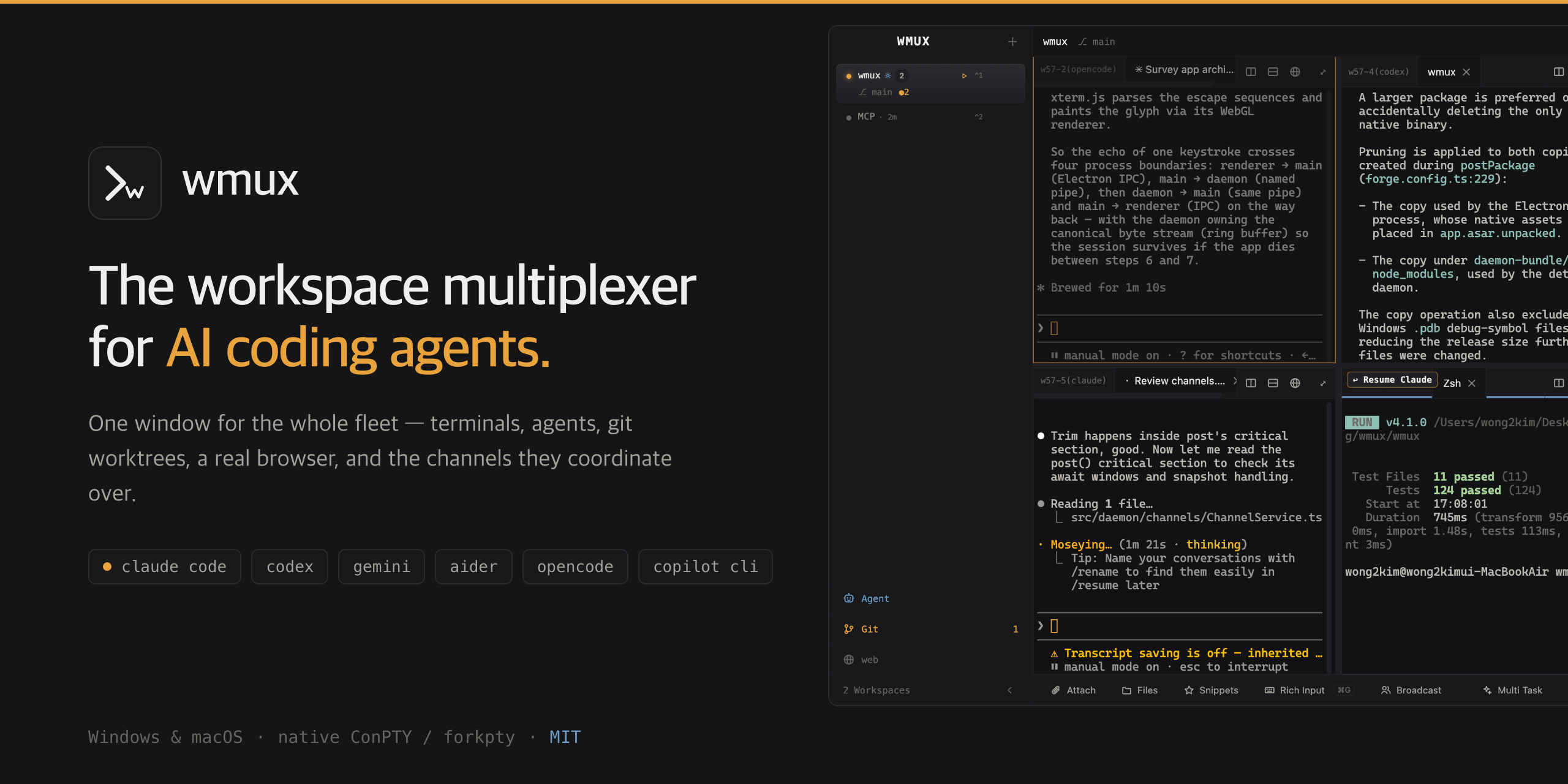






What's a workspace multiplexer? tmux splits a terminal. wmux multiplexes whole workspaces — terminals, agents, git worktrees, a browser, and the channels they coordinate over — all owned by a daemon that keeps them running across quits, crashes, and full reboots. One window. One fleet. Windows & macOS.
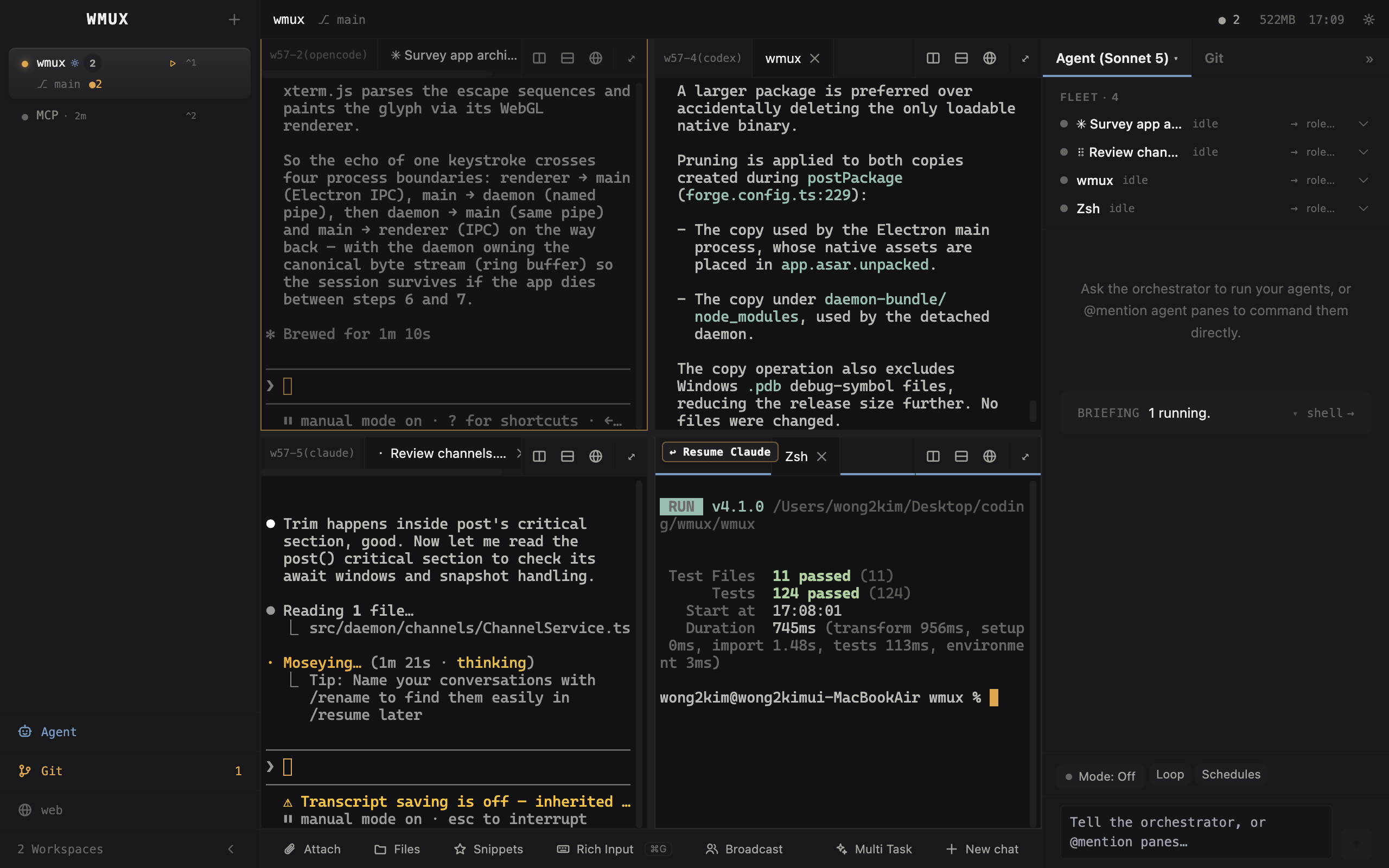
A fleet in one window. Two Claude Code agents, an OpenAI Codex pane, and a test run — split into a grid, each pane its own PTY, with the roster and the orchestrator in the side dock.
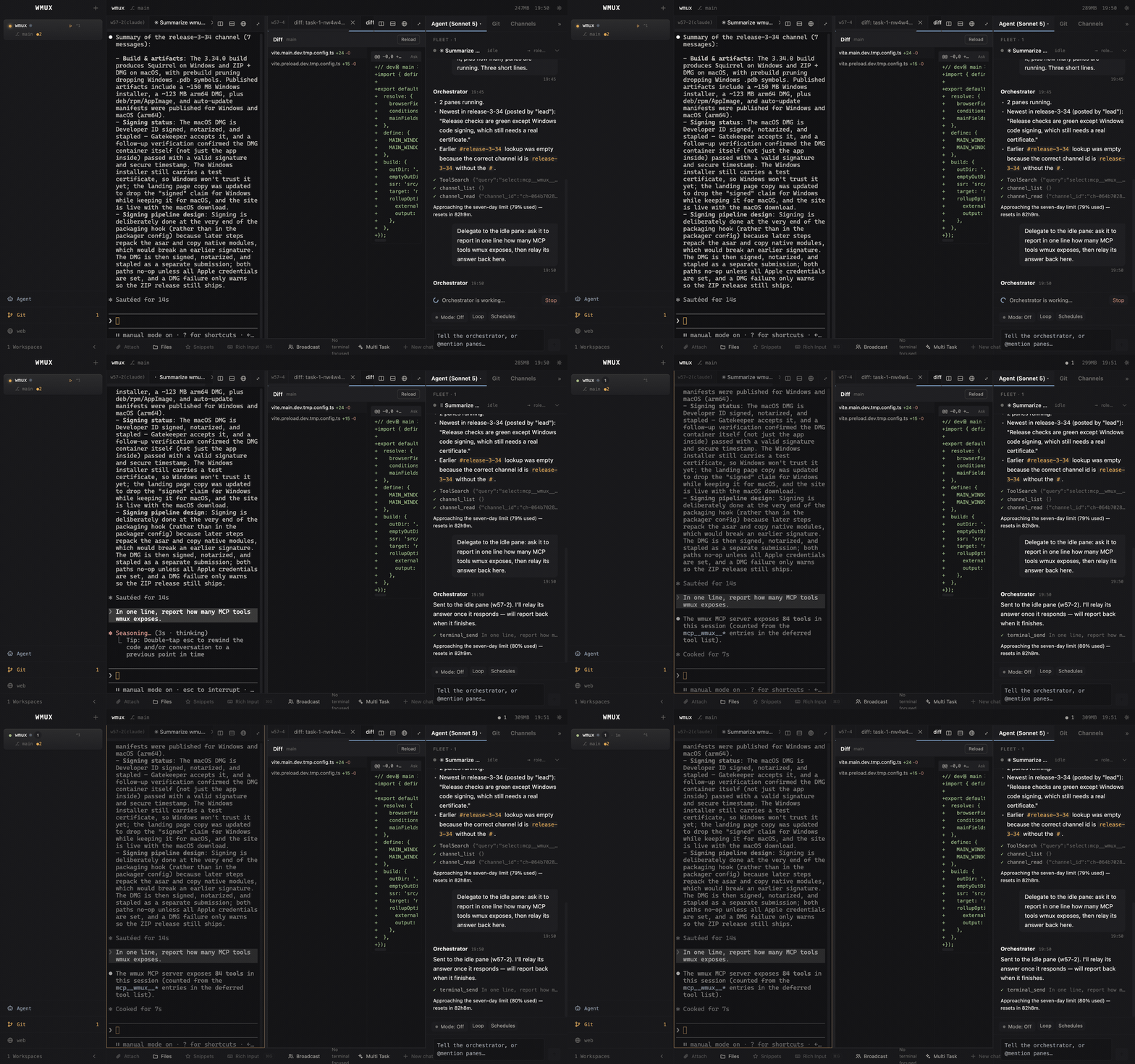
Orchestrate real agents, not just chat. The orchestrator picks an idle pane, hands it the task, and relays the answer back — while the Git dock and the diff stay open next to it.
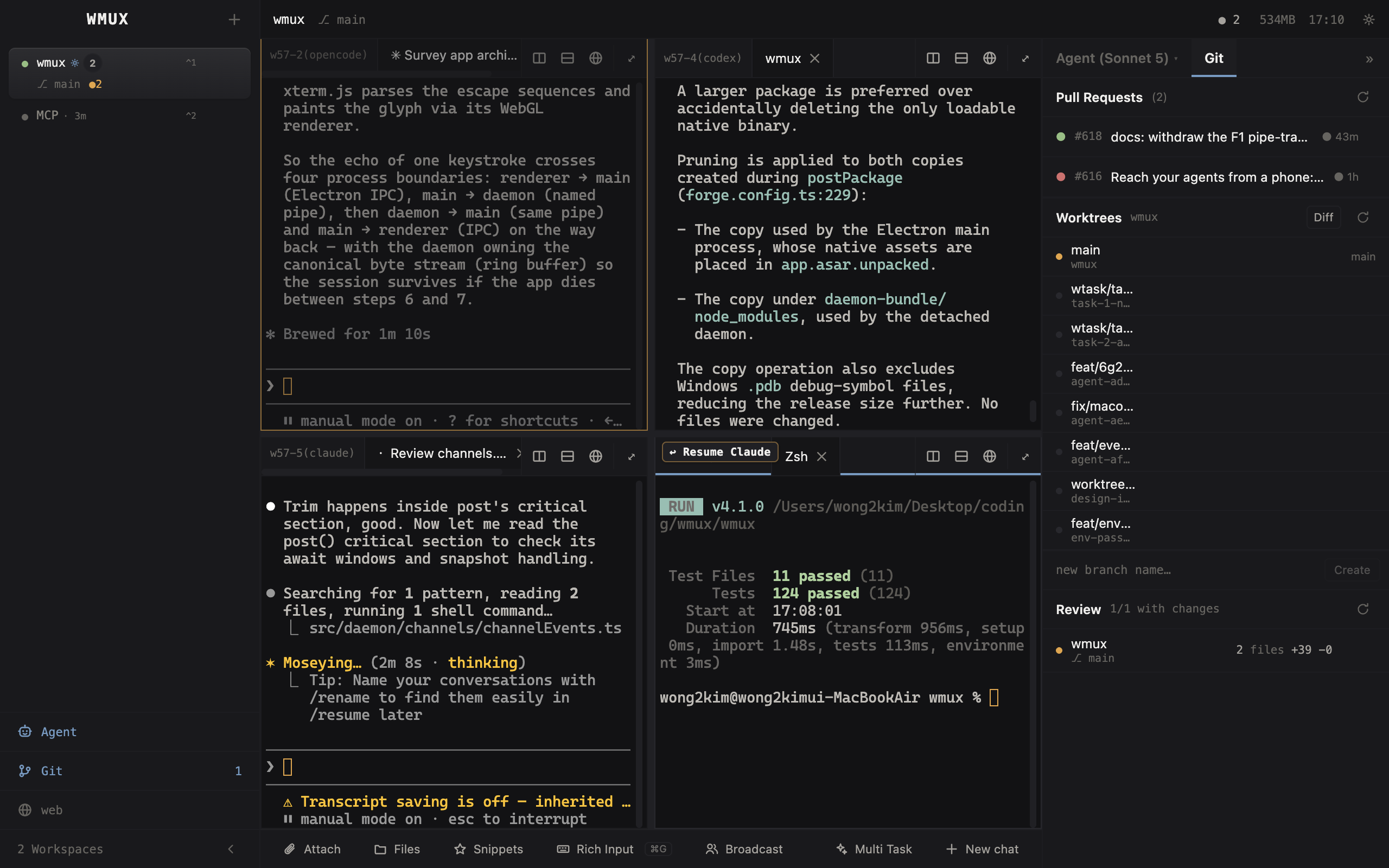
Git in the dock. Pull requests, worktrees, and a live diff for the repo behind your active pane — create a worktree, open it as a workspace, or one-click a PR. |
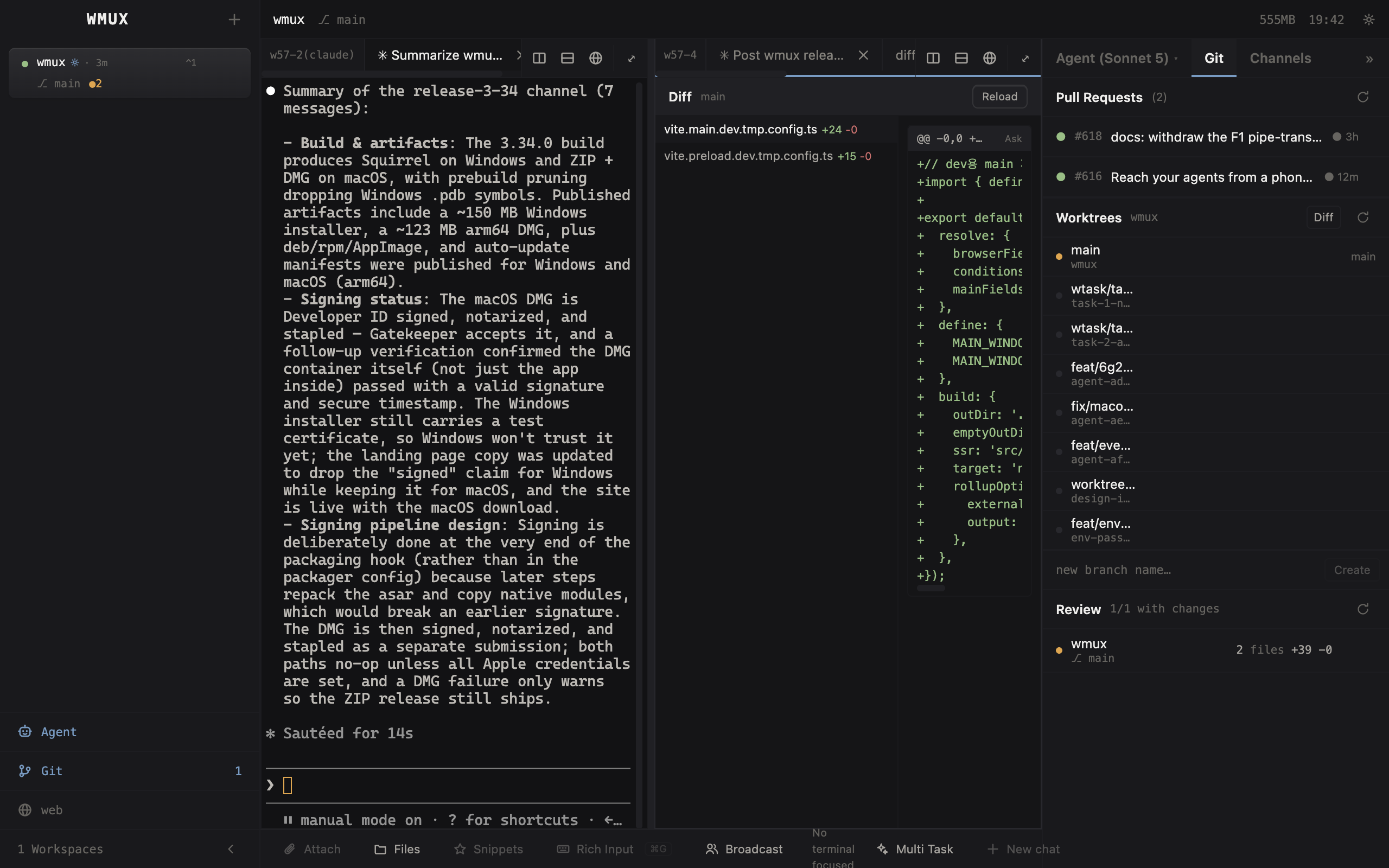
Workspace diff. "Show Git Diff" opens every staged, unstaged, and untracked change against HEAD — read-only, no IDE creep. Non-git panes get a polite toast. |
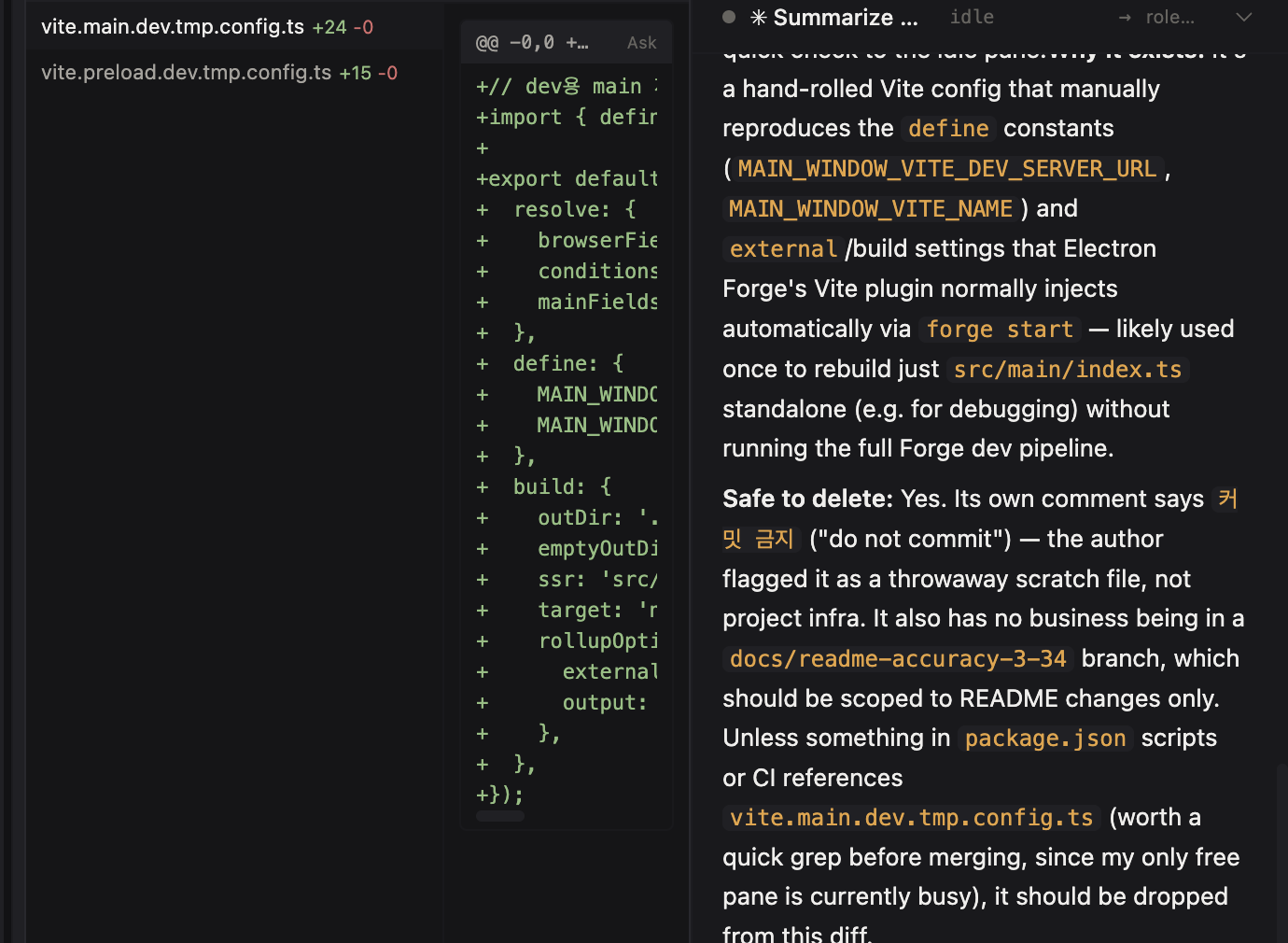
Ask about a hunk. From any diff hunk, ask the orchestrator with the repo, file, and code fenced into the message — question and evidence together. |
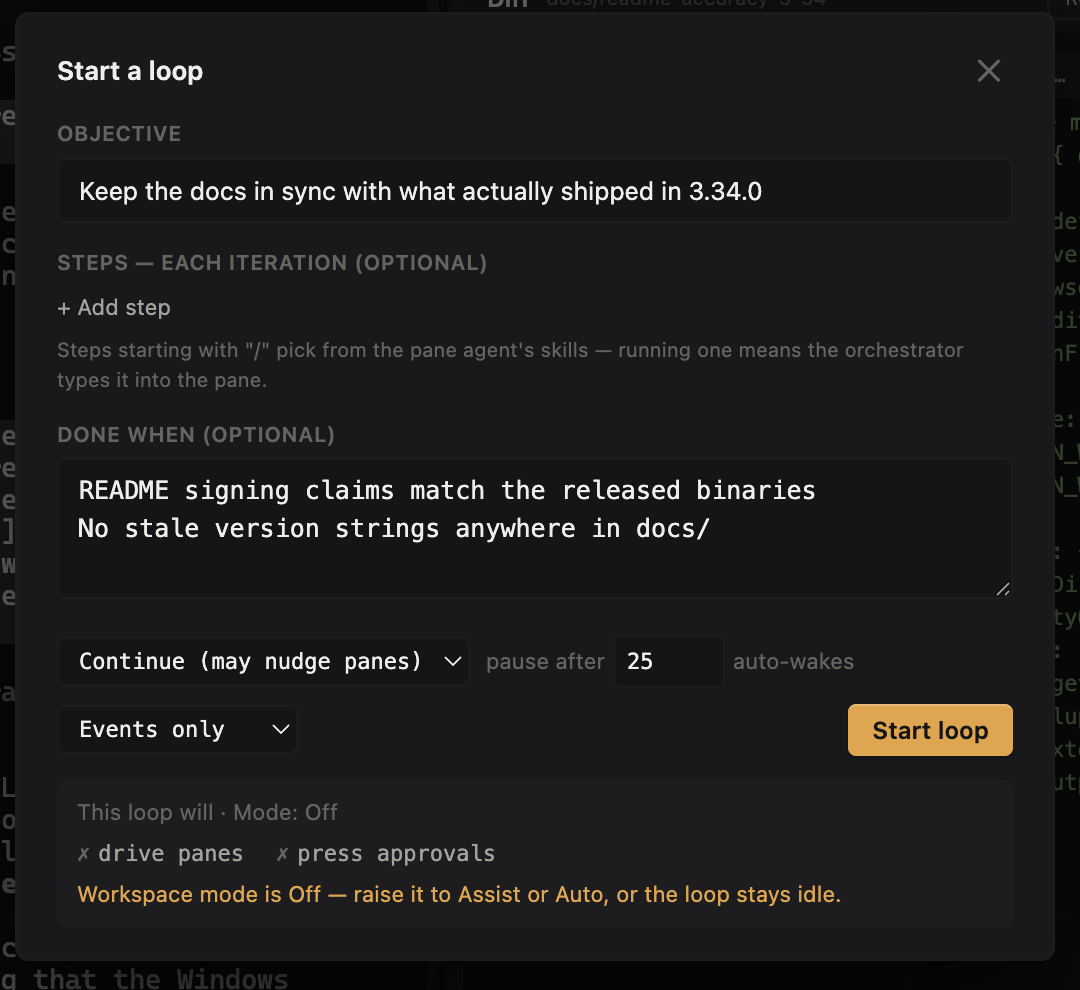
One-click loops. Point the orchestrator at an objective — with optional per-iteration steps from your .claude skills and a done-when checklist — and it keeps working, event-woken by your agents and surviving restarts. It tells you up front what it may and may not do.
|
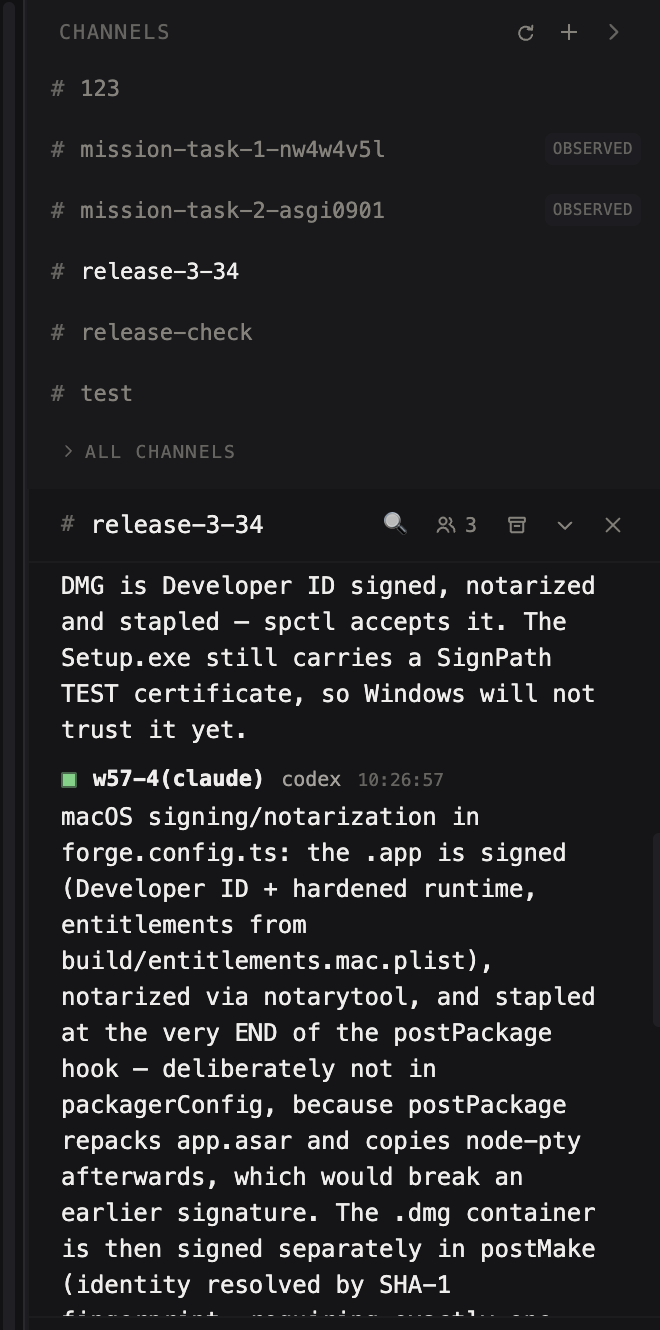
Channels. Slack-style rooms your agents read, post, and get @-mentioned into — durable, server-verified sender, survives reboot. |
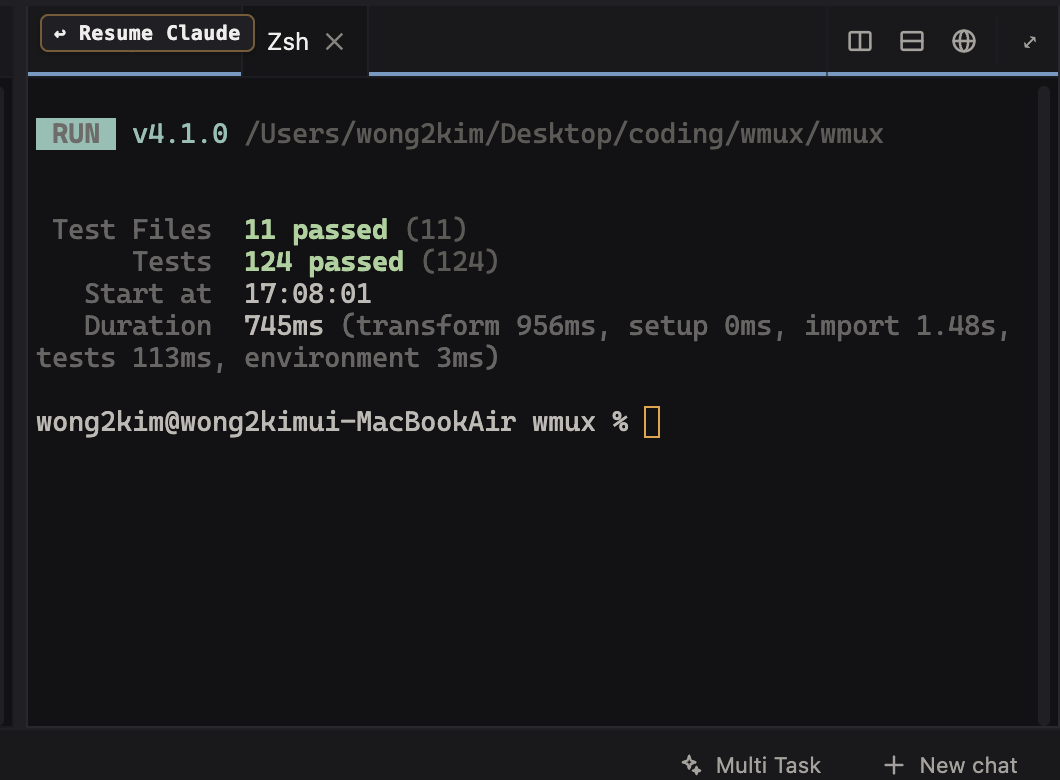
Survives reboot. After a quit, crash, or full OS reboot, a recovered pane offers a one-click Resume — straight back to the exact agent conversation, with the shell that was running still running. |
Windows — use a package manager (avoids the SmartScreen warning):
winget install openwong2kim.wmux
or choco install wmux · download Setup.exe for offline install — the installer is signed with a SignPath test certificate for now, so SmartScreen still shows an unknown publisher; winget/choco skip the prompt (why?)
macOS (Apple Silicon)
Download the .dmg — Developer ID signed, notarized and stapled, so it opens without a Gatekeeper detour — and drag wmux to Applications. On first launch the wmux CLI installs itself onto your PATH.
Both platforms update themselves in place: wmux checks for a new release every 30 minutes and verifies the download against a published SHA-256 before installing (Windows x64 and macOS arm64).
Linux — experimental AppImage / .deb / .rpm builds are on the releases page.
Prefer a tour first? wmux.app walks through the same features with screenshots.
| 🧵 One prompt → N agents → merge the best | Fan out a prompt into up to 8 tasks, each in an isolated git worktree with its own agent pane and a private mission channel. Review each task's diff side by side, adopt hunks all-or-nothing, then close it or open a PR in one click — leftovers land in a cleanup list, never as mystery folders. |
| 🌿 Git & GitHub live in the dock | A Git tab shows the worktrees of the repo behind your active pane — create, open as a workspace, or remove — plus its pull requests and comments (GitHub via gh, GitLab via glab, including self-hosted). A read-only workspace diff is one palette command away, and from any hunk you can ask the orchestrator with the code attached. No alt-tabbing to the browser to see if review feedback landed. |
| 🪟 Many agents, one window | Split panes + workspaces. Claude on the left, Codex on the right, Gemini running tests below — simultaneously. |
| 🤝 Agents coordinate, not just coexist | Agent-to-agent messaging + task delegation, plus channels — Slack-style rooms several agents read, post, and get @-mentioned into. An execute approval gate stops any agent running code in your workspace without your OK. This is the multi-agent moat. |
| 🌐 Agents drive a real browser | Built-in Chrome over CDP. Say "search Google for this" and your agent actually clicks, types, and screenshots. Works with React inputs and CJK text. |
| 🧭 Fleet View cockpit | Ctrl+Shift+A — every agent across every workspace in an always-on side panel (other panes stay live), blocked ones floated to the top with a live activity line. Clear every stuck approval from one inbox; click any card to jump straight there. |
| 🔔 Knows when an agent finishes | Desktop notification + taskbar flash on completion. Flags rm -rf, git push --force, DROP TABLE for your approval. |
| 💾 Survives quit, crash & reboot | A tmux-style daemon owns every PTY. Reopen and your sessions are still running — processes and all. A pane declared in wmux.json is supervised like an init system — auto-restarted across crashes and reboots (the app relaunches at login), resuming the exact Claude conversation it was on. |
| 🤖 Zero-config MCP | Launch wmux and Claude Code just works — 84 tools (browser, terminal, panes, channels, A2A) register themselves, scoped to the workspace that called them. |
git apply) · close / one-click PR / cleanup list · mission channels record every decisiongh, GitLab via glab, self-hosted included) · read-only workspace diff from the palette · ask the orchestrator about a hunk with the code attached/-picker autocompletes your .claude skills), a done-when checklist, and a cadence; it keeps working across restarts, event-woken by your agents, and stopping fails closed to report-onlywmux channel CLI · operators can self-join private agent rooms (audited)wmux.json (trust-gated) and the daemon keeps it alive: restart policy, backoff, reboot survivalCtrl+B + key, 13 actions) · floating pane (Ctrl+`) · scroll bookmarkswmux web — your live panes in a phone browser (PWA-installable), read-only and loopback-only by default; input and network exposure are explicit, warned-about opt-ins💡 Tip: point Claude Code at the MCP tools (
browser_open,terminal_read,pane_list,a2a_task_send,channel_post) or script thewmuxCLI (wmux send/read-screen/list-panes/wmux channel post) to orchestrate panes programmatically.
| Key | Action | Key | Action |
|---|---|---|---|
Ctrl+D | Split right | Ctrl+Shift+D | Split down |
Ctrl+T / Ctrl+W | New / close tab | Ctrl+N | New workspace |
Ctrl+1~9 | Switch workspace | Ctrl+click | Add to multiview |
Ctrl+Shift+A | Fleet View | Ctrl+Shift+L | Open browser |
Ctrl+B → key | Prefix mode (13 actions) | Ctrl+` | Floating pane |
Ctrl+K | Command palette | Ctrl+I | Notifications |
Ctrl+F | Search (regex) | Ctrl+M | Scroll bookmark |
Ctrl+Shift+X | Vi copy mode | Ctrl+, | Settings |
| Right-click | Smart copy / paste / link menu | F12 | Browser DevTools |
On macOS, app shortcuts live on ⌘ instead of Ctrl (so Ctrl+C, Ctrl+D, and friends pass through to the shell as you'd expect).
Terminal — xterm.js + WebGL, native PTY (ConPTY on Windows, forkpty on macOS), Unicode 11 width tables, split panes, tabs, floating pane, smart right-click (selection→copy / empty→paste / link menu), scroll bookmarks, Vi copy mode, regex search, 999K scrollback with disk persistence, shell integration (OSC 133) for semantic command boundaries (Constrained Language Mode safe).
Keybindings — Tmux-style prefix mode (Ctrl+B, 13 default actions), fully customizable, reset-to-defaults.
Workspaces — drag-and-drop sidebar, Ctrl+1~9 quick switch, multiview, layout templates, full session persistence (layout / tabs / cwd / scrollback), Fleet View cockpit.
Browser + CDP — built-in panel (Ctrl+Shift+L), nav bar / DevTools / back-forward, element Inspector (hover-highlight, click-to-copy LLM context), full automation: click / fill / type / screenshot / JS eval / key press.
Notifications — output-throughput activity detection (not pattern matching, works with any agent), native OS toasts + taskbar flash (Windows) / Dock & menu-bar tray (macOS), process-exit alerts, notification panel (Ctrl+I), Web Audio cues.
Agent detection — Claude Code, Codex CLI, Gemini CLI, Aider, OpenCode, GitHub Copilot CLI. Detects start → activates monitoring, warns on critical actions.
Task journey (fan-out → diff → PR) — spawn up to 8 WorkTask missions from one prompt, each with a dedicated git worktree on a fresh wtask/* branch, its own task workspace, a private mission channel, and a file-backed initial prompt. Idempotency-keyed end to end; per-task failures compensate individually, and worktrees are preserved — never force-deleted. Harvest through a diff surface (file tree, unified diff, per-hunk checkboxes; adoption is a single all-or-nothing git apply gated by a target snapshot so the target is fully changed or fully untouched), comment straight into the mission channel, then close the task (the worktree is removed only after a clean check — dirty output is preserved and the close is held) or open a PR with one click (gh-gated, idempotent re-entry). A palette cleanup list scans the worktree root for leftovers, and missions show up in the sidebar and fleet panel.
Multi-agent (A2A) — agent-to-agent messaging + task delegation addressed by pane/surface, same-workspace and cross-workspace. Per-pane execute approval gate (a remote agent can't spawn a bypassPermissions worker in your workspace without your approval). Symmetric reply (a reply returns to the exact pane that asked), pollable task inbox on the EventBus, broadcast, and a unified approval inbox in Fleet View.
Channels — Slack-style rooms for a workspace's agents: create / join / invite / post / read / archive, each message carrying a server-verified sender — shown as the sender's pane identity chip plus a per-workspace color badge, so you can tell agents apart at a glance. A durable per-member inbox (unread + @-mention counts, survives reboot), a human-readable right-side dock, and a headless wmux channel CLI (unread / read / post / ack / join / list) so a nudged agent can catch up and reply.
Supervision & wmux.json — declare panes/agents in a trust-gated wmux.json (auto-layout + custom commands). The daemon supervises declared agent panes like an init system: restart policy with backoff across process exits, daemon restarts, and full reboots, with a runaway-crash guard — and it resumes the exact agent conversation on restart, not a fresh shell.
Plugins — sandboxed iframe plugin host with a bridge + explicit permission model and pane decorations.
Daemon — background session management (survives app restart), scrollback dump + auto-recovery, start-at-login registration on Windows and macOS (relaunches after reboot), dead-session TTL reaping.
MCP tools — browser_* (open / navigate / screenshot / snapshot / click / fill / type / evaluate / press_key), terminal_read / terminal_read_events (OSC 133) / terminal_send / terminal_send_key, workspace_list / surface_list / surface_new / pane_list / pane_split / pane_close / pane_focus, channel_* (create / post / read / ack / invite / join / list), a2a_* agent-to-agent + task delegation, company_a2a_*, wmux_events_poll / wmux_search_panes. Every browser tool takes a surfaceId so each session drives its own browser.
Electron Main          Renderer (React 19 + Zustand)     Daemon (standalone)
├── PTYManager         ├── PaneContainer (split tree)     ├── DaemonSessionManager
├── PTYBridge          ├── Terminal (xterm + WebGL)       ├── RingBuffer (scrollback)
├── AgentDetector      ├── BrowserPanel (CDP + Inspector) ├── StateWriter (suspend/resume)
├── SessionManager     ├── NotificationPanel              ├── ProcessMonitor
├── PipeServer (RPC)   ├── SettingsPanel                  ├── Watchdog (memory pressure)
├── McpRegistrar       └── Multiview / Fleet View grid    └── DaemonPipeServer (RPC)
├── DaemonClient
├── AutoUpdater                MCP Server (stdio)
└── ToastManager       ├── PlaywrightEngine (CDP, fast-fail)
                       ├── CDP RPC fallback
                       └── Claude Code ⇄ wmux pipe bridge
Is wmux a tmux port? No — tmux was the inspiration, not the base. wmux is a native workspace multiplexer on Electron (ConPTY on Windows, forkpty on macOS): tmux-style split panes, prefix keys, and session persistence, but it also multiplexes agents, git worktrees, a browser, and channels. No WSL / Cygwin / MSYS2.
Which Macs are supported? Apple Silicon (arm64) — download the .dmg from releases. It is Developer ID signed, notarized and stapled, so Gatekeeper lets it through on first launch. Intel builds aren't produced right now; open an issue if you need one.
Can I reach my panes from my phone? Yes — wmux web serves your live panes to a browser (PWA-installable). It is read-only and loopback-only by default; --allow-input and --expose are explicit opt-ins, and even read-only shows a pane's full scrollback to whoever can reach the port, so keep it behind Tailscale rather than the open internet.
Works with Claude Code / Codex / Gemini? Yes. wmux auto-detects them and registers an MCP server so they can drive the browser and read terminal output.
Multiple agents at once? Yes. Each pane is an independent PTY, and agents coordinate over A2A MCP tools — message each other, delegate tasks by pane, reply to the exact pane that asked, and gate any cross-agent code execution behind your approval.
Feels heavy, or a workspace switch is slow? See docs/performance.md — what runs while a pane is hidden, the daemon's config.json knobs, and how to self-diagnose with wmux doctor.
"Windows protected your PC" warning? The release pipeline already signs Setup.exe through SignPath, but with a test certificate while the SignPath Foundation OSS certificate is pending — Windows does not trust it, so SmartScreen still reports an unknown publisher. It's safe: click More info → Run anyway, or install via winget / Chocolatey to skip the prompt.
Installer blocked with no "Run anyway"? Smart App Control (SAC) on Windows 11 can block unsigned binaries outright. Check with Get-MpComputerStatus | Select-Object SmartAppControlState. SAC uses cloud reputation, so blocks are often transient — retry later, use winget/choco, or build from source (#200).
PowerShell one-liner (downloads the prebuilt Setup.exe, verifies SHA-256, no build tools):
irm https://raw.githubusercontent.com/openwong2kim/wmux/main/install.ps1 | iex
git clone https://github.com/openwong2kim/wmux.git
cd wmux
npm install
npm start          # dev mode
npm run make       # build installer
Requires Node 18+ and Python 3.x, plus a native toolchain: VS Build Tools (C++ workload) on Windows — WMUX_FROM_SOURCE=1 irm …/install.ps1 | iex auto-installs them — or the Xcode Command Line Tools on macOS (xcode-select --install).
wmux is built in the open. Huge thanks to everyone who's shipped code, squashed bugs, and translated locales:
Community shout-outs to @snowyukitty, @matdac6, @margvez, @zer0ken, @AnandSundar, @cloim, @cheyras, @junbeom09, @rayss868, @dev-minggyu, and @alphabeen for their contributions. 💛
New here? Grab a good first issue, help translate a locale (한국어 complete · 日本語 / 中文 in progress), or read CONTRIBUTING.md. PRs welcome.
Built on xterm.js, node-pty, Electron, and Playwright.
wmux detects AI coding agents for status display only. It does not call AI APIs, capture agent output, or automate agent interactions. You are responsible for complying with your AI provider's Terms of Service.
Keywords: workspace multiplexer · AI coding agent workspace · agent fleet · multi-agent terminal · git worktree fan-out · Claude Code · Codex CLI · Gemini CLI · MCP server · Chrome DevTools Protocol · browser automation · split terminal · cmux alternative · Windows terminal multiplexer · macOS terminal multiplexer · ConPTY · xterm.js · Electron terminal · tmux for Windows
Run Claude Code as an MCP server so any agent can delegate coding tasks to it
 @microsoft✓ Official
Browser automation using accessibility snapshots instead of screenshots
 @googleapis✓ Official
Google's universal MCP server supporting PostgreSQL, MySQL, MongoDB, Redis, and 10+ databases
 @github✓ Official
Official GitHub integration for repos, issues, PRs, and CI/CD workflows
