

Are you the author? Sign in to claim
YantrikDB memory provider for NousResearch/hermes-agent — self-maintaining memory with canonicalization, contradiction t







YantrikDB as a memory provider for Hermes Agent. Self-maintaining memory — canonicalizes duplicates, surfaces contradictions, explains recall — in a drop-in plugin. As of v0.2.0 the default backend is in-process (
pip installand go, no separate server).
This repository is the canonical distribution. Per Hermes maintainer guidance, new memory providers aren't being merged upstream — the recommended pattern is standalone plugins that users install via pip and register with their Hermes home directory. That keeps the version cadence, CI gating, issue triage, and review cycle on the plugin author's side, so fixes ship the same day they're ready instead of waiting on upstream review bandwidth.
Two recurring observations from the Hermes community map directly to what yantrikdb does:
"Compression was silently dropping earlier constraints by turn 50." — Hermes developer building a long-running coding agent (user-stories)
The on_pre_compress hook injects the highest-salience memories before Hermes compresses, so constraints survive long sessions. Recency-aware ranking + conflicts() makes superseded claims visible instead of letting them silently outrank their replacements.
"Spent 200-400 hours building a memory kernel because standard vector approaches dropped important constraints; successful implementations used temporal context graphs with lifecycle management — promotion / demotion / supersession — rather than vector similarity alone." — Hermes developer who built their own memory layer after vector approaches failed (user-stories)
This is the substrate yantrikdb already ships: temporal context graph via relate(), lifecycle via consolidation_status + forget() + the think() maintenance pass, recency ranking, first-class conflicts/canonicalization. Drop-in via hermes plugins install. The 200-400 hours are someone else's; you get the substrate.
| Capability | yantrikdb-hermes-plugin | Most others |
|---|---|---|
Agent-authored skills with outcome ledger (yantrikdb_skill_define / _search / _outcome) | ✓ first-class, DB-native peer to Hermes' filesystem Markdown skills | filesystem-only (Hermes built-in) |
Contradiction tracking (conflicts() + resolve_conflict()) | ✓ first-class primitive | not in mem0's 2026 taxonomy |
Explainable recall (why_retrieved per result) | ✓ list of scoring reasons returned with every result | rarely surfaced |
| Owner-scoping for multi-platform Hermes (Telegram + WhatsApp + Discord routed by canonical owner) | ✓ v0.4.10 identity-map + v0.4.11 shared group spaces | one shared namespace, manual scoping |
| Embedded mode default (no server, no token, no GPU) | ✓ v0.2.0+ | varies |
| HTTP backend for HA clusters | ✓ v0.5.0 (against yantrikdb-server) | varies |
Reproducible recall benchmark (benchmarks/run_recall_bench.py) | ✓ v0.6.0 — recall@k / MRR / answer-containment, CI-guarded | claims, rarely a runnable number |
Self-tuning recall (recall(reinforce=[...])) | ✓ v0.6.0 — reinforced memories climb over time, opt-in | static ranking |
Proactive memory hygiene (yantrikdb_hygiene) | ✓ v0.6.0 — scan/apply consolidate-or-forget | manual cleanup |
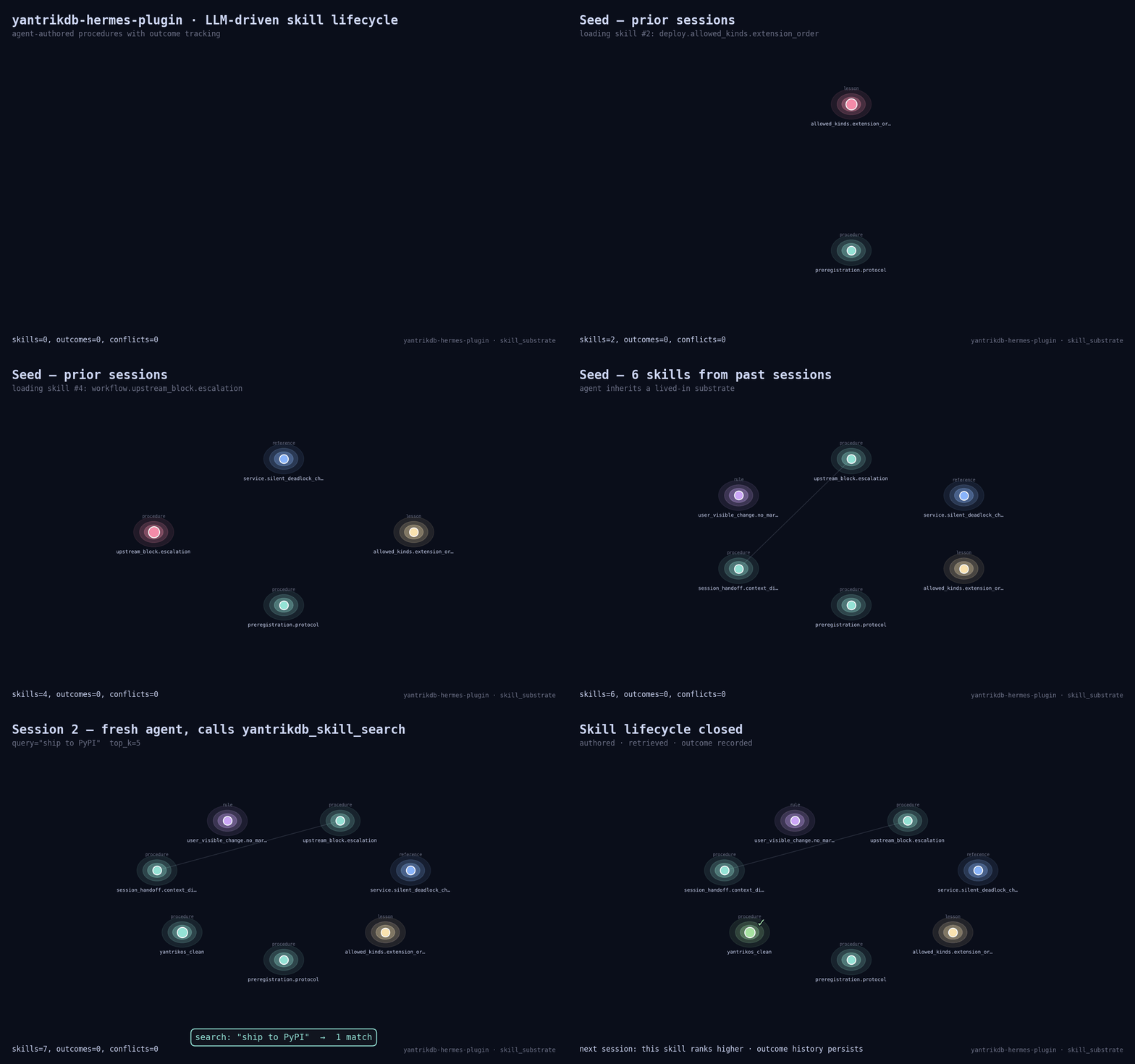
Six skills from prior sessions, color-coded by type. Session 1: the agent adds a 7th (pink, just-created). Session 2 search highlights the relevant node, outcome recorded turns it green. Source: demo_visual.py.

gpt-4o-mini receives the plugin's 15 tool schemas via OpenAI's chat-completions API and chooses when to call each one. In session 1 it autonomously picks the skill_id (release.yantrikos.clean), applies_to tags, and body for a workflow it just learned. In session 2 — fresh provider instance, same substrate — it searches the substrate, finds the skill, follows it, and records an outcome. Two real rids land. The autonomy loop closes in ~10 seconds.
Sources: demo_llm.py + transcript-llm.txt + demo_llm.tape for rendering. A scripted (no API key required) deterministic version is also included: demo.py / demo.gif.
The plugin's handle_tool_call dispatch path you see in both demos is the same entry point Hermes invokes internally. For larger-scale evidence of LLM-driven autonomy: yantrikdb.com/guides/autonomous-skills/ documents 17 skills authored by Claude across many sessions on one production substrate, with 9 showing cross-session reuse via the outcome ledger.
The v0.2.0 default backend is in-process: no separate server, no token, no GPU, no network. Bundled potion-base-2M static embedder (~8 MB, dim=64) loads on first call (~80 ms one-time warmup) and stays in-process.
hermes plugins install (v0.4.5+, one command for the plugin source)source ~/.hermes/hermes-agent/venv/bin/activate
hermes plugins install yantrikos/yantrikdb-hermes-plugin
pip install yantrikdb # ~10 MB; in the same Python env as Hermes
hermes memory setup # → Select "yantrikdb" and press Enter
hermes memory status # → Provider: yantrikdb Status: available ✓
hermes plugins install clones the repo into ~/.hermes/plugins/yantrikdb/ based on plugin.yaml's name: field. The pip install yantrikdb step gets the engine — hermes plugins install doesn't auto-install pip dependencies, so this is a separate step. Crucially: pip-install into the same Python environment Hermes runs from. If Hermes was installed via pipx, use pipx inject hermes-agent yantrikdb. If you're using a regular venv, source it first.
If your Hermes environment uses uv and does not have pip available, install with the Hermes Python explicitly:
uv pip install --python ~/.hermes/hermes-agent/venv/bin/python yantrikdb
pip install yantrikdb-hermes-plugin (bundled package path)source ~/.hermes/hermes-agent/venv/bin/activate
pip install yantrikdb-hermes-plugin # pulls yantrikdb engine + the provider source
yantrikdb-hermes install # registers ~/.hermes/plugins/yantrikdb
hermes memory setup # → Select "yantrikdb" and press Enter
hermes memory status # → Provider: yantrikdb Status: available ✓
If your Hermes environment uses uv and does not have pip available, install with the Hermes Python explicitly:
uv pip install --python ~/.hermes/hermes-agent/venv/bin/python yantrikdb-hermes-plugin
~/.hermes/hermes-agent/venv/bin/yantrikdb-hermes install
yantrikdb-hermes install registers the pip-installed provider with Hermes by creating a lightweight shim at ~/.hermes/plugins/yantrikdb (or $HERMES_HOME/plugins/yantrikdb). The shim imports the real provider from the installed yantrikdb-hermes-plugin package, so future package upgrades are picked up without copying the whole provider tree. Use yantrikdb-hermes install --copy if your environment prefers a physical copy instead of the default shim.
Option A updates the plugin checkout and the engine dependency separately:
source ~/.hermes/hermes-agent/venv/bin/activate
hermes plugins update yantrikdb
pip install --upgrade yantrikdb
hermes gateway restart                    # if Hermes is running as a gateway/service
hermes memory status
If your Hermes CLI does not have hermes plugins update, reinstall the plugin source in place:
hermes plugins install yantrikos/yantrikdb-hermes-plugin --force
Option B updates the pip package, then refreshes the registered shim:
source ~/.hermes/hermes-agent/venv/bin/activate
pip install --upgrade yantrikdb-hermes-plugin
yantrikdb-hermes install --force
hermes gateway restart                    # if Hermes is running as a gateway/service
hermes memory status
For uv-only environments, target the Hermes Python explicitly:
uv pip install --python ~/.hermes/hermes-agent/venv/bin/python --upgrade yantrikdb
uv pip install --python ~/.hermes/hermes-agent/venv/bin/python --upgrade yantrikdb-hermes-plugin
--force replaces the registered plugin directory. Back up any plugin-local files first if you keep custom files under ~/.hermes/plugins/yantrikdb/; normal YantrikDB settings belong in ~/.hermes/.env and are not touched.
Option A uses Hermes' plugin manager for the plugin source, plus pip for the engine dependency:
source ~/.hermes/hermes-agent/venv/bin/activate
hermes plugins remove yantrikdb
pip uninstall yantrikdb
hermes memory setup                      # choose another provider, or disable external memory
hermes gateway restart                   # if Hermes is running as a gateway/service
Option B removes the user-plugin registration, then optionally removes the pip packages:
source ~/.hermes/hermes-agent/venv/bin/activate
yantrikdb-hermes uninstall
pip uninstall yantrikdb-hermes-plugin yantrikdb
hermes memory setup                      # choose another provider, or disable external memory
hermes gateway restart                   # if Hermes is running as a gateway/service
If your installed version does not yet have yantrikdb-hermes uninstall, remove the registration manually:
rm -rf ~/.hermes/plugins/yantrikdb
pip uninstall yantrikdb-hermes-plugin yantrikdb
yantrikdb and yantrikdb-hermes-plugin must be importable from whatever Python interpreter Hermes uses:
pipx install hermes-agent → pipx inject hermes-agent yantrikdb yantrikdb-hermes-pluginsource ~/.hermes/hermes-agent/venv/bin/activate first, then pip install ...source path/to/hermes-venv/bin/activate first, then pip install ...uv pip install --python path/to/hermes-venv/bin/python ...pip installIf hermes memory status shows Status: not available ✗ after install, the most common cause is the plugin landed in a different Python than Hermes is using. which hermes && which python will confirm.
echo "YANTRIKDB_EMBEDDER=potion-base-8M" >> ~/.hermes/.env     # 28 MB, dim=256, ~92% MiniLM
# or potion-base-32M for 121 MB, dim=512, ~95% MiniLM
# or multilingual via the v0.4.2 model2vec path:
echo "YANTRIKDB_EMBEDDER_MODEL2VEC=minishlab/potion-multilingual-128M" >> ~/.hermes/.env
# or the broader HF ecosystem via sentence-transformers:
echo "YANTRIKDB_EMBEDDER_HF=sentence-transformers/paraphrase-multilingual-MiniLM-L12-v2" >> ~/.hermes/.env
YANTRIKDB_EMBEDDER_HF uses sentence-transformers, which by default emits noise to stdout — tqdm progress bars on every encode and a one-time HF Hub auth warning at startup. The plugin disables the per-encode progress bars internally (v0.4.12+). For the rest, add to your .env:
HF_HUB_DISABLE_PROGRESS_BARS=1
TRANSFORMERS_VERBOSITY=error
# Optional, when running fully offline after the first download:
HF_HUB_OFFLINE=1
Without these, sentence-transformers / huggingface_hub output can pollute the agent's own stdout stream.
If you run multiple Hermes instances that need to share one memory store, or you want HA via raft:
docker run -d -p 7438:7438 -v yantrikdb-data:/var/lib/yantrikdb \
  --name yantrikdb ghcr.io/yantrikos/yantrikdb:latest
docker exec yantrikdb yantrikdb token --data-dir /var/lib/yantrikdb \
  create --db default --label hermes
# → ydb_abc123...

cat >> ~/.hermes/.env <<EOF
YANTRIKDB_MODE=http
YANTRIKDB_URL=http://localhost:7438
YANTRIKDB_TOKEN=ydb_abc123...
EOF
Same plugin, same 8 tools, same hooks, same provider contract — just talks HTTP to a separately-managed server instead of running the engine in-process.
Full config, tool reference, troubleshooting: yantrikdb/README.md.
The differentiator versus other Hermes memory plugins is not the vector store — it's what happens after the write:
| Feature | Plain vector memory | YantrikDB |
|---|---|---|
| Duplicate facts | pile up | canonicalized by think() |
| Contradictions | silently overwrite | surfaced via conflicts(), closed via resolve_conflict() |
| Stale facts | outrank fresh ones | recency-aware ranking without deletion |
| Why did a memory rank? | ¯\(ツ)/¯ | every recall() result carries a why_retrieved reason list |
| Cross-entity recall | semantic-only | graph edges from relate() boost related memories |
Twelve tools exposed to the agent by default: yantrikdb_remember, _recall, _forget, _think, _conflicts, _resolve_conflict, _relate, _stats, plus the trigger-lifecycle consumers _pending_triggers, _acknowledge_trigger, _dismiss_trigger, _act_on_trigger (v0.4.13+). Three additional opt-in skill tools (v0.3.0+): _skill_search, _skill_define, _skill_outcome — see Skills below.
Every tool response carries the same four envelope fields so an LLM later asked "what did I just do?" can't confabulate success on a silent failure:
{
  "status": "ok" | "failed",
  "ok": true | false,
  "tool": "yantrikdb_remember",
  "ts": 1748394801.42,
  ...tool-specific keys preserved verbatim (rid, stored, results, ...)
}
Failure responses additionally carry error (legacy key) and reason (alias). The envelope is purely additive — existing agent code that reads rid / stored / results / etc. continues working unchanged.
Why this matters: tool failures used to be communicated as {"error": "..."} only. When the agent's narrative LLM was later asked to summarize the session, it could confabulate plausible completion because the failure wasn't loudly present in machine-readable form. The new status: "failed" + ok: false are intentionally redundant — the word "failed" lands during narrative summarization, the boolean lands for programmatic consumers. Pattern documented by yantrikdb-agi after a real incident where the agent described a telegram_send that never happened.
yantrikdb_think flags redundancies, conflicts, and surprise cross-domain connections as triggers — substrate signals the agent can inspect and close out:
yantrikdb_pending_triggers — list what's waiting (with urgency, reason, suggested_action, and the source_rids that produced it).yantrikdb_acknowledge_trigger — agent saw it, no follow-up needed.yantrikdb_dismiss_trigger — false positive or out of scope.yantrikdb_act_on_trigger — agent took action; records an audit-trail entry.All three closers remove the trigger from pending_triggers. Without these tools (pre-v0.4.13) the pending queue grew indefinitely because the producer (think()) had no matching consumer surface.
Each row in the table below is backed by tests/comparison/findings_scale_lxc/<provider>/ — the actual findings_scale.yaml, transcript.md, and raw/ response capture from running a 1000-fact + 20-query probe against that provider on a real Hermes 0.9.0 install (LXC 129, commit 4610551). The corpus is deterministic (fixtures/corpus_1k.json, seed=20260512: 600 realistic agent-memory facts + 300 noise + 50 planted duplicates + 50 planted contradictions); the probe is provider-agnostic and reproducible. Methodology details in tests/comparison/README.md.
| Provider | Hosting | Verified at 1000 scale | Writes (ok/attempted; latency) | Recall latency | Precision@5 | why_retrieved field | Maintenance behaviour observed |
|---|---|---|---|---|---|---|---|
| yantrikdb (this) | embedded | yes — 256/1000 writes 1 | 256/1000; p50 0.48 ms / p99 5.13 ms | p50 3.78 ms / p99 32.94 ms | 0.80 (16/20) | yes — why_retrieved per result | contradiction API: yantrikdb_conflicts; duplicates kept separate (canonicalisation via explicit think()) |
| byterover | cloud | couldn't verify — requires brv CLI auth | — | — | — | — | — |
| hindsight | cloud-default (local-stub mode used) | yes — 1000/1000 writes | 1000/1000; p50 0.27 ms / p99 0.31 ms | p50 0.28 ms / p99 0.30 ms | 0.00 (0/20) 2 | no | — |
| holographic | embedded (SQLite + FTS5) | yes — 1000/1000 writes 3 | 1000/1000; p50 23.43 ms / p99 68.52 ms | p50 0.06 ms / p99 0.23 ms | 0.00 (0/20) 4 | no | — |
| honcho | self-hosted | couldn't verify — requires honcho-server URL or api key | — | — | — | — | — |
| mem0 | cloud or self-host | couldn't verify — requires mem0.api_key | — | — | — | — | — |
| openviking | self-hosted | couldn't verify — requires OPENVIKING_ENDPOINT | — | — | — | — | — |
| retaindb | cloud | couldn't verify — requires RETAINDB_API_KEY | — | — | — | — | — |
| supermemory | cloud | couldn't verify — requires SUPERMEMORY_API_KEY | — | — | — | — | — |
Where the verified data lives — every cell in the table maps to a file:
findings_scale.yaml — structured cells (the table is generated from these by compare.py)transcript.md — human-readable session log with timingraw/recall-Q*.json — captured raw recall responses for every queryfixtures/corpus_1k.json, fixtures/queries_1k.json — the deterministic corpus + queries usedHow to re-run it — clone the repo, scp tests/comparison/ to a Hermes-installed machine, python3 runner_scale.py --all. The harness will skip-with-honest-reason for any provider whose is_available() returns False (e.g. missing API key); for the ones that initialise, it produces a fresh findings_scale.yaml. Pull requests welcomed when accounts unlock more rows.
Three optional lifecycle hooks: on_session_end auto-consolidates, on_pre_compress preserves high-salience memories through context compression, on_memory_write mirrors built-in MEMORY.md / USER.md additions.
Skills are procedural memory: reusable patterns the agent distills from observed success and pulls back next session. They live in YantrikDB's shared skill_substrate namespace alongside skills authored by other consumers (Lane B SDK, server handlers, WisePick). Hermes-authored skills are tagged metadata.source=hermes so any downstream consumer can filter them in or out cleanly.
Disabled by default. Adding the plugin to an existing Hermes install doesn't change the tool schema the model sees. Enable explicitly when you want the agentic skill loop:
echo "YANTRIKDB_SKILLS_ENABLED=true" >> ~/.hermes/.env
When enabled, three new tools join the schema:
| Tool | Purpose |
|---|---|
yantrikdb_skill_search | Semantic search over agent-authored skills, namespace-isolated from regular memory recall. |
yantrikdb_skill_define | Distill a procedural pattern into a reusable skill (skill_id, body, skill_type, applies_to). Client-side validation reproduces yantrikdb-server's wrapper checks. |
yantrikdb_skill_outcome | Record success/failure for a skill after it's used. Append-only event log; rollup is the agent's call, not the substrate's. |
The agentic loop closes: agent observes a successful sequence → distills it via define → next session pulls it via search → records outcome via outcome → over time, ranking reflects what actually works.
Lifecycle distinction worth understanding. Hermes' own filesystem skills ($HERMES_HOME/skills/*.md) are human-authored, durable, version-controlled. YantrikDB skills are agent-authored, runtime-evolving, semantic-search-queryable. Different kinds of canonical, not competing authorities. The model picks by lifecycle.
Every recall() result already carries the structured ranking-reason list — that's the engine's standard response shape. The model can read it without prompt engineering. From the live Hermes session captured in VERIFICATION.md, DeepSeek's natural-language summary of the recall:
"All 3 memories returned, ranked by relevance × recency × importance. The top result ranked highest (semantic match + keyword + high importance + recency), followed by [...] (keyword match), then [...] (high importance but no direct keyword overlap)."
DeepSeek wasn't told the reason codes existed; it parsed them from the tool response and reflected them in its explanation. That's the architectural shape we wanted: the explainability surface is the recall response itself, transport-agnostic, model-agnostic, and visible to anyone who looks at the JSON. No separate "explain" tool. No second LLM call. The cost of explainability is zero because it was never separate.
tests/integration/test_live.py) that exercise the full flow against a real yantrikdb-server. Skipped by default; run with YANTRIKDB_INTEGRATION_URL + YANTRIKDB_INTEGRATION_TOKEN set.why_retrieved reason codes flowing through the model's reasoning verbatim.| Op | v0.1 HTTP (Apr 14) | v0.2 Embedded (May 9) |
|---|---|---|
record_text p50 | 13.8 ms | 0.60 ms |
recall_text p50 | 24.0 ms | 2.58 ms |
record_text p99 | 55.3 ms | 10.66 ms |
recall_text p99 | 67.2 ms | 13.24 ms |
| Cold start | n/a | 77 ms (one-time) |
| Required infrastructure | yantrikdb-server + token | none |
pip install footprint | wheel + requests | wheel + 2 small libs (~10 MB total) |
Even embedded p99 tail latency is faster than HTTP p50 — bad-case embedded beats typical-case HTTP. Long-running soak validation is in progress upstream (yantrikos/yantrikdb saga task #2); these numbers are 100-iteration micro-benchmarks, not 24-hour production traces.
Tier 1 (with_default(), ~8 MB) uses potion-base-2M via model2vec-rs — a pure-Rust static embedding (lookup table + mean-pool + L2-normalize), no transformer forward pass. Tier 2 (potion-base-8M, 28 MB) and Tier 3 (potion-base-32M, 121 MB) trade larger model files for higher recall and live behind set_embedder_named() (downloaded on first use, cached under user data dir).
Quality numbers cited in this README are R@5 vs sentence-transformers/all-MiniLM-L6-v2 (dim=384) on the upstream evaluation corpus. The "~89% / ~92% / ~95% of MiniLM" approximations are from that specific eval; your mileage will vary on a different corpus or task. Semantic separation is also corpus-size dependent — at 3 records all vectors look similar (top score ~0.58); at 8+ with real diversity the score range opens up (top score ~0.84). If you're evaluating, run against your own data.
CI runs ruff + mypy + pytest on Python 3.11 / 3.12 / 3.13 / 3.14 on every push.
"Best in class" is only worth saying if you can reproduce it. benchmarks/run_recall_bench.py spins up a real embedded YantrikDB, ingests a curated MIT-clean memory-QA corpus (benchmarks/dataset.json — 40 memories, 37 queries across preferences / architecture / people / work / infra), runs the real provider recall path, and scores it:
python benchmarks/run_recall_bench.py            # baseline
python benchmarks/run_recall_bench.py --reinforce  # + self-tuning lift
Current run (bundled potion-2M embedder, deterministic):
| metric | @1 | @3 | @5 |
|---|---|---|---|
| recall | 0.865 | 1.000 | 1.000 |
| answer-containment | 0.865 | 1.000 | 1.000 |
MRR 0.928. With --reinforce, reinforcing each query's gold memory lifts recall@1 to 0.865 and MRR to 0.928 — a measurable self-tuning gain that the loop produces on its own. tests/test_recall_benchmark.py asserts conservative floors so a ranking regression fails CI (it skips when the native engine wheel isn't installed). Extend the corpus to benchmark against your own data. Details: benchmarks/README.md.
python -m pytest tests/                          # unit tests
YANTRIKDB_INTEGRATION_URL=http://localhost:7438 \
YANTRIKDB_INTEGRATION_TOKEN=ydb_... \
  python -m pytest tests/integration/ -v         # live integration
v0.4.2 (current) — first-class embedder loaders for the model2vec family and the HF sentence-transformers ecosystem; embedding dim auto-probed; default install stays slim via optional [model2vec] and [sentence-transformers] pip extras. 151 tests passing on Python 3.11/3.12/3.13. Standalone-by-design per Hermes maintainer guidance — Hermes is not accepting new memory providers upstream; standalone plugins installed via pip are the recommended pattern. PR #9989 closed 2026-05-13 with that resolution.
| Version | Date | Highlight |
|---|---|---|
| v0.1.0 | 2026-04-14 | HTTP backend, 8 tools, 96 tests |
| v0.2.0 | 2026-05-09 | Embedded backend default, ~10 MB install, sub-ms recall |
| v0.3.0 | 2026-05-09 | Skill substrate bridge (opt-in) |
| v0.3.1 | 2026-05-09 | PyPI distribution + yantrikdb-hermes CLI installer |
| v0.4.1 | 2026-05-12 | Pluggable embedders (custom Python class via YANTRIKDB_EMBEDDER_CLASS) |
| v0.4.2 | 2026-05-12 | First-class model2vec + sentence-transformers loaders, auto-probed dim |
The maintainer doesn't promise "I won't quit" — promises like that aren't testable. What's testable:
That's what I can give you. The technical merits are above; the maintenance shape is here so you can audit before adopting.
See yantrikdb/CHANGELOG.md for full release notes and yantrikdb/ARCHITECTURE.md for the control flow, error taxonomy, and threading model (covering both backends).
This plugin is MIT (matching Hermes — the code is intended for upstream contribution). The YantrikDB server itself is AGPL-3.0; the plugin only talks to it over HTTP and does not embed or redistribute any server code, so the boundary is the same as any MIT client talking to an AGPL service. See yantrikdb/SECURITY.md for the full note.
yantrikdb v0.4.2 plugin against yantrikdb engine 0.7.8 on Linux: the engine's ingest queue is bounded at 256 pending ops and didn't drain during the 1000-fact burst (probe hit RuntimeError('ingest queue full ...; retry after 50ms') from fact 257 onward, even with 60-attempt × 100 ms backoff). Recall on the 256 stored facts is solid (P@5 = 0.80). Surfaced upstream as a likely queue-drain regression in the manylinux build of 0.7.8 — the Hermes plugin itself doesn't loop the writes. ↩
HINDSIGHT_MODE=local_embedded was set so is_available() returns true without an API key, but in this configuration writes return immediately (sub-millisecond) and recall returns no results — the local mode appears to be a no-op stub rather than a real local backend. Full retrieval almost certainly requires the cloud account. ↩
At ~256 stored items, the engine emits HRR storage near capacity: SNR=2.00 (dim=1024, n_items=...) warnings on every subsequent write. The capacity warning is part of holographic's normal output; it's not an error and writes continue to succeed, but retrieval quality is expected to degrade past that point. ↩
Holographic's recall is keyword-based (FTS5 + HRR cleanup); the probe's queries are full sentences ("What color scheme does the user prefer in VS Code?"). The 0/20 result is a query-format mismatch, not a retrieval failure — keyword-shaped queries probably hit. The honest takeaway is that holographic and yantrikdb target different query shapes, not that one is "better". ↩
⚠️ Experimentelle Skill-Sammlung für deutsches Recht (Arbeits-, Gesellschafts-, Insolvenz-, Datenschutz-, Prozessrecht u
Manage multiple Claude Code agents from TUI or Web with tmux and git worktrees
Project management using GitHub Issues + Git worktrees for parallel agent execution
Core skills library for Claude Code with 20+ battle-tested skills including TDD, debugging, and brainstorming
