

Are you the author? Sign in to claim
Local-first MCP server + CLI giving terminal AI agents an endless, low-token memory via Anchored Compacting
Endless semantic memory for terminal AI agents — without the bloated context window.
zipmem-mcp is a local-first MCP server + CLI that lets agents like Claude Code carry an entire project's history across sessions while keeping the live context window small. It works by Anchored Compacting: stripping semantic noise, replacing massive code blocks with file-coordinate anchors, and preserving architectural blueprints, schemas, and hard-won lessons verbatim.
No cloud. No API keys. No AI calls on the server side. Your memory lives in a single human-readable JSON file under .zipmem/.
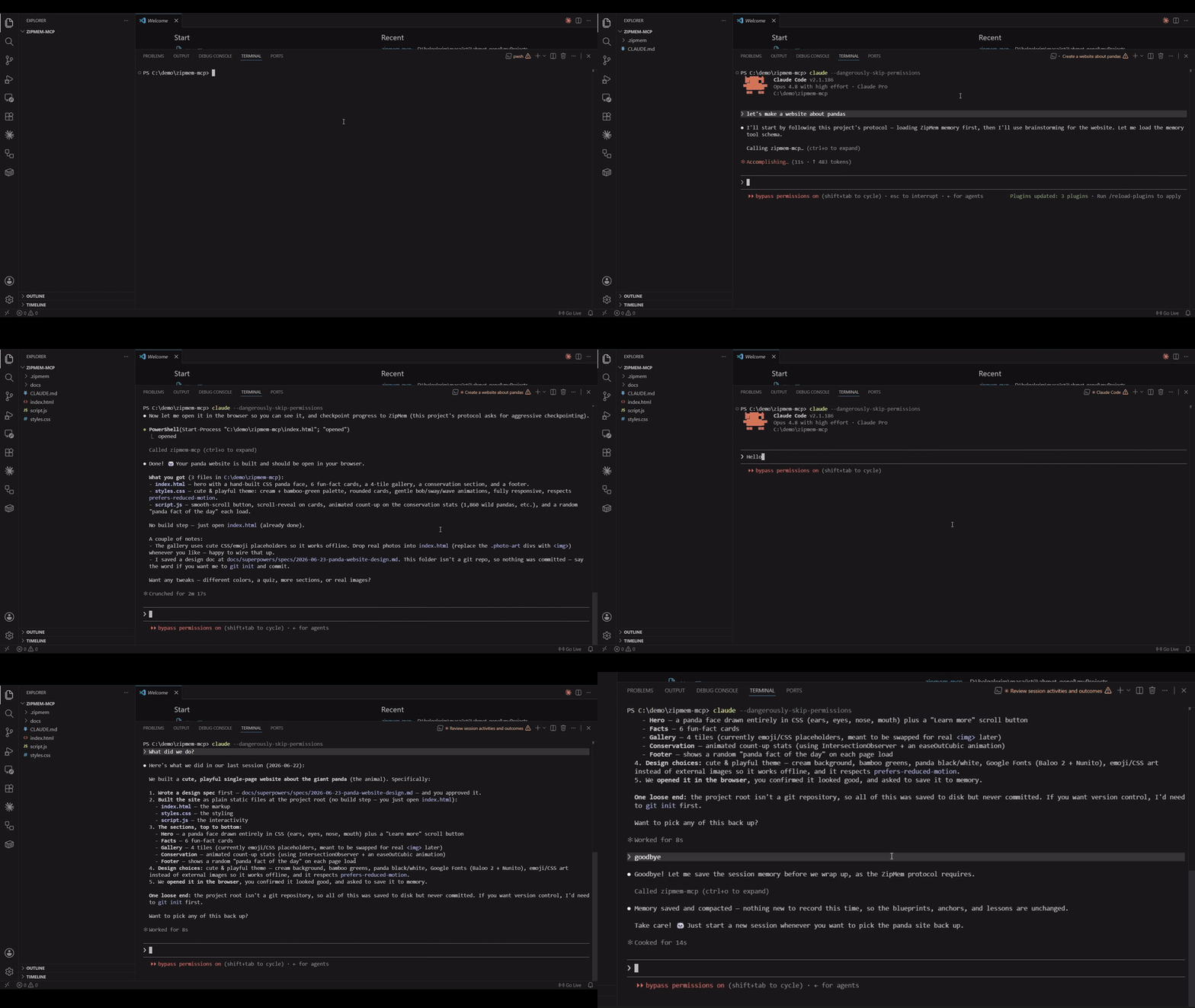
Long, high-intensity agent sessions fill up the context window:
Instead of storing the session, zipmem stores its meaning:
| Raw session content | What zipmem keeps |
|---|---|
| 200-line code block you just wrote | [src/auth/oauth.ts -> 15-42 -> PKCE flow with refresh-token rotation] |
| A 6-step debugging saga | A one-line lesson: "Stripe webhook must be idempotent — it retries on 5xx" |
| Architecture you designed | A blueprint, preserved verbatim |
| Repetitive logs, dead ends, pleasantries | Discarded |
Anchors are coordinates, not code — the agent re-reads the file on demand when it actually needs the detail. The result is an endless memory loop where the window stays small but nothing foundational is ever lost.
The intelligence lives in the prompt, not the server.
zipmem initinjects a Constitutional Directive into yourCLAUDE.md. The agent itself produces the compact, structured payload; the server only validates, deduplicates, merges, and persists. That keeps the server dependency-free and instant.
npm install -g zipmem-mcp
Requires Node.js ≥ 18.
# 1. Initialize in your project root (once per project)
cd your-project
zipmem init

# 2. Register the MCP server with Claude Code
#    (add -s user to make it available in every project — see below)
claude mcp add -s user zipmem-mcp -- npx zipmem-mcp
That's it. zipmem init:
.zipmem/state.json (your memory store),CLAUDE.md (or memory.md, or creates CLAUDE.md),.zipmem/ to .gitignore (keep memory local — see Shared memory),balanced by default; pass --checkpoint=conservative|aggressive to change it).From the next session on, the agent loads memory automatically at the start and compacts automatically when you say goodbye or it nears its context limit. You don't run anything by hand.
If you register MCP servers via a JSON config (claude_desktop_config.json or similar):
{
  "mcpServers": {
    "zipmem-mcp": {
      "command": "npx",
      "args": ["zipmem-mcp"]
    }
  }
}
The server reads CLAUDE_PROJECT_DIR (set automatically by Claude Code) to find the project's .zipmem/. It otherwise falls back to the nearest .zipmem/ ancestor of the working directory.
zipmem works per-project, and getting it running everywhere depends on two separate, independent steps. If it works in one project but seems dead in another, one of these is almost always the reason:
1. Register the MCP server at the right scope. Claude Code's claude mcp add defaults to local scope — the server is then only visible inside the one directory where you ran it. In any other project the tools simply don't exist. To register it once for all your projects, use user scope:
claude mcp add -s user zipmem-mcp -- npx zipmem-mcp
Verify what's registered (and at which scope) from inside the project that isn't working:
claude mcp list
If zipmem-mcp isn't listed there, that's the problem — re-add it with -s user (or -s project to share it with a repo via a committed .mcp.json).
2. Run zipmem init in every project. This is per-project, not per-machine. Registering the server is not enough on its own, because init is what:
.zipmem/state.json (without it there's no memory to load), andCLAUDE.md. Without the directive the agent never learns to call the tools — the server is running but nothing triggers it, so it looks like "zipmem doesn't work here."cd your-other-project
zipmem init
Heads-up on project resolution. The server locates memory via
CLAUDE_PROJECT_DIR→ the nearest.zipmem/ancestor →cwd. If a project has no.zipmem/of its own but sits inside another project that does, the agent can silently read/write the parent project's memory. Runningzipmem initin each project gives it its own.zipmem/and avoids this.
Quick checklist when a project "doesn't work":
| Symptom | Check | Fix |
|---|---|---|
| Tools not offered at all | claude mcp list — is zipmem-mcp there? | claude mcp add -s user zipmem-mcp -- npx zipmem-mcp |
| Server runs but agent never calls it | Is the directive in this project's CLAUDE.md? Is there a .zipmem/? | zipmem init in the project root |
| Wrong / unexpected memory loads | Does a parent folder have a .zipmem/? | zipmem init here so the project has its own store |
Session start ──► agent calls zipmem_load_memory ──► regains full context (few tokens)
      │
      │   ... work ...
      │
"we're done" message / context pressure ──► agent calls zipmem_save_and_compact
                                         │
                                         ▼
                          validate → dedup-merge → prune → write .zipmem/state.json
| Tool | When the agent calls it | What it does |
|---|---|---|
zipmem_load_memory | First thing, every session | Returns blueprints, anchors, and lessons as compact text. Surfaces a recovery banner if the previous session ended abruptly. |
zipmem_checkpoint | Depends on the checkpoint mode (every unit of work, only at milestones, or when you say checkpoint) | Stages progress into a crash-safe buffer (session.json) — intermediate, not final, never touches state.json. Called many times per session. |
zipmem_save_and_compact | When you signal the session is wrapping up in a chat message ("we're done", "that's all", "goodbye", or save), or when context nears its limit | Finalizes: folds the staged buffer + final delta into persistent memory (state.json), prunes, closes the session. Usually once at the end. |
The tool descriptions are written so the agent knows when and why to call them without you prompting it.
Heads-up about
exit/quit: these are Claude Code's own CLI commands — they close the terminal instantly, before the agent gets a turn, so they do not triggerzipmem_save_and_compact. To get a clean final save, send a normal chat message first ("we're done", "save", "goodbye"), let the agent compact, then quit. Otherwise durability falls back to your last checkpoint + next-session recovery.
Checkpoint = cheap, frequent, "don't lose my progress" insurance (recovered only on the next session if you crash). Save & compact = the authoritative commit to long-term memory that a future zipmem_load_memory reads back. Many checkpoints during a session; one save at the end.
zipmem_checkpoint is the main cost ↔ safety knob. Each checkpoint is agent-generated output, so frequent checkpoints mean more durability but more tokens. You pick the cadence at init time and it's baked into the injected directive (the server treats every checkpoint identically — only the instruction to the agent changes):
zipmem init --checkpoint=balanced # default
| Mode | The agent is told to… | Best for |
|---|---|---|
aggressive | Checkpoint after every meaningful unit of work (a feature wired up, a bug fixed). Maximum durability against hard exits. | Long, high-stakes sessions where losing even a few steps hurts. |
balanced (default) | Checkpoint only at major milestones — a big refactor finished, a critical bug resolved, a foundational decision made. | Most projects: low token overhead, still protects the work that matters. |
conservative | Never persist on its own. Memory is written only when you say so, via two plain words: say checkpoint → the agent stages progress (zipmem_checkpoint); say save → the agent does a full compaction (zipmem_save_and_compact). Either way it runs the tool immediately and replies with a one-line confirmation. | Token-tight workflows where you want full manual control. |
Modes are instructions, not guarantees. The cadence lives in a prompt directive, not server code — the agent usually follows it but can't be forced to. In
aggressivemode it may occasionally finish a unit of work without firing an interimzipmem_checkpoint, or ask before it saves rather than acting silently. That's an accepted trade-off: a missed checkpoint degrades gracefully via crash safety, and you can always force a write yourself by sayingcheckpointorsave.
In
conservativemode you stay in the driver's seat: saycheckpointfor a quick crash-safe stage, orsaveto compact everything into long-term memory — no slash commands, just the plain word.
Changing modes later — re-run init with a different value; it updates meta.checkpoint_mode in state.json and rewrites the directive block in place (re-running without --checkpoint leaves your stored mode untouched):
zipmem init --checkpoint=conservative # switch an existing project to conservative
In
aggressiveandbalanced, the agent still callszipmem_save_and_compacton its own when you signal you're done (in chat) or context nears the limit — modes only govern the interim checkpoint cadence. Inconservative, nothing is automatic: the final save happens only when you saysave.
Relying on the agent to gracefully call zipmem_save_and_compact on the way out is fragile: a closed terminal window, Ctrl+C, or a killed process can skip it. zipmem defends against this in layers — and is honest about the limits:
zipmem_checkpoint writes .zipmem/session.json atomically on every call. A hard exit therefore loses at most the work since the last checkpoint, and that data is already on disk — no death-handler required.claude process via the stdin pipe (EOF when the parent dies), SIGINT/SIGTERM/SIGHUP, and a PID liveness probe. On any catchable termination it does the minimal safe thing: a single atomic write marking the session interrupted and recording the reason. It deliberately does not fold into state.json or shell out to git — heavy I/O during the narrow OS termination window risks a torn write. All folding is deferred to layer 3.state.json, captures the git-changed files, and zipmem_load_memory shows a ⚠️ ZipMem recovery banner so the agent re-anchors them. This is the authoritative path — it also covers the SIGKILL case where layer 2 never ran.Honest limitation: a true hard kill (
SIGKILL,kill -9, power loss) cannot be intercepted by any in-process handler — and semantic compaction can't run at death time anyway, because it requires the LLM. zipmem does not dump raw code orgit diffinto memory (that would violate Anchored Compacting). Instead, durability comes from checkpoints already on disk + next-session recovery, which together guarantee no silent loss: the worst case is "the last few un-checkpointed steps need redoing," and the next session is explicitly told what changed.
The practical takeaway: checkpoint as you go (the injected directive tells the agent to, at the cadence set by your checkpoint mode), and abrupt exits become recoverable instead of catastrophic. If you run in conservative mode, remember that durability is on you — say checkpoint at the points you don't want to lose.
.zipmem/session.jsonis runtime state and is always gitignored (via.zipmem/.gitignore), even in--sharedmode — onlystate.jsonis shared.
zipmem init [--shared] [--checkpoint=<mode>]   # set up .zipmem/ and inject the directive
                                               #   <mode>: conservative | balanced | aggressive
zipmem status            # summary: counts, size vs. limits, mode, checkpoint mode, timestamps
zipmem --version
zipmem --help
--checkpoint is validated — an unknown value errors out with the allowed set. See Checkpoint modes for what each does.
zipmem statusZipMem status — my-app
Blueprints : 4
Anchors : 11
Lessons : 6
Sessions : 18
Compactions: 18
Size : 7.4KB
Mode : local (gitignored)
Checkpoint : balanced
Created : 2026-05-02T10:01:55.000Z
Updated : 2026-06-20T13:32:17.324Z
Everything lives in one validated JSON file at .zipmem/state.json:
blueprints[] — immutable-by-default architectural facts (architecture, schema, decision, convention, dependency), preserved verbatim.anchors[] — { file_path, line_range, concept } coordinate stand-ins for code.lessons[] — distilled bug fixes and gotchas, so regressions don't recur.session_log[] — an append-only audit trail of compactions.meta — counters plus shared and checkpoint_mode (your chosen checkpoint cadence).Merging is deterministic: blueprints dedup by title+category (immutable ones are never overwritten unless explicitly superseded), overlapping anchors for a file union-merge with the newest concept winning, and duplicate lessons are skipped. Writes are atomic (temp file + rename) so a crash can never corrupt your memory.
Size management: above a 100 KB soft limit you get a nudge; above a 500 KB hard limit the next compaction auto-prunes least-valuable data first (stale anchors whose files are gone, then old session-log rows, then oldest lessons).
By default memory is local (.zipmem/ is gitignored) — personal to each developer, no merge conflicts.
To share memory with your team (commit it to git so everyone's agent inherits the same blueprints and lessons):
zipmem init --shared
This leaves .gitignore untouched so you can commit .zipmem/state.json.
A single 200-line code block can cost ~2,000+ tokens every time it re-enters the window. One anchor costs ~20. A new session that would otherwise re-read tens of thousands of tokens of history to regain context instead loads a few hundred tokens of structured memory. Because the compaction is semantic (not just truncation), the agent loses none of the decisions — only the bulk.
Be precise about where the saving happens. zipmem does not shrink your live context window within a single chat — there it's a small (mostly cacheable) overhead. The payoff is at the session boundary: the next chat reloads compressed memory instead of re-deriving the project from scratch. So it's net-positive for long, multi-session work and net-negative for one-off short chats. See
docs/token-economics.mdfor a realistic per-stage and cross-session cost model.
zipmem isn't the only way to give an agent memory. Here's where it fits — and what it trades away. (This is a comparison, not a claim of being strictly "better"; the right tool depends on your workflow.)
| Approach | Persists across sessions | Token cost | Infra / API keys | Determinism | Main trade-off |
|---|---|---|---|---|---|
| No memory (re-read each session) | ❌ | Highest over time | None | — | Context rebuilt from zero every session |
| Paste old transcript | ⚠️ manual | Very high | None | Low | Bloats the window — defeats the purpose |
Manual CLAUDE.md notes | ✅ but static | Very low | None | Medium | Hand-maintained, goes stale, no anchors, lossy |
Claude Code /compact | ❌ (within a session) | Low | None | Medium | Shrinks the live window only; not persistent; lossy |
| RAG / vector memory (e.g. mem0, Letta/MemGPT) | ✅ | Medium (retrieval per query) | Embeddings + DB/keys | Low (fuzzy) | Infra overhead; can retrieve noise; non-deterministic |
| Whole codebase in context | ❌ | Highest | None | High | Expensive and window-bound |
| zipmem | ✅ | Low (mostly cacheable, bounded) | None (local, key-free) | High (deterministic) | One project at a time; no fuzzy semantic recall; relies on checkpoint discipline |
How to read this: zipmem is complementary to /compact, not a competitor — /compact trims the live window within a session, zipmem carries meaning across sessions. Versus RAG/vector memories it gives you zero infrastructure, no API keys, deterministic output, verbatim blueprints, and code anchors; in exchange it gives up fuzzy semantic retrieval breadth and multi-project scope. Versus a hand-kept CLAUDE.md it's automatic, structured, and anchor-based; versus pasting transcripts it's incomparably cheaper.
Being honest about what zipmem does not do:
session.json is a single "current session" file and state.json uses read-modify-write without locking. Running two claude sessions in the same project simultaneously (e.g. two terminal tabs) will clobber session.json and can silently lose compactions through a race — with no error shown. Different projects are fully isolated and safe. Fixing same-project concurrency would require per-session files + locking; it's a known design boundary, not a bug.docs/token-economics.md.)SIGKILL / power loss can't be intercepted, and compaction needs the LLM anyway. zipmem never writes raw code or git diff into memory — durability comes from on-disk checkpoints + next-session recovery, never from dumping the transcript.npm install
npm run build # tsc -> dist/
npm test # vitest
npm run test:watch
npm run lint
npm run format
Run a single test file:
npx vitest run tests/core/state.test.ts
npx vitest run -t "merges overlapping anchors"
Manual end-to-end smoke tests (build first):
npm run build
node tests/smoke-mcp.mjs /path/to/a/project   # handshake + save→load
node tests/smoke-crash.mjs                     # checkpoint → hard exit → recovery
MIT — see LICENSE.
Run Claude Code as an MCP server so any agent can delegate coding tasks to it
 @microsoft✓ Official
Browser automation using accessibility snapshots instead of screenshots
 @googleapis✓ Official
Google's universal MCP server supporting PostgreSQL, MySQL, MongoDB, Redis, and 10+ databases
 @github✓ Official
Official GitHub integration for repos, issues, PRs, and CI/CD workflows